
‘The IPC findings will guide investments in food security, nutrition and resilience under Uganda’s NDP IV, aligning collective action with national priorities and the UN Sustainable Development Cooperation Framework 2026–2030’
Kampala, Uganda | THE INDEPENDENT | Prime Minister Robinah Nabbanja has called on development partners and international agencies to widen their El Niño interventions beyond Karamoja, warning that several other epicentres of climate-induced hardship now exist across the country.
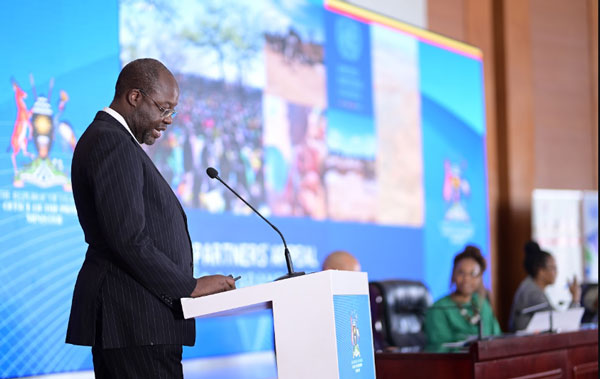
Speaking at the Office of the President’s auditorium during the launch of the latest Integrated Food Security Phase Classification (IPC) analysis, the global standard for measuring food and nutrition crises, and the UN and Partners’ Joint Appeal, Nabbanja said focus should extend to areas like Mount Elgon and the Rwenzori region, where government is struggling to relocate people because of rains.
“I am, however, very happy with the intervention in Karamoja that is struggling with drought. I am happy to see the UN team was recently in Karamoja,” she said.
The appeal received immediate backing from key development partners. The United Kingdom, through the Foreign, Commonwealth and Development Office, announced £2 million, approximately UGX 11.7 billion, to be channelled through UNICEF for life-saving nutrition services in Karamoja and refugee settlements over the next 10 months. The European Union also committed an additional €3 million in support.
UN Resident Coordinator Leonard Zulu explained that El Niño first brought drought and would later bring floods, and that the UN is responding to both.
“I am in agreement that we should have enough resources to respond to landslides and floods in all areas in Uganda, even in Kampala if it is necessary,” Zulu said in reaction to an intervention by the Prime Minister on his remarks on El Niño.
The Prime Minister also stressed the need for better data collection so that the government can target the actual beneficiaries. She said transport costs are eating into the budget, explaining why in the past year government used the Uganda People’s Defence Forces to transport food to Karamoja. She thanked President Yoweri Museveni for prioritising the region in July and directing her to use the National Enterprise Corporation, the army’s private arm, to avoid the procurement process and deliver food at parish level in record time. She said the President has now directed that irrigation be prioritised.
Funding Gap
In his presentation, Zulu noted that Uganda is facing a convergence of humanitarian risks unlike any seen in recent years.
“In Karamoja, hundreds of thousands of people continue to struggle with acute food insecurity, severe malnutrition and loss of livelihoods,” he said. “At the same time, forecasts point to significant El Niño-related flooding and landslide risks, threatening lives, infrastructure, crops and essential services across large parts of the country.”
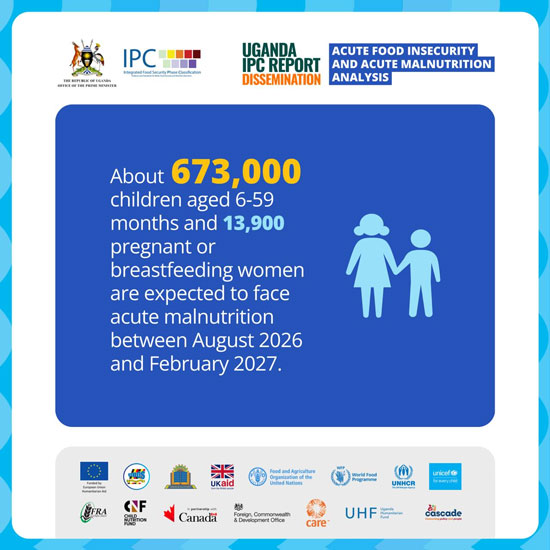
The IPC analysis shows that 3.6 million people are currently in crisis or worse levels of acute food insecurity, with the number projected to climb to 4.4 million by the February to June 2027 lean season. An estimated 465,900 children under five and 246,300 pregnant and breastfeeding women will require treatment for acute malnutrition between April 2026 and March 2027.
The UN and Partners’ Joint Appeal seeks approximately US$61 million to protect more than half a million people. The appeal targets 430,000 people for the El Niño response and 130,000 to 135,000 people in Karamoja, corresponding to 32,000 households facing the most severe food insecurity and nutrition challenges.
The response is anchored around five pillars: food security and livelihoods; nutrition and health; protection; water, sanitation and hygiene; and assessment, early warning and information management.
Zulu revealed that resources mobilized by donors, government, UN agencies and partners, amounting to over US$17 million, are already producing measurable results. In Karamoja, humanitarian partners have sustained food security, nutrition, health, protection and resilience interventions despite an extremely challenging operational environment.
He cited Moroto Regional Referral Hospital, where intensive therapeutic care services continue to admit and successfully treat children suffering from severe acute malnutrition.
“Out of the 108 cases admitted for severe wasting between July and September, 97 cases were successfully treated and released,” Zulu said. “This is evidence that the response is working.”
However, the appeal faces a significant shortfall.
“The message from the field is clear: Uganda is leading the response, but the scale of the challenge requires sustained international solidarity,” he said. “Today, the United Nations and partners are therefore calling on the international community to help close the remaining US$50 million funding gap so that lives can be saved, livelihoods protected, and future shocks anticipated rather than endured.”
The report
The report indicates that Uganda’s generous refugee policy is buckling under financial strain.
The report cites a familiar but devastating cocktail: El Niño dry spells, crop pests, livestock disease, and high food and fuel prices. In Karamoja, household food stocks were expected to last only about seven days. The assistance gap is not gradual—it is a cliff. Food assistance in Karamoja reached 1.1 million people in August 2026. From October through February, it will cover roughly 74,000 people a month—about 10 percent of those in urgent need.
The analysis was conducted by the Uganda IPC Technical Working Group, bringing together the Office of the Prime Minister, the Ministry of Agriculture, Animal Industry and Fisheries, the Ministry of Health, the Uganda Bureau of Statistics, and the Ministry of Water and Environment, alongside UN agencies including FAO, WFP, UNICEF, and UNHCR. Technical and NGO partners include FEWS NET, World Vision International, OXFAM GB, Action Against Hunger, and Makerere University’s Institute of Statistics and Applied Economics. The European Union and WFP Uganda provided financial and technical support.
The Prime Minister called for the IPC findings (snap review link here ) to translate into action, urging partners to commit to “timely, practical and adequately resourced interventions that save lives, protect livelihoods and build long-term resilience.”
The post PM Nabbanja calls for broader El Niño response as Uganda, UN launch $61 million appeal appeared first on The Independent Uganda:.