
MONROVIA – On paper, Liberia has some of the cheapest petrol in West Africa. Away from the capital, it may have some of the most expensive in the region.
By Rodney D Sieh
The gap between those two facts is now a political problem for President Joseph Boakai’s economic team. Lawmakers are asking why better macroeconomic numbers have not lowered what ordinary Liberians pay for fuel, rice and building materials.
A regional bargain, on paper
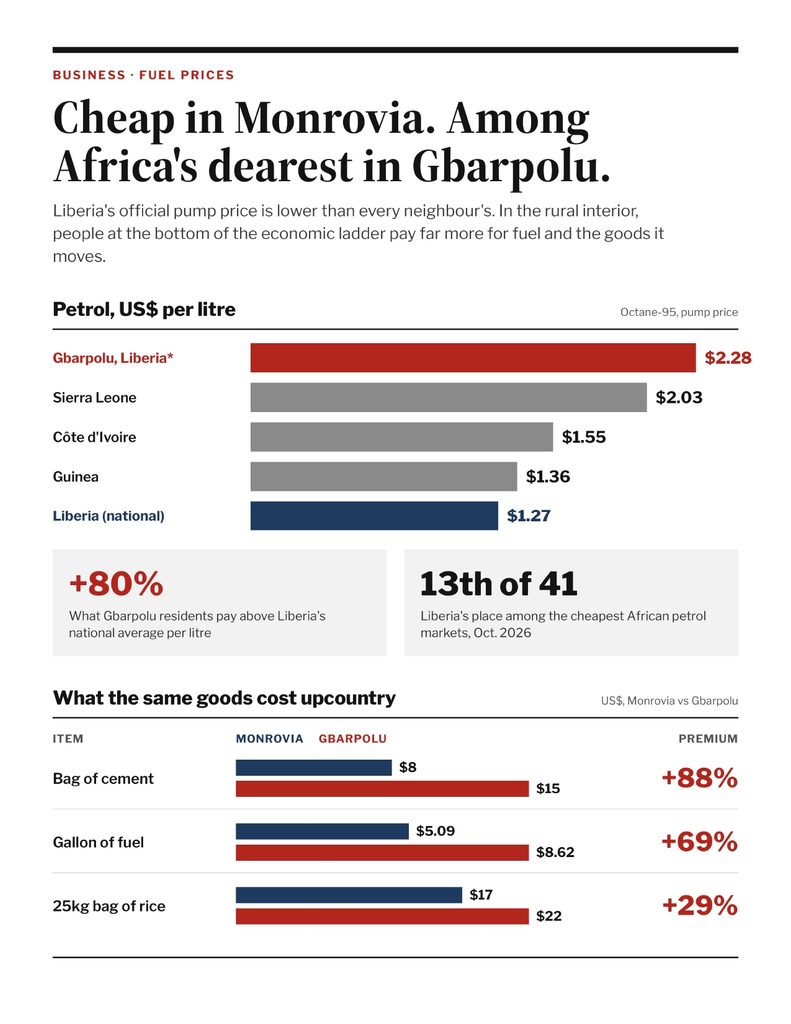
Industry tracker GlobalPetrolPrices compiled data on 12 October covering 41 African countries. In that ranking, Liberia’s octane-95 petrol sold for $1.269 a litre, the 13th-cheapest of the 41. Every one of its neighbours pays more. Guinea’s price was $1.364 a litre and Côte d’Ivoire’s $1.55. Sierra Leone, at $2.03, was the third most expensive on the continent, behind only Zimbabwe and Malawi.
Liberia’s official ceiling price is also in a moderate range. The Ministry of Commerce and the Liberia Petroleum Refining Company (LPRC) set the retail pump price of gasoline at US$5.09 a gallon, or L$935, in a circular effective May 6. That works out to roughly $1.34 a litre.
Liberia gets no help from oil production. The country produces none of its own fuel, has no strategic petroleum reserves and has limited ability to cushion global price spikes. Prices therefore depend on Platts benchmarks, shipping costs and the exchange rate.
What Gbarpolu pays
The numbers look very different 100 kilometres inland.
Senator Amara Konneh chairs the Senate Committee on Public Accounts and Audit and represents Gbarpolu County. He told a Senate confirmation hearing that a gallon of fuel in his county sells for L$1,500. The Central Bank of Liberia’s rate was recently around L$174 to the dollar. At that rate, L$1,500 is roughly US$8.60 a gallon, or about $2.28 a litre.
That price is about 70% above the official ceiling. It is also higher than Sierra Leone’s national average, the third highest in Africa. For residents of rural western Liberia, fuel costs about as much as in Africa’s most expensive markets.
Fuel costs spread to other prices. Konneh said a 25kg bag of rice costs US$22 in parts of Gbarpolu, against US$17 in Monrovia. A bag of cement costs US$15, against US$8 in the capital. That is an 87% premium on the material Liberians need to move “from mud to brick houses,” as he put it. He linked the rising cost of petroleum products directly to the rising cost of basic goods.
Stability without relief
Konneh served as finance minister under former president Ellen Johnson Sirleaf, and he does not dispute the government’s numbers. He made his comments at the confirmation hearing of Euphemia Sweh Monmia, nominated as the Central Bank’s Deputy Governor for Economic Policy. He credited the economic management team with stabilising the economy.
“The economy is more stable now,” he said. Growth is expected to exceed 5% this year, and inflation stands at 4.6%. The Liberian dollar has also strengthened. The Central Bank has reported sharp appreciation, from about L$201 to the dollar at the end of August 2025 to around L$180 a week later. The currency has firmed further since then.
Normally a stronger currency would lower the local price of imported goods such as fuel, rice and cement. Konneh said that has not happened.
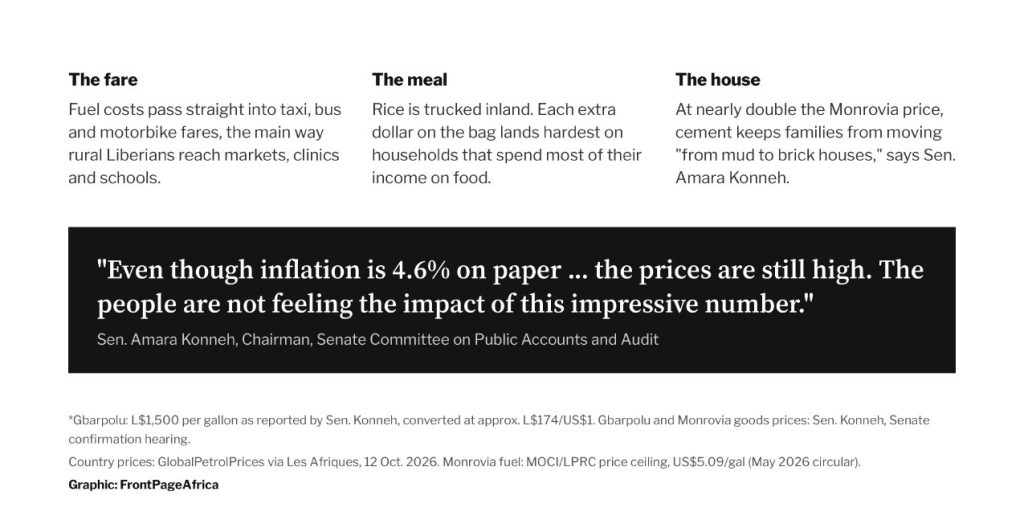
“Our money, the Liberian dollar, is stronger here today against the US dollar. With all of that, we should technically see some relief,” he said. “Even though inflation is 4.6% on paper, in Bopolu, Gbarpolu County, in Kinjor in Cape Mount, close to where the biggest mining company in our country is operating today, and in Tubmanburg, the prices are still high. The people are not feeling the impact of this impressive number.”
Where the money goes
Analysts point to three reasons why the official numbers and rural prices have moved apart.
The first is the last mile. Liberia’s price circular sets a national ceiling, but poor roads, few filling stations and informal resellers add large markups in the interior. Enforcement mostly happens in and around Monrovia.
The second is exchange-rate pass-through. Fuel prices are set in US dollars and converted at an official rate. A Senate committee report this year found that the exchange rate used in the price calculation, rather than the actual cost of fuel, had driven pump prices. It estimated that Liberians were overcharged by up to L$131 million. When the Liberian dollar strengthens but the price circular is not updated quickly, consumers lose the benefit.
The third is the mining economy. Konneh’s examples, Bopolu, Kinjor and Tubmanburg, lie along western Liberia’s mining corridor. Salaried mine workers and contractors there compete with subsistence households for the same goods, which can push local prices up.
The government’s response
The Ministry of Commerce and Industry says it is tightening controls. Stephen Marka Yekeson Jr. was appointed acting minister in September after President Boakai removed Magdalene Dagoseh. He said the ministry is focusing on the imports that matter most to household budgets.
“We are stepping up monitoring and enforcement and working closely with importers of socially and politically sensitive items—such as petroleum and rice—to help curb inflation,” Yekeson said.
The ministry’s challenge is reach. Its own price circulars warn that “hoarding, undercutting, or arbitrary price increases will not be tolerated.” But the gap between the official ceiling and what people pay in Gbarpolu suggests that warning carries less weight the further a filling station is from Monrovia.
The investor read-through
For investors, this shows the limits of Liberia’s improved macroeconomic picture. Low inflation, a firmer currency and a budget of more than US$1 billion matter for creditors and rating agencies. But Konneh warned that public anger rises when people cannot see those gains in their own costs, and he called that anger legitimate.
Fuel is the most visible example of that gap. Monrovia’s prices compare well with its neighbours’. In much of the interior, prices are among the highest in the region.