
President says he seeks membership despite political risks, slim prospects of deal during his term
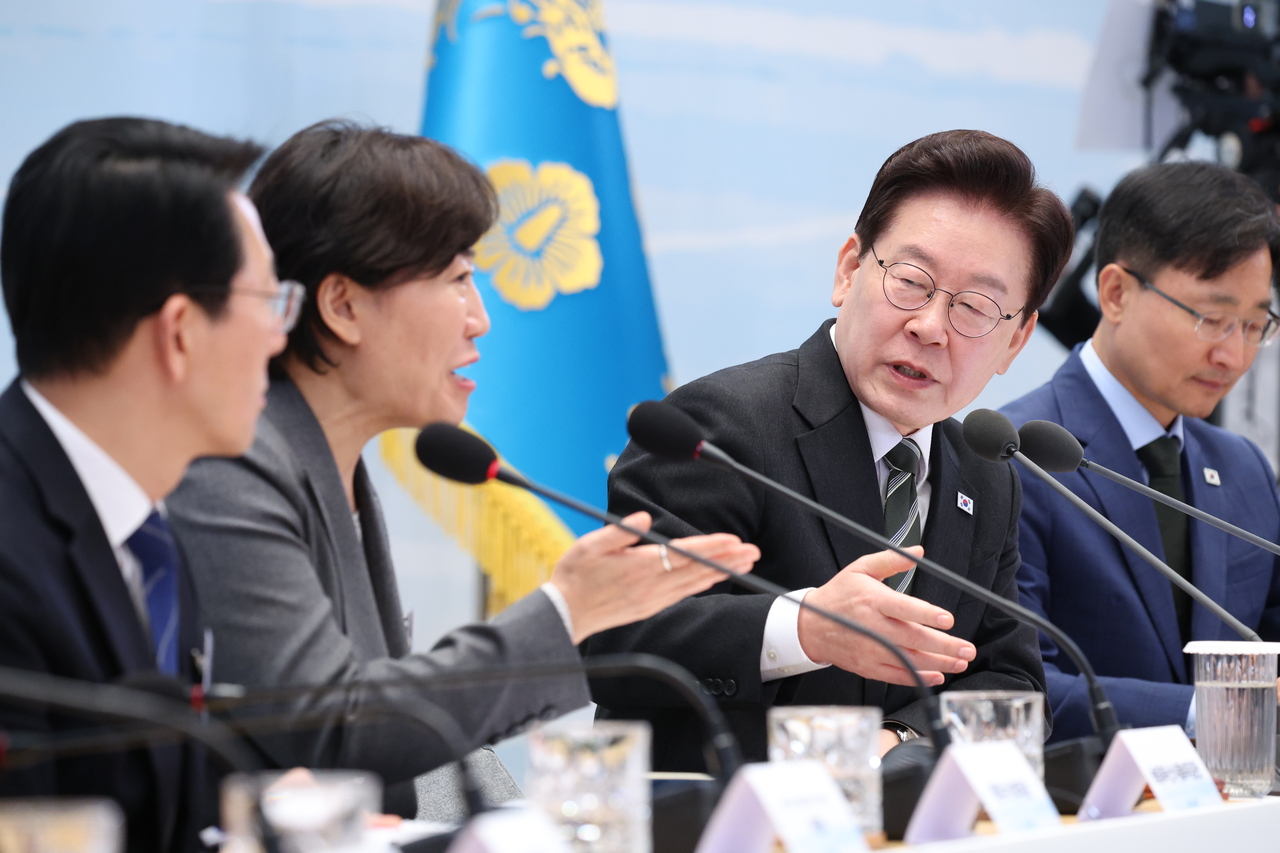
President Lee Jae Myung reaffirmed the need for South Korea to join a major trans-Pacific trade pact, but vowed farmers and fishermen would not be left to shoulder the costs of trade liberalization without compensation.
"We must no longer force losses and suffering on people simply because they lack power or are small in number," Lee said Monday during a meeting with around 110 farmers and fishermen at Cheong Wa Dae in Seoul.
It marked the first time since 2018 that a sitting South Korean president had personally met with a large group of farmers and fishermen.
The meeting came amid growing concerns over the country's potential accession to the Comprehensive and Progressive Agreement for Trans-Pacific Partnership or CPTPP, a 12-nation free trade pact and a controversial nationwide farmland survey.
Lee stressed that agriculture, fisheries, forestry and livestock farming play a vital role in national survival, despite their relatively small share of the economy.
"Primary industries should no longer be viewed through the lens of comparative advantage, but rather as industries vital to the Republic of Korea's national security and survival, as well as strategic industries," Lee said, referring to South Korea by its official name.
"As for joining the CPTPP, which I know is a matter of great concern to all of you, I have instructed officials not to apply for membership this year and to decide on our next steps only after extensive consultations with you."
Lee nevertheless stressed the importance of expanding overseas markets. "For the Republic of Korea, an open, trade-oriented economy that depends heavily on exports, expanding access to global export markets — what we call our economic territory — is extremely important," he said.
"We cannot survive on semiconductors alone, but neither can we survive on agriculture alone."
Lee argued that while government policies should benefit the country as a whole, the resulting losses should not fall disproportionately on smaller or politically weaker groups.
"In the past, we have taken sacrifices by minorities for granted," he said. "If someone makes a special sacrifice for the benefit of everyone, they should receive sufficient compensation commensurate with that sacrifice, or more."
Lee stressed that the government must honor its commitments to compensate those who suffer losses from national policies, arguing that keeping such promises is essential to building public trust and securing support for difficult decisions.
Lee cited the government's pledge to make up for a roughly 700 billion won ($529 million) shortfall in a rural cooperation fund established following South Korea's 2015 free trade agreement with China. Only about 325.5 billion won of the promised 1 trillion won has been raised, largely because the fund relied on voluntary corporate contributions.
Lee said that while the government should seek consensus, it could not abandon policies necessary for the country's broader interests simply because some groups opposed them.
"These are difficult issues, but there are still things we must do," he said. "We cannot simply abandon something that needs to be done just because some people oppose it and resist fiercely. But we must never treat anyone unfairly."
Lee acknowledged that pursuing CPTPP membership could come at his own political cost, as the accession process requires the consent of all 12 member countries and could take years to complete.
"We don't even know how many years it might take. The easiest choice for a politician would be not to pursue it at all," Lee said, noting that accession was unlikely to be finalized during his presidency.
"I could end up facing criticism with nothing to show for it. But even so, for the sake of the Republic of Korea as a whole, we have to lay the groundwork for the next step."
On Oct. 8, Lee ordered the government not to apply for CPTPP membership this year, saying consultations with farmers and fishermen should take precedence over meeting an application deadline.
The decision followed Cabinet discussions in which officials said South Korea would need to publish a notice of planned public hearings in the official government gazette by mid-October for its potential CPTPP membership to be discussed at the bloc's ministerial meeting in November.
Farmers and fishermen have long opposed CPTPP membership over concerns that increased competition from cheaper imports could threaten domestic production and incomes.
A recent government assessment report, released by relevant ministries in late September, projected that South Korea's accession to the CPTPP would boost the country's real gross domestic product by 0.38 percent over 10 years. However, agricultural, forestry and fisheries production would decline by approximately 850 billion won annually over a 15-year period.
South Korea previously pursued CPTPP membership under the Moon Jae-in administration in 2021 but never submitted an application amid opposition from agricultural and fisheries groups and tensions with Japan over restrictions on Fukushima-area seafood imports.
dagyumji@heraldcorp.com