Published : 27 October 2026
•
Updated : 27 October 2026, 02:51

Mohiuddin Alamgir

Arafat Rahaman

“They have prioritised their own political outlook and have been treating student unions as weapons to serve their own interests.” Ragib Ahsan Munna, ex-VP of Rucsu
Elected with a mandate to protect students’ rights, student union leaders at five major public universities have instead repeatedly been embroiled in controversies over student assaults, teacher intimidation, administrative interference, and divisive initiatives.
The latest one was at Jagannath University, where JnUcsu leaders came under fire for backing a “beef feast” involving the slaughter of cattle during Durga Puja.
The event was organised to protest a university decision to restrict animal slaughter following objections from Hindu students to an earlier cookout near the campus temple.
The incidents have raised questions about whether elected student leaders are adequately addressing pressing campus concerns, including accommodation shortages, rising living costs, transport, healthcare, security, and academic rights.
“Student unions exist primarily to protect students’ rights, and their involvement in such controversies undermines the very purpose of student movement,” said Mohammad Mushtuq Husain, former general secretary of Dhaka University Central Students’ Union (Ducsu).
Talking to The Daily Star, Ragib Ahsan Munna, ex-vice-president of Rajshahi University Central Students’ Union (Rucsu), said the student unions drifted away from their fundamental responsibilities.
“They have prioritised their own political outlook and have been treating student unions as weapons to serve their own interests.”
Prof A Al Mamun of RU’s mass communication and journalism department said the return of elected student unions was a positive development, but their representatives failed to meet students’ expectations.
“They have done little to address accommodation, food, and other welfare-related issues.”
Dhaka University held Ducsu polls in September last year after a six-year hiatus. Jahangirnagar, Rajshahi, and Chittagong universities held elections after more than three decades, while Jagannath University elected its first central student union this year.
All five student unions are led by platforms backed by Chhatra Shibir, pro-Jamaat student body. Most of the leaders emerged in the public sphere following the July uprising.
Ducsu completed its one-year term on September 14, followed by Jahangirnagar University Central Students’ Union (Jucsu) on September 18, and Chittagong University Central Students’ Union (Cucsu) on October 23. Rucsu’s tenure ended yesterday.
Defending the “beef feast”, JnUcsuGeneral Secretary Abdul Alim Arif told The Daily Star that the event was organised in protest against what he termed “an unreasonable administrative decision”. He claimed that almost all student organisations on the campus participated.
Former Ducsu leader Mushtuq said the event reflected a troubling erosion of values the universities should uphold.
“A genuinely religious person would never deliberately insult or humiliate followers of another faith. Incidents like these are deeply shameful for all of us.”
WRONGDOINGS
Several controversies they have been entangled in centred on historical narratives and cultural issues.
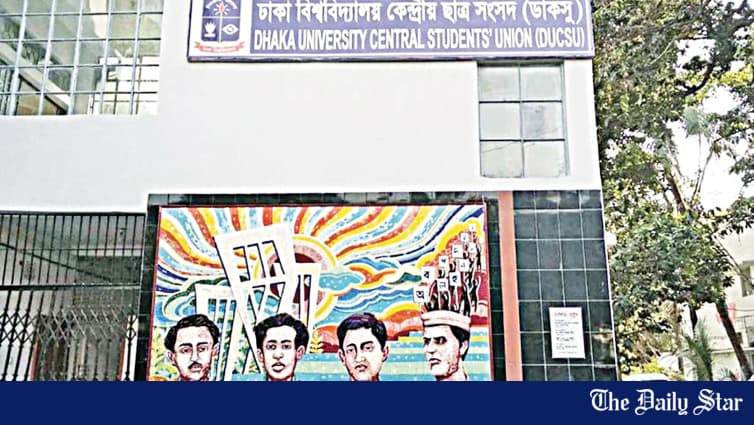
Ducsu leaders removed photographs of Bangabandhu Sheikh Mujibur Rahman from its museum and replaced them with portraits of Muhammad Ali Jinnah.
“We are witnessing activities that run counter to our history and traditions,” said Mushtuq, expressing concern.
Criticising the move, Prof Tanzimuddin Khan of DU’s international relations said the Ducsu leaders ignored the university administration, which failed to hold them accountable, showing that the scope for exercising power remains unchanged.
Besides, Ducsu also introduced a curtained “Female Zone” in the TSC’s cafeteria without university approval, drawing criticism from those who viewed it as promoting gender segregation.
“The root cause lies in their political ideology. It is fundamentally backward-looking. Had their political outlook been progressive and future-oriented, they would not have acted this way,” Mushtuq said.
When Ducsu launched an online teacher-evaluation platform, teachers alleged that it facilitated cyber harassment.
Prof Tanzimuddin, also a member of University Teachers’ Network, described the initiative as concerning. Ducsu has no authority to conduct such evaluations, which damage teacher-student relations and create a toxic academic environment.
Prof Mamun also questioned the authority of student representatives to evaluate teachers and alleged the initiative was politically motivated.
Ducsu General Secretary SM Farhad defended the initiative, claiming that it was approved through university procedures.
On July 27, Rucsu leaders beat three students accused of links to the banned Chhatra League.
Video footage shows Rucsu General Secretary Salahuddin Ammar assaulting them inside the university library in the presence of the proctor.
Denying any wrongdoing, Ammar said, “They attacked us, and we resisted.”
Ammar, who lost his Shibir membership over alleged misconduct, argued that ensuring student safety sometimes required actions beyond the union’s constitutional mandate.
On December 18 last year, Rucsu VP Mostakur Rahman Zahid called for The Daily Star and Prothom Alo to be shut down. Mobs attacked and torched the newspapers’ offices in the capital.
In December last year, Ammar demanded the resignation of six deans he identified as members of the pro-Awami League teachers’ body. The deans later stepped down.
At Chittagong University on January 10, several Cucsu leaders chased law teacher Hasan Mohammad Roman Shuvo and took him to the proctor’s office over his alleged affiliations with a pro-AL teachers’ body.
On July 28, Ducsu Literary and Cultural Affairs Secretary Musaddiq Ali Ibne Mohammad threatened to break down a syndicate meeting-room door during a protest over dormitory seat allocations.
At Jahangirnagar University, Jucsu General Secretary Md Mazharul Islam and other students locked the university’s Registrar Building on December 12 last year, demanding action against teachers accused of supporting attacks during the July uprising.
Several other student union leaders have also faced misconduct allegations.
Ducsu Executive Member Sarba Mitra Chakma took flak after assaulting a transport worker, harassing a couple near the Central Shaheed Minar, and forcing teenagers and young men to do squats at a playground and gymnasium.
The university later issued him a show-cause notice.
He apologised and announced his resignation on January 26 but withdrew it five days later, saying students had urged him to stay.
Ducsu Social Welfare Secretary AB Zubair chased Prof AKM Jamal Uddin, a leader of pro-AL teachers’ body, on the campus on December 11, video clips show.
In September, Ducsu leaders claimed to have undertaken projects worth over Tk 40 crore, against an official university allocation of Tk 35 lakh, but could not provide a complete project-wise breakdown.
At Rajshahi University, media reports citing treasurer’s office records said Rucsu had been allocated Tk 1.29 crore for 42 programmes, but vouchers for about Tk 61.5 lakh remained outstanding as of August 20.
Prof Mamun alleged that some student union leaders encouraged mob violence, incited hostility against particular groups and media organisations through social media, and interfered in university administration.
Prof Tanzimuddin said, “Universities already have their own legal mechanisms for addressing complaints. If justice is not achieved there, criminal law is also available. But instead of following institutional procedures, we have seen teachers being chased and mobs being mobilised against them.”
Former Ducsu leader Mushtuq said even in the years after the Liberation War, student organisations refrained from publicly humiliating teachers despite deep political disagreements.
“Students criticised teachers they disagreed with, certainly, but we never witnessed personal attacks or attempts to humiliate them. The very idea of insulting a teacher was unimaginable.”
He added that political opponents should be challenged through democratic means.
Prof Mamun said the controversies reflected a broader failure to fulfil the July uprising’s aspirations for reforms in education, research, accommodation, and campus security.
He alleged that Chhatra Shibir used student union leaders and its existing organisational network to establish campus dominance after the uprising.