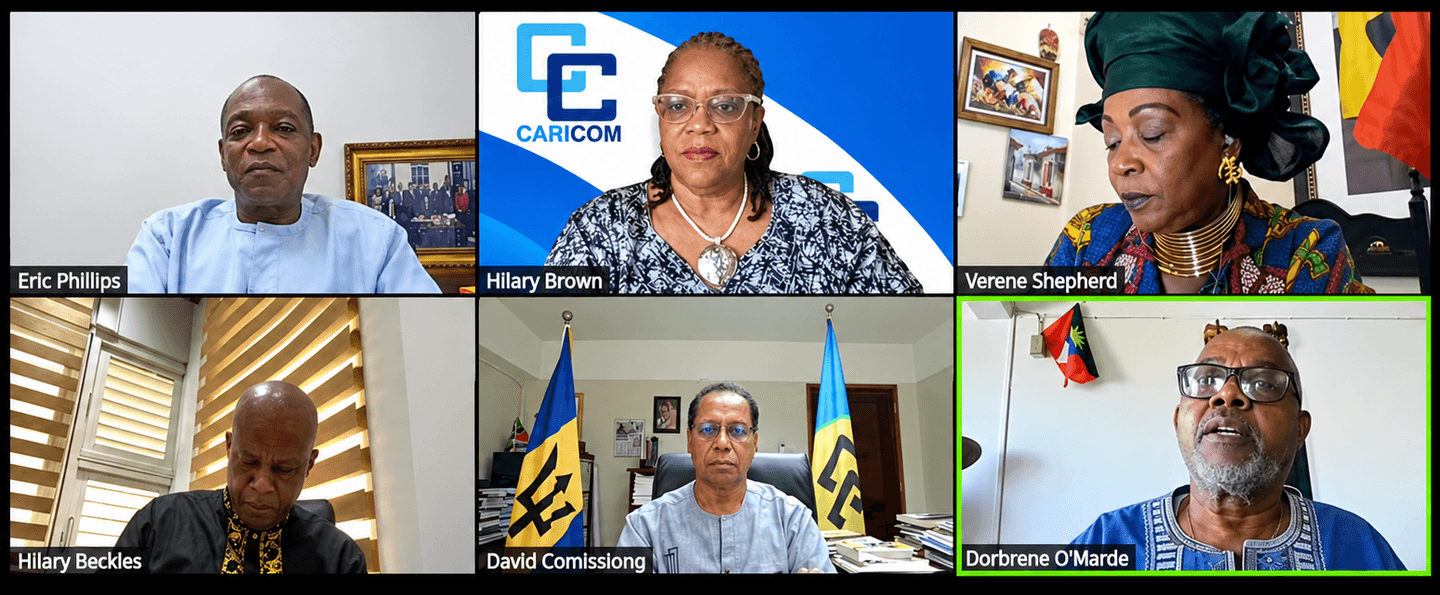

Media Briefing Caricom Reparations Commission. Photo: Caricom /YouTube
by Roxanne Thompson
- CRC prepares 2027-2031 action plan
- King Charles’ CHOGM visit brings reparations into focus
- Grenada’s leaders and advocates continue to raise the issue
The Caricom Reparations Commission (CRC) is preparing a new 5-year action plan as regional advocates call for further steps towards reparatory justice. The proposed 2027–2031 plan comes as King Charles III prepares to visit Antigua and Barbuda for the Commonwealth Heads of Government Meeting (CHOGM), where Caribbean advocates hope to advance discussions on the legacy of slavery and reparations.
At a media briefing on 22 October, CRC chair Professor Sir Hilary Beckles appealed to the King to use his influence to support reparations discussions. The commission is also seeking progress through the Commonwealth and the United Nations. However, David Comissiong, a member of the Barbados National Task Force on Reparations, said a proposed paragraph in the draft CHOGM communiqué calling for structured, inclusive and good-faith dialogue on historical harms, had not received unanimous agreement.
The debate was also taking place in Britain that day. Labour MP Dawn Butler used a House of Commons speech on Black History Month to explain reparations through the example of a stolen watch passed from one generation to the next. “A gift does not erase a theft,” she said, arguing that the passage of time does not turn an injustice into rightful ownership. Butler also questioned the use of cultural symbols for commercial gain, pointing to Adinkra symbols associated with the Akan people of Ghana and the need to acknowledge the origins of cultural traditions. Butler’s speech addressed how historical injustices and cultural appropriation can have consequences for present-day generations.
Grenada’s advocates have also addressed the issue publicly. In February 2025, Prime Minister Dickon Mitchell told European Commission President Ursula von der Leyen that slavery should be recognised as a crime against humanity, and that an appropriate apology and compensation should follow. Arley Gill, chair of Grenada’s National Reparations Committee, a member of the CRC and the Democratic People’s Movement (DPM) candidate for St John, has also stressed the importance of ensuring that Grenadians understand the case for reparations. In a 2025 interview with The Repair Campaign, Gill said the country had a role in helping people in St George’s understand the issue.
Public education was a key conversation at the CRC briefing. Vice-chair Verene Shepherd said efforts must reach younger generations and continue beyond high-profile visits and international meetings. Commission members discussed public meetings, television programmes, educational materials and school debating competitions as ways to improve understanding. Here in Grenada, the ongoing Grenlec Debates offer an existing platform for secondary school students to research issues, develop arguments and consider different perspectives. Although the competition does not focus specifically on reparations, it provides an example of how young people engage with public issues.
The CRC’s 5-year action plan will guide its work from 2027 to 2031, building on Caricom’s revised 10-Point Plan for Reparatory Justice. Eric Phillips, vice-chair of the CRC and Chair of the Guyana Reparations Committee, said the commission expects funding from Caricom governments, but specific contributions and a detailed budget have yet to be outlined. The commission’s ability to secure funding and track progress will shape how it carries out the plan over the 5-year period.
NOW Grenada is not responsible for the opinions, statements or media content presented by contributors. In case of abuse, click here to report.