"North Korea needs sanctions relief, and a moment may come when the U.S. position becomes critical to achieving it," said Kim Hyoung-zhin, former South Korean ambassador to the United Nations.
"The fact that the supreme leader publicly inspected a bus factory in Dandong shows that North Korea wants to expand economic cooperation beyond livelihood issues into industrial collaboration," said Chung Eun-lee, head of the North Korea research division at the Korea Institute for National Unification.
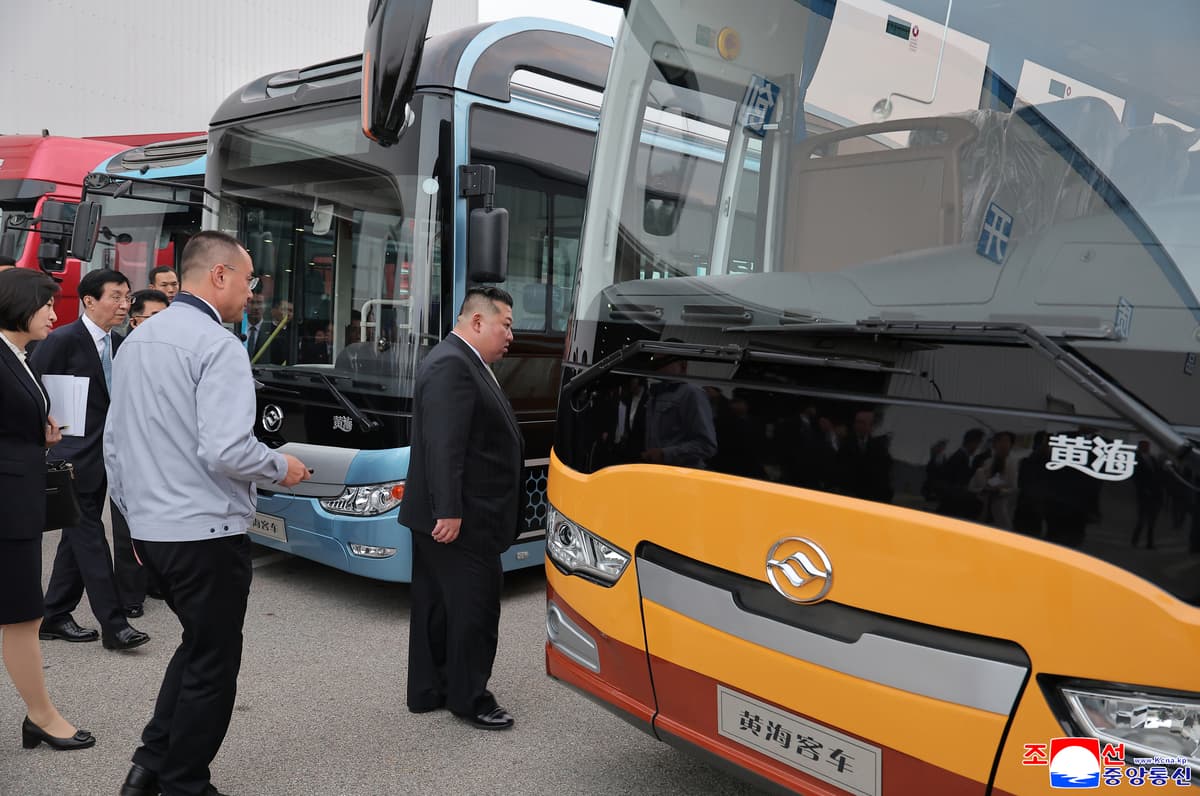
With North Korean leader Kim Jong-un visiting a bus factory in Dandong, China, on the 24th, attention is turning to whether the sanctions that have long squeezed the North Korean economy could become an opening for reviving talks between Washington and Pyongyang.
In a report titled "Assessing Kim Jong-un's Dandong Visit and Prospects for a North Korea-U.S. Summit," released on the 26th, Chung described Kim's visit to the New Yalu River Bridge on the 24th as "a space that demonstrates the expansion of economic cooperation between North Korea and China." Dandong is also where Chinese People's Volunteer Army troops deployed and crossed the river in October 1950 after entering the Korean War.
During the one-day trip, Kim inspected Dandong's Huanghai bus factory. "Kim inspected the plant's electric vehicle section, which attests to North Korea's interest in advanced electric vehicles while also symbolizing the potential for industrial cooperation between the North and China," Chung said.
The western district of Dandong, where Huanghai Automobile is located, housed as many as 100,000 North Korean garment and seafood processing workers during the pandemic, and a significant number remain there working today. The area offers favorable industrial conditions that could lead to parts production and transfers of technology and equipment, and if road transport across the New Yalu River Bridge begins in earnest, an industrial supply chain linking Dandong and Sinuiju could take shape, according to the analysis. "North Korea's request to inspect the electric vehicle sector revealed its expectations for such industrial linkages," Chung added.
Transport equipment such as buses, however, falls under items banned by U.N. Security Council resolutions on North Korea. That Kim nonetheless visited the Huanghai bus factory and that North Korean media gave it extensive coverage can also be read as signaling Pyongyang's hope for economic cooperation with China that goes beyond those sanctions.
Kim Hyoung-zhin, the former ambassador, described North Korea's situation in a presentation at the Institute for National Security Strategy's 2026 INSS Peace Forum, held on the 26th at the Westin Josun Seoul hotel in Seoul's Jung district. "North Korea may already be preparing for the point when the Russia-Ukraine war ends and its usefulness to Russia declines," he said. He noted that while the North received crude oil, cash and military technology from Russia in return for sending troops and has seen its economy improve, no fundamental upgrades have been made to infrastructure such as railways.
"North Korea needs sanctions relief, and a moment may come when the U.S. position becomes critical to achieving it," the former ambassador said. "Even if it is not as specific as the 'five of 11 Security Council sanctions' discussed at the 2019 Hanoi summit between the U.S. and North Korea, there are several things President Donald Trump could offer, such as South Korea-U.S. joint military exercises or U.S. unilateral sanctions."
Lee Jung-chul, a professor at Seoul National University, said the same day that "North Korea is in urgent need of sanctions relief, including on coal exports." He added: "As President Lee Jae-myung said in a recent New York Times interview, the time has come to use unnecessary sanctions on North Korea as a bargaining chip." Lee argued that "sending a message that something like North Korean coal exports is possible would give Pyongyang a justification for coming to the table."