
A surge of stay-at-home voters ended Aleksandar Vucic’s Serbian Progressive Party’s 14 years in government on October 25, as a late turnout jump carried Brazil’s Lula past the Bolsonaro clan.
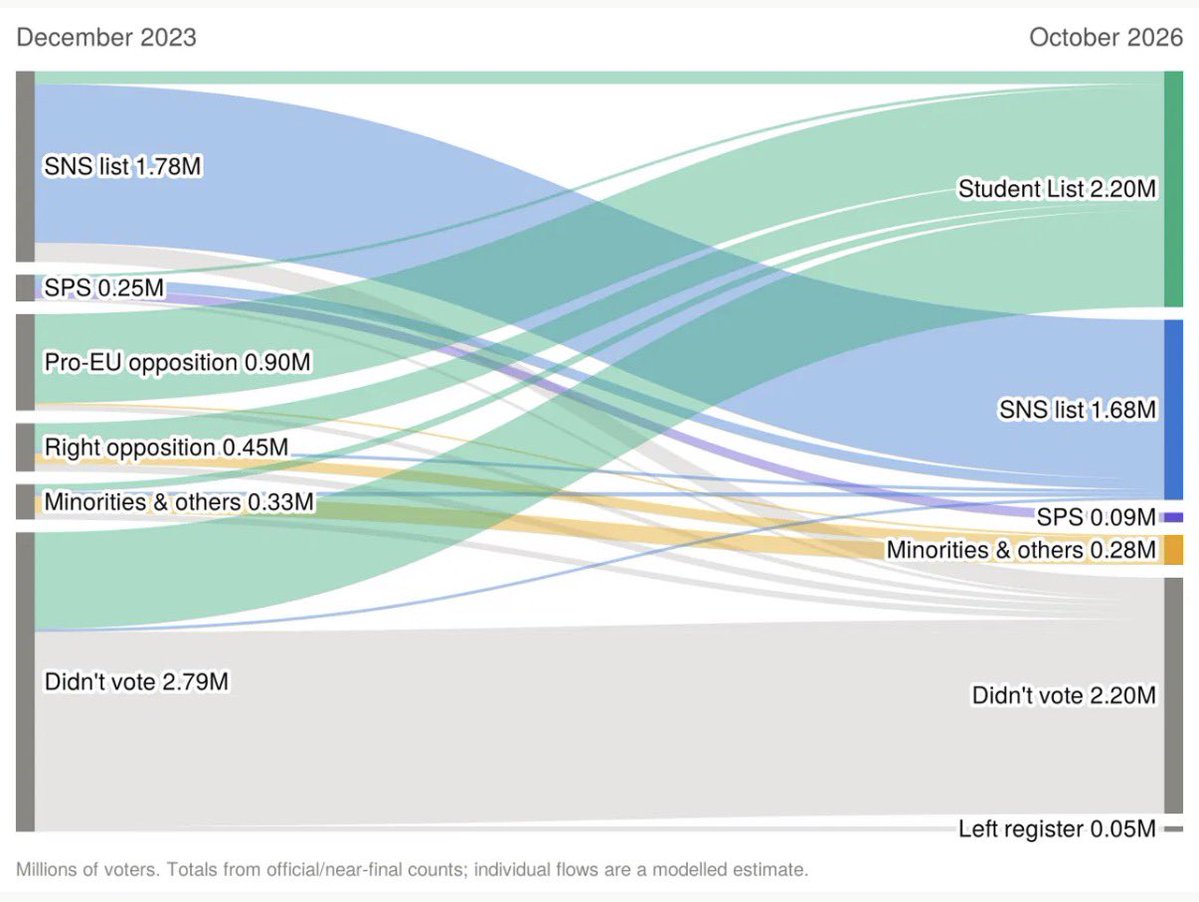
Serbian voters, December 2023 and October 2026, millions. Totals from official or near-final counts; individual flows are a modelled estimate. Source: unattributed voter-flow model circulated on X.
High voter turnout makes all the difference in closely contested elections and can be crucial in votes held in less than democratic countries. Incumbents in under developed countries where the state controls access to the media of indulge in vote-buying can swing the count their way, but as there are limits to the size of the fix they can put in, a surge of votes by genuinely disgruntled citizen can still force an unpopular leader out of office.
And Serbs were heartly fed up with Vucic. Some 4.3mn of the 6.45mn registered voters cast a ballot, with 97.6% of polling stations processed, according to preliminary figures from the Republic Electoral Commission (RIK). Pollster CeSID put final turnout at 69.3% excluding the diaspora and monitor CRTA expected more than 70%, against 58.8% in the December 2023 election. The Student List won 52.7% and 140 of the 250 seats, while Vucic's Serbian Progressive Party (SNS) list took 39.2% and 104 seats.
Vucic did not lose his voters. The SNS list took 1.69mn votes, down only modestly from about 1.78mn in 2023. What changed was the size of the electorate that showed up: some 600,000 more Serbians voted than three years ago, and the Student List collected 2.27mn votes, more than any party has won since the largest protest in the country's history in March 2025 turned a student movement into an electoral machine.
The pattern stretches from the Balkans to the former Soviet Union and Latin America. Electoral autocracies are built to win low-turnout contests, where a loyal base of pensioners, state employees and the beneficiaries of patronage is enough. When turnout surges, the regime faces a binary choice: concede, as Vucic did and as Hungary's Viktor Orban did in April, or falsify the count on a scale that is impossible to hide - which almost always brings people onto the streets, as Belarus found out in 2020 and Russia in 2011.
"That degree of democratic participation is just too difficult to invalidate, even with the most earnest electoral engineering," Bosnian-American political scientist Jasmin Mujanovic wrote in Odgovor on October 26. "There were too many votes against both regimes for their apparatchiks to be able to hijack the result. They tried, but they could not overcome the overwhelming force of the democratically mobilized masses."
The stay-at-homes decide Serbia
Turnout climbed through the day. CRTA counted 67.8% by 7pm, an hour before polls closed, against 55.5% at the same point in 2023, Politico reported. European Commission President Ursula von der Leyen said Serbians had "turned out in record numbers". Diaspora voters queued for hours in Chicago, Toronto, Vienna and Zurich.
The vote was held under pressure: police closed the street leading to the electoral commission before noon and armoured riot-control vehicles rolled into central Belgrade, and in the run-up the Student List said police were targeting its activists. The last time Serbia saw this level of participation was in 2000, when voters ousted Slobodan Milosevic.
Then, an hour after the polls closed, Vucic went on every television channel in the country to concede. "Based on a stratified sample, it is clear that we lost these elections," he said at SNS headquarters. Croatian Prime Minister Andrej Plenkovic said Vucic's early concession suggested the handover would be peaceful.
Hungary followed the same script six months earlier. Turnout of 79% on April 12, up from about 70% in 2022 and a record, gave Peter Magyar's Tisza party 53.2% and a two-thirds majority, and Orban conceded within an hour of the polls closing. Mujanovic drew the contrast with Bosnia and Herzegovina, where official turnout in the recent general election was under 45% and the parties that have dominated for 20 years won again.
Brazil's comeback in the runoff
In Brazil, where voting is compulsory but abstention is common, the swing came between rounds. Turnout in the first round on October 4 was 78.9%, with 33.4mn voters staying at home - the highest first-round abstention since 1998. Lula finished second, behind Senator Flávio Bolsonaro, the son of former president Jair Bolsonaro, who is under house arrest for plotting a coup, and trailed or tied him in polls until the final days.
In the runoff on October 25 turnout rose to 80.8%, bringing roughly 3mn more Brazilians to the polls. Lula took 64.26mn votes, about 10.4mn more than in the first round, while Bolsonaro added about 3.7mn to reach 59.83mn. Lula won by 4.43mn votes and 51.8% to 48.2%, becoming the first candidate since direct presidential elections returned in 1989 to win after finishing second in the first round.
| Election | 1st round turnout | Runoff turnout | Change, points |
| Brazil 2022 | 79.05% | 79.41% | +0.36 |
| Brazil 2026 | 78.92% | 80.78% | +1.86 |
Brazilian presidential elections, turnout as a share of registered voters. Source: Superior Electoral Court (TSE), via Brazilian media.
Lula's allies credit a WhatsApp channel called Lula's Army, run by Congressman André Janones, which grew to 10.8mn followers between the rounds, the BBC reported. Colombian President Gustavo Petro hailed the channel on X as the "genius" behind the win. Political scientists were more cautious. "The physical world enabled a form of mobilisation capable of reducing abstention and persuading undecided voters," Mayra Goulart, a professor at the Federal University of Rio de Janeiro, told the BBC.
Brazil's count held. Bolsonaro first said he would seek to have the result annulled because the Supreme Court extended voting by two hours, but just over 34,000 votes were cast after regular hours against a margin of 4.4mn, Bloomberg reported. On October 26 his Liberal Party formally conceded and he dropped the challenge. "I wasn't the one who lost. The system won," he said. Lula's fourth term keeps Brazil, the region's largest economy, on the left of a continent that has swung sharply to the right.
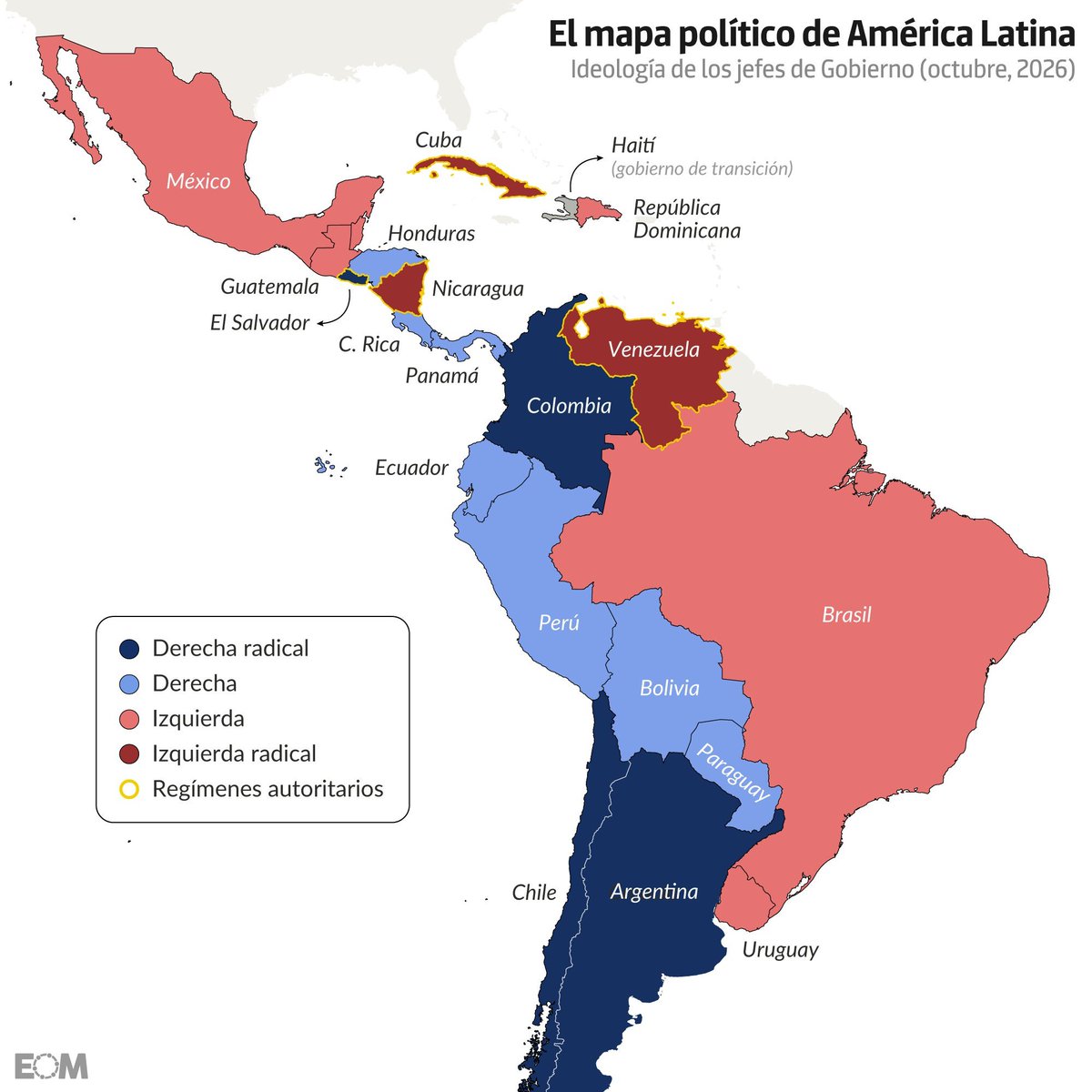
Ideology of Latin American heads of government, October 2026: radical right (dark blue), right (light blue), left (pink), radical left (dark red); authoritarian regimes outlined in yellow. Source: El Orden Mundial.
When the count is rigged, the street fills
Belarus in 2020 demonstrated that even a massive turnout at the polls is not enough to unseat an entrenched authoritarian regime. Former English teacher Svetlana Tikhanovskaya drew huge crowds to her rallies, and the Central Election Commission said a record 41.7% of voters cast ballots early, over the five days before polling day. The commission gave Alexander Lukashenko 80.08% and Tikhanovskaya about 10%, on official turnout of about 84%.
A statistical study of precinct results by Vadim Zipunnikov of Johns Hopkins University found early voting was the main vehicle for fraud: every 7% of early ballots cut Tikhanovskaya's result by about 8%. Stripping out stations with more than 25% early votes put her ahead of Lukashenko, and suggested the election would at least have gone to a second round.
The falsification brought the biggest crowds in the country's history onto the streets. At least 100,000 people rallied in Minsk on August 16, while local outlet tut.by put the crowd at 220,000, and at least 250,000 joined the March of New Belarus a week later. Workers at the MZKT truck plant chanted "Get out" at Lukashenko in his Ceausescu moment, but with Moscow's backing the security services held and he stayed in power.
Russia's 2011 Duma election followed the same arc, although national turnout actually fell, to 60.1% from 63.7% in 2007. The anger came from the cities. United Russia officially took 49.3%, down from 64.3%, barely clinging on to its majority, while estimates of its real result ran from 25% to 35%. A FOM exit poll gave the party 25% in Moscow, where its official score was 45%.
A Moscow precinct chairman told the Associated Press that his staff stuffed ballots all day and still fell short of the target, so the commission simply awarded United Russia 65%. Videos of ballot-stuffing spread online, and on December 10 police counted 25,000 people on Bolotnaya Square while organisers claimed 100,000. On December 24 police put the crowd on Sakharov Avenue at 29,000 and organisers at up to 120,000, The Moscow Times reported. IntelliNews reporters put a February rally on Bolotnaya Square at at least 100,000. The protests were billed as the biggest since the fall of the Soviet Union, but Vladimir Putin returned to the Kremlin in March 2012.
| Election | Turnout | Official result | Challenge to the count | Aftermath |
| Serbia, Oct 2026 | c.69-70% (2023: 58.8%) | Student List 52.7% | None, Vucic conceded | Change of government |
| Hungary, Apr 2026 | 79.0% (2022: c.69.6%) | Tisza 53.2% | None, Orban conceded | Change of government |
| Brazil, Oct 2026 runoff | 80.8% (1st round: 78.9%) | Lula 51.8% | Annulment bid dropped | Incumbent re-elected |
| Belarus, Aug 2020 | c.84% (41.7% early) | Lukashenko 80.1% | Study puts Tikhanovskaya ahead | Up to 250,000 on streets; regime survives |
| Russia, Dec 2011 | 60.1% (2007: 63.7%) | United Russia 49.3% | Real share estimated at 25-35% | Up to 120,000 on streets; Putin returns |
| Georgia, Oct 2024 | 60.2% | Georgian Dream 53.9% | Observers say vote rigged | Months of protests; ruling party holds |
| Venezuela, Jul 2024 | 57.9% (CNE) | Maduro 52.0% | Opposition tallies: Gonzalez 67% | 2,000+ arrests; Gonzalez in exile |
| Kyrgyzstan, Oct 2020 | 56.5% | Pro-presidential parties win | Result annulled October 6 | President resigns October 15 |
| Bolivia, Oct 2019 | 88.3% | Morales 47.1% | OAS alleges manipulation (disputed) | Morales resigns November 10 |
High turnout and disputed counts. Sources: national electoral commissions, CRTA, CeSID, IntelliNews archive.
In Georgia in October 2024 the ruling Georgian Dream party officially won 53.9%, but statistical analysis found a "Russian tail" of about 400 polling stations reporting near-unanimous support, and three domestic monitoring missions later said the vote was rigged in the ruling party's favour. Protests over the vote grew into months of nightly demonstrations after the government froze EU accession talks in November 2024.
In Venezuela in July 2024 the electoral council gave Nicolas Maduro 52%, while tally sheets collected by opposition volunteers from more than 80% of polling stations gave Edmundo Gonzalez 67%. More than 2,000 people were arrested in the crackdown and Gonzalez fled to Spain. Maduro stayed until US forces captured him in January this year.
In Kyrgyzstan the street won outright. The October 2020 parliamentary vote, which let only four parties into parliament, three of them close to President Sooronbay Jeenbekov, set off protests that followed the Belarus template: the election commission annulled the result two days after the vote and Jeenbekov resigned nine days later. In Bolivia in 2019, on turnout of 88%, Evo Morales resigned after an Organization of American States audit alleged manipulation of the count, although later academic studies disputed its findings.
Vucic, like Orban, chose not to test the second path. With Serbia's presidential election due in December and more than 100 SNS deputies still in parliament, the Student List now has to hold the voters who turned out on October 25 - the same people who will decide whether it lasts longer than the regime it replaced.