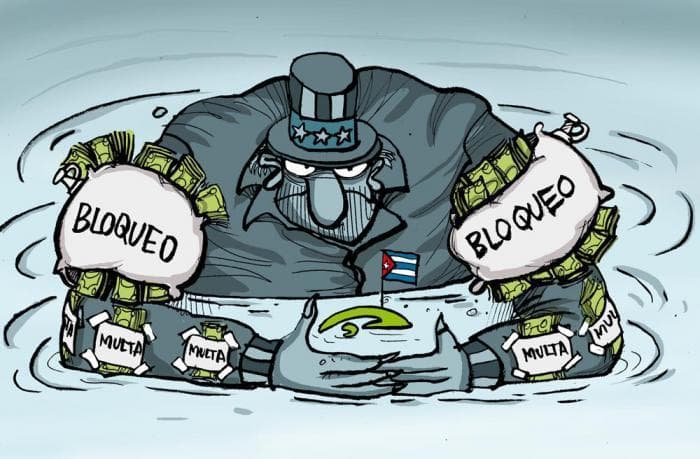
If U.S. administrations possessed any ethics, the blockade against the small and dignified island of Cuba would never have been imposed—let alone maintained and strengthened, as is the case today.
How close we are geographically—Americans and Cubans! How much potential collaboration has been lost over these long years spent in a relentless pursuit to destroy the Cuban Revolution? How much cultural exchange has been squandered?
If we look closely, the only things that have truly taken root among those who impose this blockade are hatred, selfishness, arrogance, and the fundamentalist impulses that have characterized nearly everyone—whether Republican or Democrat—who has occupied the White House.
In Cuba, meanwhile, friendship, solidarity, and love have flourished among a people who resist and prevail, even when forced to do so under adverse conditions.
I believe it is fair to assert that this evil is systemic and can only be overcome by confronting it. Cuba is a victim of a monster that has grown into a global power—a power that exploits others, seizes the wealth of other nations, wages wars, bombs countries, and fosters a massive arms industry—not merely as a military guarantee for its own survival, but as the very pillar of an economy built upon these principles.
The actions taken against this Caribbean nation lay bare the true nature of U.S. leaders—men devoid of human values, monsters who applaud while millions of women, children, and the elderly suffer from a lack of medical care and live on the brink of suffocation, all because they inhabit an island that seeks only peace and development.
Despite this obsession with our destruction, we have proven ourselves to be a people of giants—a people defined by our values and a culture of solidarity, where hatred has never played a role in our policy toward other nations.
Throughout these years, Cuba has served as a venue for dialogue and peace, hosting historic agreements—such as the one signed between the Colombian government and the FARC guerrilla movement—as well as the most comprehensive achievement of all: the declaration of Latin America and the Caribbean as a Zone of Peace.
Across almost the entire planet—including the United States—people view Cuba as a friendly nation, a country defined by solidarity, capable of sending doctors to save lives in more than a hundred nations, reaching even the most remote and inaccessible corners of each one.
It is an island that has never committed an act of aggression against any other nation; an island that knows terrorism only because it has been a victim of it for many decades—terrorism originating precisely from U.S. territory and supported by the governments of that country.
I can imagine it now—once again—when, in the great green-marble hall at the United Nations, the display board shows the usual few votes in favor of this crime; among them will be the vote of the Zionist government in Tel Aviv. There may well be others who join in, coerced by threats from Washington.
It is truly regrettable—as is the fact that the UN itself recently allowed the U.S. delegation to stage a tawdry, circus-like spectacle by bringing in terrorists wanted by the law—criminals who, because they are harbored by the United States, have never served a sentence nor even stood trial.
What a horror, and what a disgrace—or rather, what a display of utter shamelessness—to see the representative of the UN’s host country (the very same country that imposes a blockade and stifles our people) openly threaten representatives of other nations, declaring: "Either you vote against Cuba, or you may face various forms of economic and diplomatic sanctions!"