প্রতিবেদন লোড হচ্ছে…How long does it take to travel through the Universe at 1g? | Ayar News
Big Think · জীবনধারা
How long does it take to travel through the Universe at 1g?
২৬/১০/২০২৬
Here on Earth, we constantly experience Earth’s gravity: 1g, or 9.8 m/s².
This image shows a person in free-fall close to Earth’s surface. They still accelerate toward the center of the Earth at 1g, but have no normal force acting on them. As a result, for the brief moments from when this photo is taken until they hit the water, they effectively experience weightlessness.
Shown here, two astronauts experiencing weightlessness aboard the International Space Station demonstrate, together, the conservation of angular momentum. A consequence of the symmetry of rotational invariance, the astronaut spins faster only because a torque is applied to him from another astronaut’s body. The amount of angular momentum transferred to the spinning astronaut is canceled out by the equal-and-opposite amount of angular momentum transferred back into the other astronaut-ISS system.
Credit: NASA/International Space Station
As long as there’s acceleration, an astronaut’s experience is indistinguishable from gravity.
The identical behavior of a ball falling to the floor in an accelerated rocket (left) and on Earth (right) is a demonstration of Einstein’s equivalence principle. If inertial mass and gravitational mass are identical, there will be no difference between these two scenarios. This has been verified to better than ~1 part in one trillion for matter through torsion balance experiments, and was the thought (Einstein called it “his happiest thought”) that led Einstein to develop his general theory of relativity. Recently, the ALPHA-g experiment confirmed that this is true for antimatter as well.
Credit: Markus Poessel/Wikimedia commons; retouched by Pbroks13
The launch of Apollo 17, the ninth and final crewed mission to the Moon as part of the Apollo program, was also the first nighttime liftoff of a Saturn V rocket, occurring on December 7, 1972. The Saturn V remains the heaviest launch vehicle in history, capable of carrying the greatest masses to low-Earth orbit of any rocket ever.
Whereas normal matter and antimatter particles can only move at (if they’re massless) or below (if they’re massive) the speed of light, another possibility is that there’s a negative-energy state or imaginary mass state that’s possible: a tachyonic state. If that mathematical possibility is physically borne out in our Universe, then faster-than-light travel is a necessity.
If a spacecraft never exhausted its fuel, continuously accelerating at 1g, we could go anywhere.
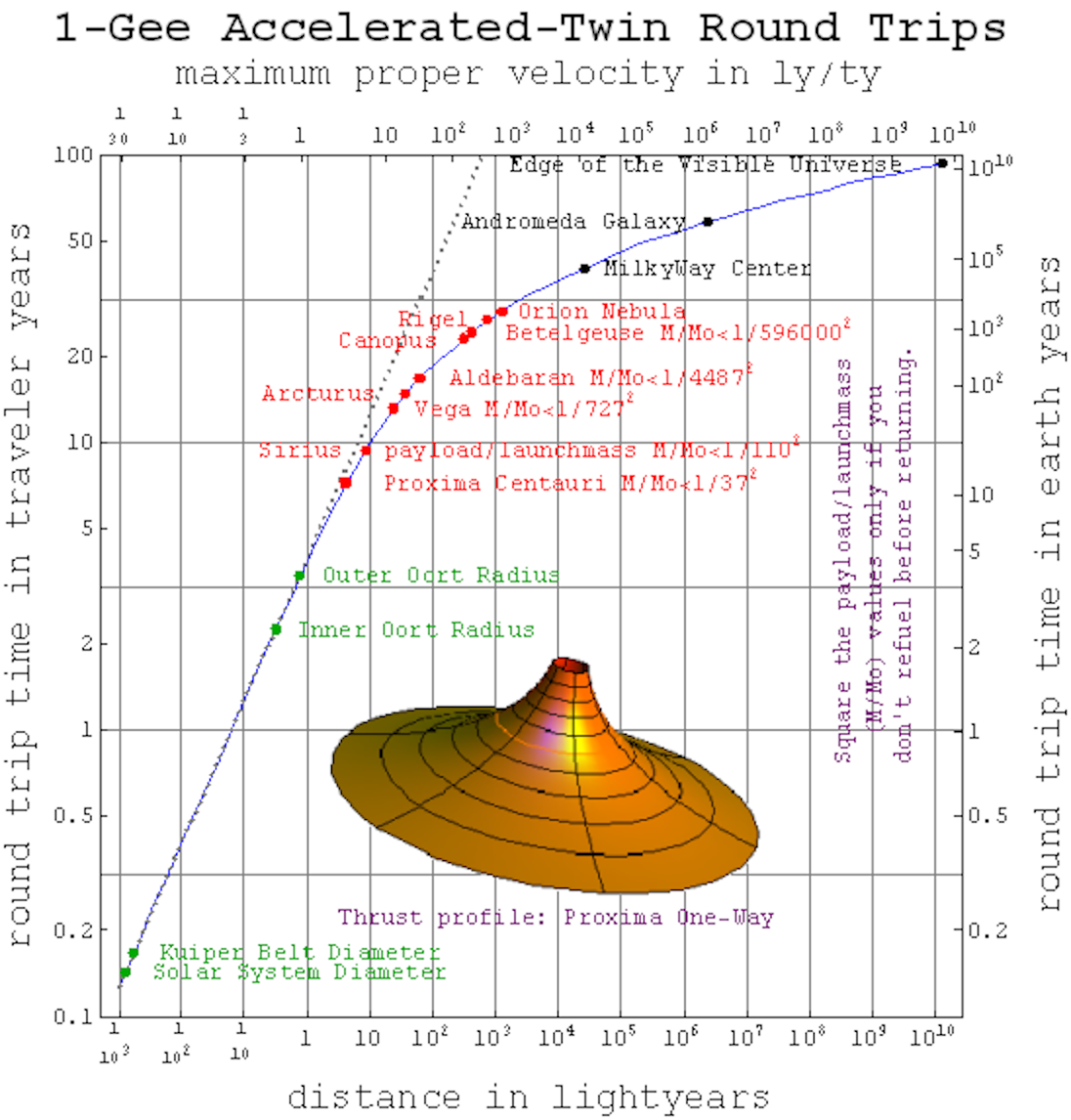
If you were to get in a spaceship and accelerate at 1g (Earth’s acceleration) for the entirety of the trip, you could travel at nearly the speed of light after only a few years of acceleration. As you increased your speed ever closer to the speed of light, the effects of time dilation would get progressively more severe. In theory, distances of many light-years could be traversed in experienced times of much less than a year, but one must reckon with the weight of realistic fuel sources as well.
Mars, at closest approach, is attainable after 1 day, 5 hours, and 42 minutes.
Mars, like most rocky worlds in the Solar System, is full of craters and has an impact-rich history. Despite how easily visible the Martian atmosphere is from orbit, it’s very thin, just 1/140th the thickness of Earth’s atmosphere and less than 1/200th of the mass of Earth’s atmosphere. With current technology, gravity does most of the driving on a journey to Mars, but the journey takes several months with current technology.
We’d reach the Kuiper belt’s end — the Kuiper cliff — after just over 2 weeks.
The Kuiper belt begins at the edge of Neptune’s orbit (30 AU), and continues on, populated by millions of ice-dominated objects left over from our Solar System’s formation, until a distance of about 50-55 AU, where the population of objects abruptly ends: what astronomers call the Kuiper cliff.
After 4 weeks, we’d pass Voyager 1: today’s most distant human-made spacecraft.
In 1977, NASA’s Voyager 1 and 2 spacecraft began their pioneering journey across the Solar System to visit the giant outer planets. Now, the Voyagers are hurtling through unexplored territory on their road trip beyond our Solar System. Along the way, they are measuring the interstellar medium, the mysterious environment between stars that is filled with the debris from long-dead stars. Voyager 1 became the most distant spacecraft from Earth in 1998, and no other spacecraft launched, to date, has a chance of catching it.
An illustration of the inner and outer Oort cloud surrounding our Sun. While the inner Oort cloud is torus-shaped, the outer Oort cloud is spherical. The true extent of the outer Oort cloud may be under 1 light-year, or greater than 3 light-years; there is a tremendous uncertainty here. Any massive object that passes through the Oort cloud has a significant chance of perturbing the objects within its vicinity.
After 1 year and 7 months, we’d depart the outer Oort cloud at 92% light-speed.
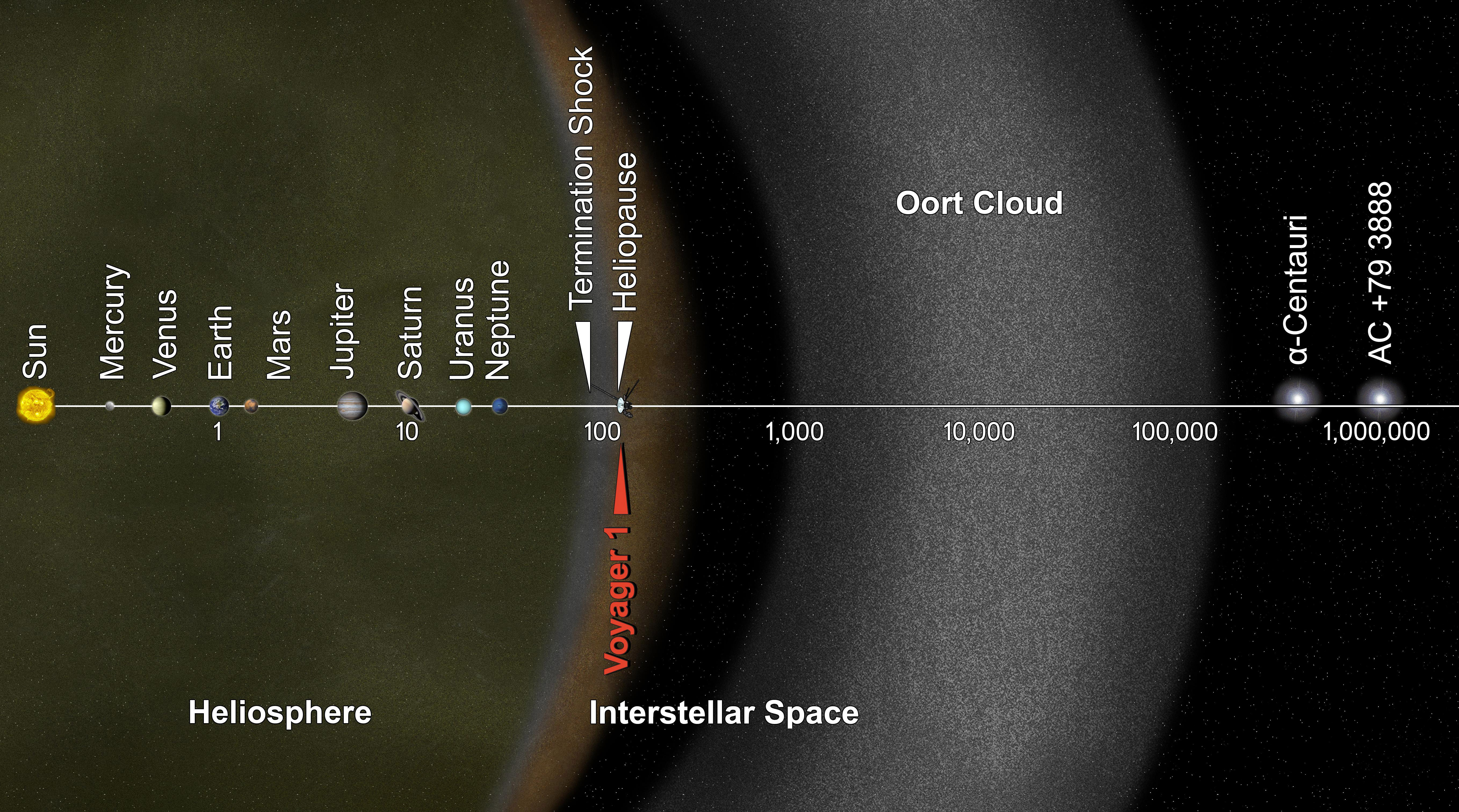
A logarithmic chart of distances, showing the planets, the Voyager spacecraft, the Oort Cloud, and our nearest star: Proxima Centauri. If we had a spacecraft that were capable of accelerating continuously and of withstanding the relativistic collisions that would ensue with interplanetary and interstellar material, upon leaving the Solar System, Voyager 1, the Oort Cloud, and Proxima Centauri would be the first three key “distance milestones” we’d encounter.
The stars Alpha Centauri (upper left) including A and B, are part of the same trinary star system as Proxima Centauri (circled). These are the three nearest stars to Earth, and they’re located between 4.2 and 4.4 light-years away. Alpha Centauri (at left) and its slightly fainter but far more distant neighbor, the almost 400 light-year distant Beta Centauri (at right), are easily visible in the southern skies. Proxima Centauri, the closest, is far too intrinsically faint to be seen with the unaided eye.
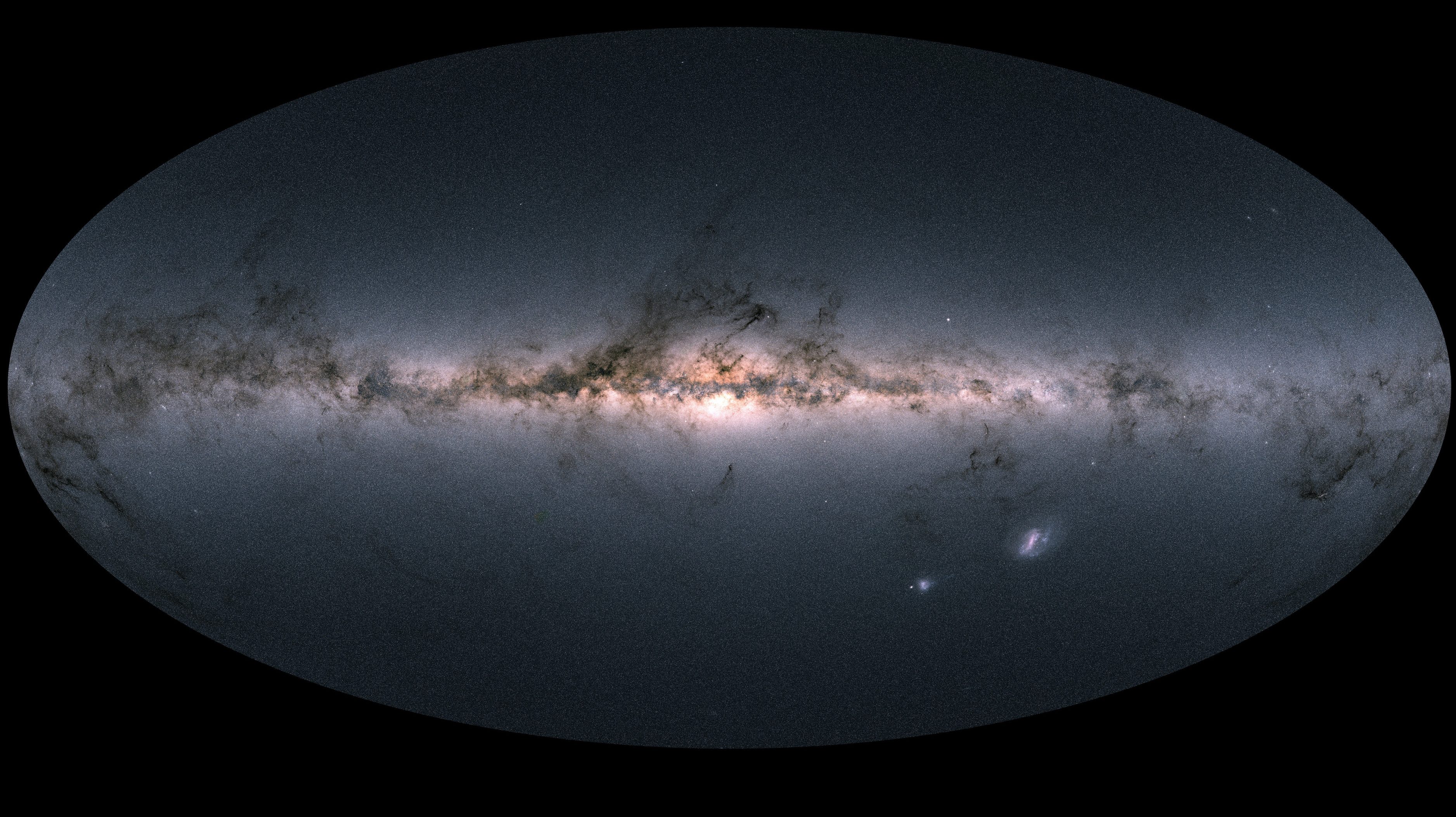
The galactic center, 26,000 light-years away, requires just under 11 years.
The European Space Agency’s space-based Gaia mission has mapped out the three-dimensional positions and locations of more than one billion stars in our Milky Way galaxy: the most of all-time, as well as many stars in sufficiently nearby galaxies. Looking toward the center of the Milky Way, Gaia reveals both light-blocking and luminous features that are scientifically and visually fascinating, but cannot see our central black hole, 26,000 light-years away, due to the intervening material.
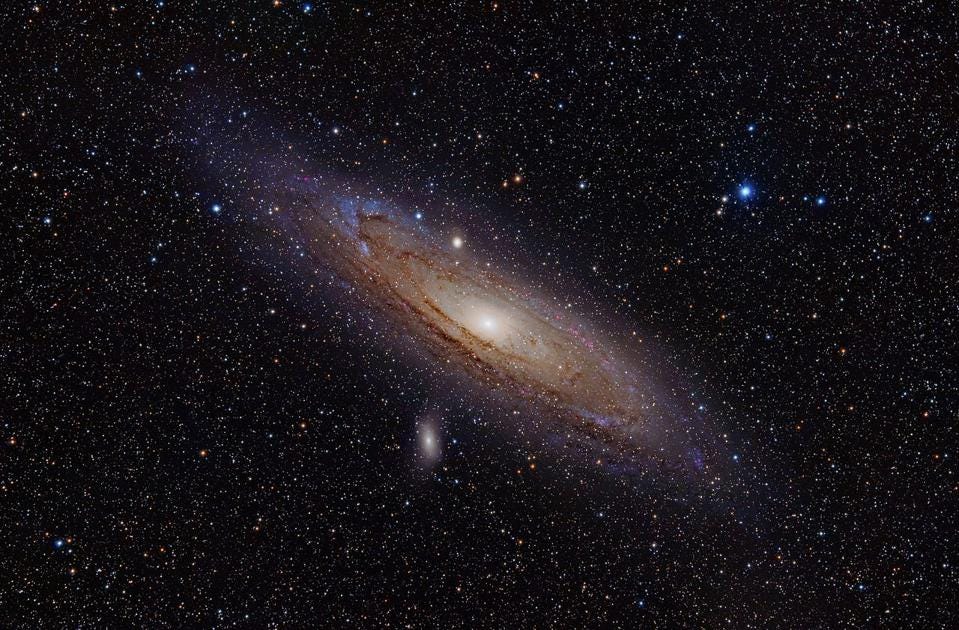
Andromeda, 2.5 million light-years distant, takes 15 cumulative years.
This full-scale view of the Andromeda Galaxy, M31, showcases its star-forming regions lining its spiral arms, its dust lanes, and its central, gas-poor region. Unlike the Milky Way, Andromeda lacks a prominent central bar. This image is a fairly close approximation of what human eyes would see if they could make out these details in Andromeda, which is the largest galaxy in the Local Group and the only one more massive than the Milky Way.
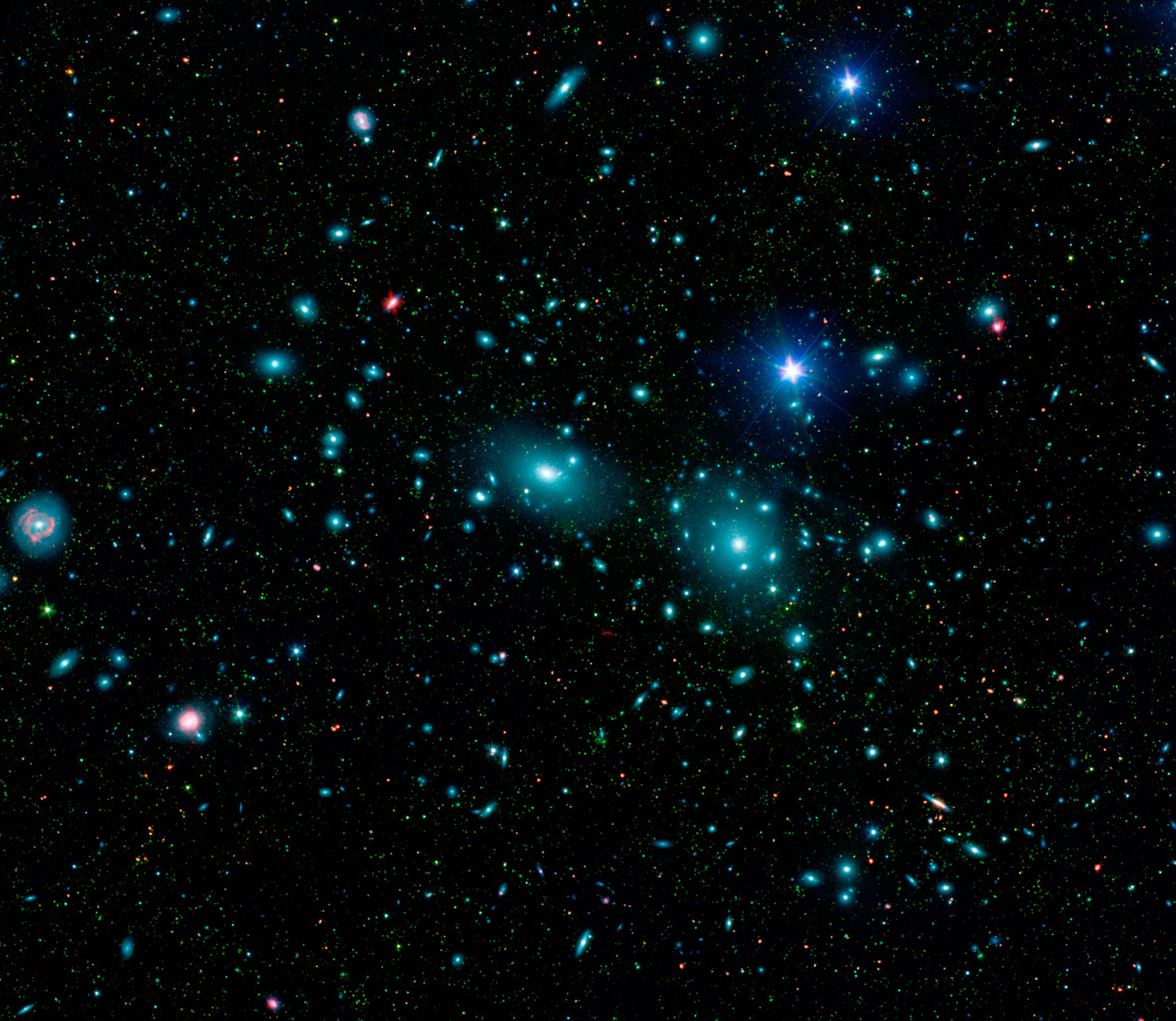
The Coma Cluster, 321 million light-years away, is reachable after 20 years.
The Coma Cluster of galaxies, as seen with a composite of modern space and ground-based telescopes. The infrared data comes from the Spitzer Space Telescope, while ground-based data comes from the Sloan Digital Sky Survey. The Coma Cluster is dominated by two giant elliptical galaxies, with over 1000 other spirals and ellipticals inside. Gas-free, red-and-dead elliptical galaxies are very common, especially toward the cluster center, in large galaxy clusters such as this one. The speed of galaxies within the cluster can be used to help determine the cluster’s total mass, revealing our first evidence for dark matter in the 1930s.
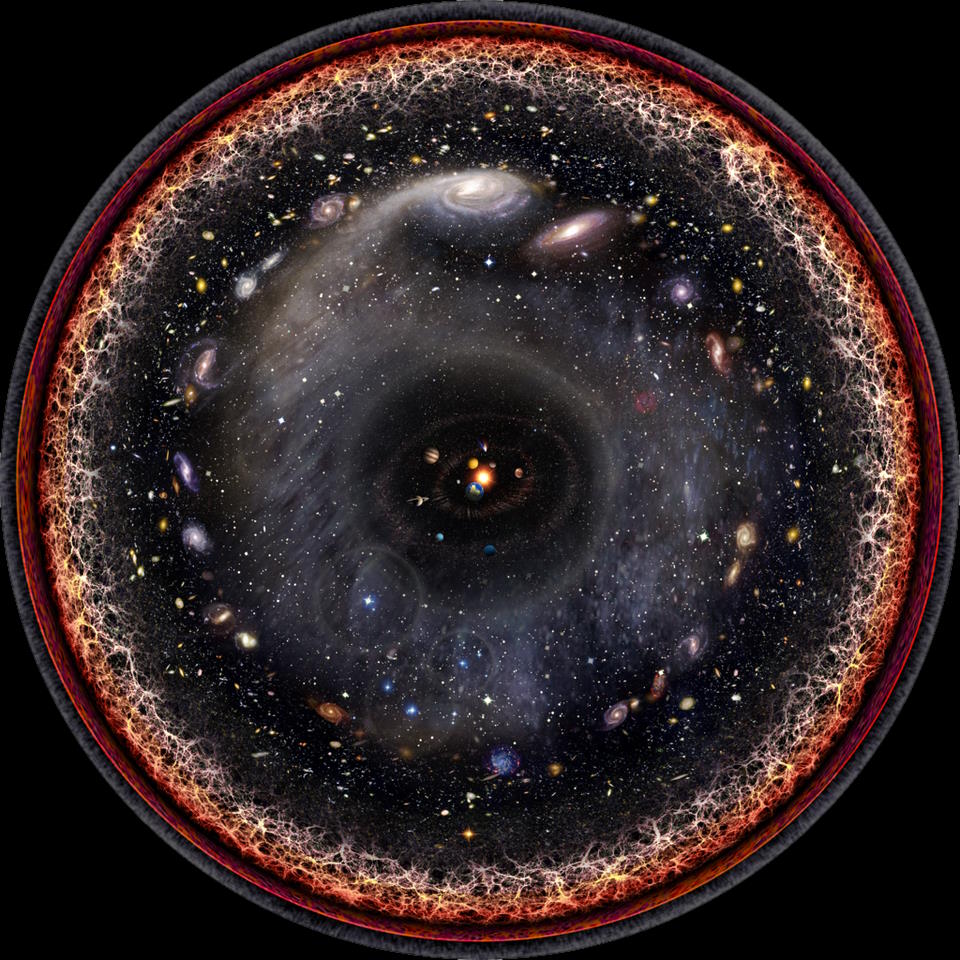
Artist’s logarithmic scale conception of the observable universe. The Solar System gives way to the Milky Way, which gives way to nearby galaxies which then give way to the large-scale structure and the hot, dense plasma of the Big Bang at the outskirts. Each line-of-sight that we can observe contains all of these epochs, but the quest for the most distant observed object will not be complete until we’ve mapped out the entire Universe.
Credit: Pablo Carlos Budassi; Unmismoobjetivo/Wikimedia Commons
Mostly Mute Monday tells an astronomical story in images, visuals, and no more than 200 words.