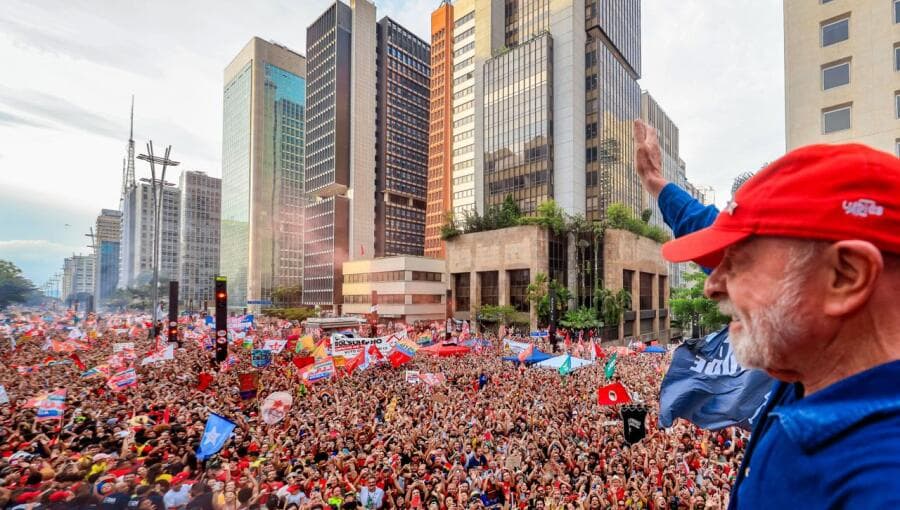
In one of the most pivotal elections of the year, Brazil has sent a message that resonates far beyond its borders. On October 25, President Lula da Silva of the left-wing Workers’ Party (PT) defeated far-right senator Flávio Bolsonaro in the presidential run-off, winning 51.8% of valid votes to 48.2%. At 80, Lula has been re-elected for a fourth, non-consecutive term.
Having trailed after the first round, he turned the race around, something no candidate had achieved before in Brazil’s democratic history. The unexpected result also broke a string of right-wing and far-right victories across Latin America.
Yet the significance of this victory cannot be measured in percentages alone. The contest was a battle over the political and social direction of Latin America’s largest nation. At stake was whether Brazil would continue to stand for democratic institutions, social protection, environmental responsibility and an independent foreign policy, or move towards a more authoritarian, socially exclusionary model aligned with the US’s political project.
Lula’s win was a stinging defeat for the Bolsonaro family and their political allies, and a blow to the international far right more broadly. It also made it harder for US President Donald Trump to complete the construction of a conservative, Washington-led bloc across the Americas. The election showed that the region’s shift to the right is not necessarily a one-way street. In his victory speech, Lula sent an immediate message to Trump and Secretary of State Marco Rubio: “Brazil is no one’s backyard.”
Trump, who had quietly backed Bolsonaro’s campaign, has made no public comment on the result, though his son Donald Trump Jr took aim at it in a post on X.
Europe, by contrast, has warmly welcomed the outcome. European Commission president Ursula von der Leyen declared that “democracy and multilateralism have won in Brazil”, while other European leaders stressed the importance of continuing to work with Brazil on trade, climate and every other area of international co-operation. It was a clear acknowledgement that Brazil remains a vital partner at a time when the multilateral system, international co-operation and the rules-based order are under sustained pressure.
The relief is palpable. Across Europe, democratic forces are confronting populist parties that play on cultural anxieties, hostility to immigration, distrust of institutions and a general sense of economic insecurity.
Brazil has shown that such movements can be defeated at the polls, even when they command significant resources and a devoted base, operate in a deeply polarised society and enjoy US support.
But the big lesson is not that Lula has beaten the far right once and for all. It is that the future remains open, and that organised citizens can shape it.
The people returned to the streets and to the political debate
One of the most remarkable features of Lula’s victory was the high level of popular mobilisation in the run-up to the second round. This was not simply a matter of the PT’s campaign machine, established political alliances or the president’s personal popularity. Indeed, Lula openly complained about his campaign’s (dis)organisation after the first round. As the prospect of a Flávio Bolsonaro victory became ever more tangible, a wider movement took shape, particularly among young people and progressive social groups, amplified by more intensive use of social media.
Students, artists, activists and citizens of all kinds helped bring the campaign back into the public sphere. Social media became another battleground. Deputy André Janones played a central, pioneering role in mobilising online supporters through the “Exército de Lula” (Lula’s Army) WhatsApp network, which, according to Agência Brasil, had 10.8mn members. Its communication with voters was far more direct and informal in tone.
This mobilisation mattered because the election was not just about Lula. Above all, it was a choice between two very different visions of Brazil. Many feared that a new Bolsonaro government would erode democratic safeguards, weaken the social safety net and further polarise Brazilian society along the lines that became clear in 2018, when Flávio’s father, convicted former president Jair Bolsonaro, was elected.
The campaign thus became a defence of much more than one candidate, uniting people concerned about public healthcare, social assistance, workers’ rights, the environment, religious pluralism and, above all, the future of democracy itself. Brazilians who voted for Lula in the second round did not necessarily agree on every political issue. What they did agree on was that Brazil should not throw away the social and democratic gains it has painstakingly built over the years.
Lula alluded to this in his post-election speech, thanking voters and stressing that no one can win an election without the people. It was also a clear warning for the future: a movement should not come together only when an election looms. The energy that brought Lula back from behind must be sustained through his next term, keeping the government on its toes and demanding real improvements in people’s lives.
Brazilian democracy has survived authoritarianism, political crises and deep social divisions. Its strength has always lain in its citizens’ capacity to organise, protest and defend their rights. The historic mobilisation ahead of the run-off built on exactly that tradition.
The election also exposed the dangers of the digital public sphere. Campaigns increasingly depend on platforms whose algorithms determine what voters see, share and believe. During the campaign, multiple allegations surfaced of unequal treatment and political bias by social media companies such as Meta, owner of Facebook, Instagram and WhatsApp.
Leaks from Meta staff confirmed that the company was biased towards Bolsonaro, as did its own council and a UN expert panel. Meta officially blamed the shortcomings on technical problems. However, the disruptions were consistently one-sided, hampering the left’s efforts to amplify its messaging and leading to messages and accounts being blocked.
These allegations raise a wider democratic question. Private technology companies, most of them US-based, should not be able to wield political power through opaque algorithms without transparency, accountability and appropriate safeguards. In his victory speech, Lula renewed his commitment to further regulating digital platforms.
Democracy must deliver social justice
Brazil’s choice was also a defence of a particular conception of the state, one in which public institutions have a duty to reduce poverty, protect the vulnerable and ensure basic services are available to all.
Social policy was at the heart of the run-off. Welfare programmes such as Bolsa Família, Lula’s flagship cash-transfer scheme for the poor, are not simply handouts. They enable families to put food on the table, keep their children in school and tackle the structural inequalities that persist in Brazilian society. Universal public healthcare, real increases in the minimum wage, employment and access to education are equally part of this social contract.
The World Bank has linked Brazil’s recent poverty reduction to a combination of real increases in the minimum wage, the expansion of Bolsa Família and better labour market conditions. These include a recently legislated maximum five-day working week, while free public transport for all at weekends (Saturday and Sunday) is due to be discussed soon.
Such progress does not mean Brazil has solved inequality for good, but it does show that public policy can raise living standards when growth is combined with measures that effectively reach the poor.
The right’s alternative, in fact, was not simply a pledge to scrap existing programmes. Later in the campaign, Flávio Bolsonaro and his allies went some way towards assuring voters that social benefits would remain. But that made the core argument of their campaign inconsistent: slash spending with Argentina’s Milei-style chainsaw while keeping Lula’s outlays. The numbers did not add up, and both market participants and his own voters questioned Bolsonaro’s credibility. As a result, the right’s message became far less convincing.
Brazil has a long and painful history of slavery, racial inequality, regional disparities and concentrated wealth. Brazilians expect democracy to mean more than the right to vote. It must also mean the ability to live with dignity. Lula’s record provides grounds for defending this model, but there is still a long way to go.
The environmental dimension is just as important. According to INPE, Brazil’s National Institute for Space Research, deforestation in the Amazon fell by 41.8% between August 2025 and July 2026 compared with the previous year, the lowest level in the 38-year monitoring series that began in 1988. Deforestation in the Cerrado also declined. This does not mean the country’s ecosystems are no longer under threat, but it does underline the value of enforcement and the need for continued policy and monitoring.
Voters’ choice, then, was never simply an abstract one between left and right. It was about the kind of society Brazil wants to build.
Sovereignty, multilateralism and a different international order
Lula’s victory carries enormous geopolitical significance. Brazil is a major economy, set to climb from 10th to 8th in the global rankings in 2027, as well as a continental power, a leading agricultural producer and a significant diplomatic player. Its position has implications for Latin America, the Global South and the future of multilateralism.
Sovereignty was the defining issue of the campaign when it came to Brazil’s international posture. Lula has been unequivocal that Brazil has the right to maintain relations with the US, China, the EU and all its other partners without accepting that Washington can dictate the terms of Brazilian foreign policy. His ironclad commitment to BRICS, south-south co-operation and a more multipolar world order is central to that stance.
For Lula, however, strategic autonomy does not mean hostility towards the US. The leftist leader maintains good personal relations with Trump and instead blames Secretary of State Marco Rubio, whom he sometimes calls “the frustrated Latino”. Lula also prides himself on his strong relations with Xi Jinping, Vladimir Putin, Narendra Modi, Emmanuel Macron, and practically the rest of the world, though less so with Latin America’s hard-right governments. A former union negotiator, he is skilled at working with all kinds of partners.
This matters all the more as competition intensifies over energy, critical minerals, advanced technology, trade and supply chains. In his victory speech, Lula said Brazil’s resources should underpin industrial development, scientific research and well-paid jobs at home, rather than leaving the country as just another exporter of raw materials and importer of processed goods. Sovereignty must have economic and social substance, he said. That means the capacity to generate value, develop technology and improve the lives of the Brazilian people.
Lula’s victory also matters for the defence of multilateralism. Brazil has long championed diplomacy, supported international institutions and promoted co-operation across political divides. Its continued participation in BRICS and other international forums gives it the opportunity to act as a bridge between countries whose interests do not always align. However, Brazil’s natural leadership in South America has been damaged by the recent election of a large number of far-right governments that prefer direct alignment with Trump’s Latin America policy.
For Europe, the stakes are particularly high. A democratic Brazil that supports open trade, notably the EU-Mercosur trade agreement, as well as climate action and multilateralism, is a very useful partner in an increasingly uncertain geopolitical landscape. The relationship should not be seen as a simple contest between Brussels, Washington and Beijing. It should rest on mutual interest, mutual respect for national sovereignty and a shared desire to work together on common problems.
The sovereignty agenda has not gained the same traction in Europe as in Brazil, where voters’ choice was rooted in the country’s own history, inequalities, institutions and political struggles. Even so, the outcome offers a lesson: democratic states need not accept that international politics must be structured around authoritarian nationalism, perpetual confrontation and the subordination of the weak to the strong.
Brazil now has the opportunity to show that sovereignty and international engagement are not mutually exclusive, and can in fact reinforce each other.
The road ahead
Brazil’s message is a positive one, but it by no means marks the end of the far-right threat. Flávio Bolsonaro took 48.2% of valid votes, and the right emerged from the legislative elections with considerable strength. Lula now faces a hostile conservative Congress and a very difficult road to getting his programme through.
These realities demand political intelligence from Lula, not triumphalism. He must govern well beyond his own electorate, negotiate with the legislature without losing sight of his core principles, and show that a democratic government can in fact get things done. He will have to tackle soaring crime, the cost of living, employment and the state of public services while managing significant fiscal constraints. And he must do all this in a way that revitalises the progressive movement, so that its future does not depend entirely on one elderly man, particularly as this is his last election.
The final point is the most important. Lula’s political career has been built on bringing broad coalitions together. For his fourth administration to be viable and democratic, it must involve the Brazilian people in decision-making, as he promised in his victory speech. The spontaneous mobilisation of young people in the run-off should be seen not as a mere electoral tool, but as a demand for a genuine role in shaping the country’s future.
Europe, likewise, will defeat the far right only if it stays in touch with its people. Holding elections is not enough to make a democracy if governments do not serve the people. Geopolitical pressures close to home have led European leaders to relegate their own citizens to second or third place. We have even heard remarks such as: “I do not care what my voters think.” The far right cannot be kept at bay simply by telling people what a threat it poses.
Brazil has not solved all these problems. Society remains deeply divided, the defeated candidate is questioning the result, institutions are under pressure, especially the Supreme Court, and the next government faces a very difficult set of challenges.
The election has nonetheless shown something very significant: the populist conservative forces can be challenged, electoral momentum can be reversed, and popular mobilisation can make a real difference. That offers grounds for hope to democrats around the world. But defeating the far right at the ballot box is only the beginning. Lasting victory comes when democracy proves it can deliver a better life.
Ricardo Martins is based in Utrecht, the Netherlands, and has a PhD in Sociology specialising in European politics, geopolitics and international relations.