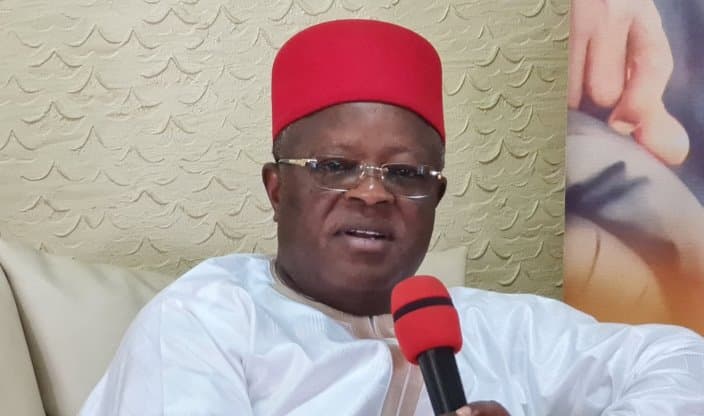
David Umahi, Nigeria’s minister of works, has defended the Federal Government’s decision to award the Lagos-Calabar Coastal Highway to Hitech Construction through direct procurement, but his explanation has renewed questions about the project’s planning, particularly whether a complete engineering design existed for the entire highway before construction contracts were awarded.
Speaking in an exclusive interview with ARISE News, Umahi acknowledged that the project was not subjected to public advertisement or open competitive bidding, insisting that the procurement method was permitted under Nigerian law because of the specialised engineering expertise required to construct a highway along the Atlantic coastline.
However, his defence, which centred largely on Hitech’s experience in coastal protection and its work on Eko Atlantic, raises a broader question about the relationship between a contractor’s technical capability and the government’s responsibility to establish a comprehensive design, cost estimate and implementation framework for a project spanning several states.
When asked whether the highway had been publicly advertised or subjected to competitive bidding, Umahi responded: “But there was direct procurement. It’s within the law.”
The minister explained that the government relied on Hitech’s experience in managing coastal erosion and protecting Victoria Island from Atlantic Ocean surges to justify its selection for the highway project.
According to him, the company’s work on Eko Atlantic demonstrated its ability to undertake technically demanding coastal engineering projects that previous interventions by foreign contractors had failed to resolve permanently.
“Our job was to construct road along the coast — coastal highway — and we knew that we were going to be confronted with the ocean surge,” Umahi said.
He recalled that Hitech initially resisted undertaking the coastal protection project because of the financial risks involved but eventually developed a system using massive concrete structures and geotextile materials to contain the Atlantic Ocean.
“And today we have a beauty to behold, the Eko Atlantic,” he said.
Umahi said the government subsequently presented Hitech’s work on Eko Atlantic to the Bureau of Public Procurement (BPP) as evidence of its technical capacity and performance.
The BPP, he said, reviewed the proposal and advised that the highway should be procured in sections. The government then obtained a Certificate of No Objection before securing approval from the Federal Executive Council.
“Federal Executive Council approved: go ahead, direct procurement, but procure it in sections,” he said.
Yet, approval of a procurement method does not, by itself, establish whether the government had completed the engineering design for the entire highway, determined its final cost or adequately assessed the technical and financial implications of delivering the project across different coastal environments.
For a highway of this scale, a comprehensive design would ordinarily provide the engineering basis for determining the alignment, bridge and drainage requirements, soil conditions, coastal protection measures, environmental safeguards, construction specifications and estimated costs. Where a project is divided into sections, the government would also need to demonstrate how the individual designs fit into a coordinated master plan for the entire corridor.
The distinction is important because a contractor’s experience in constructing coastal infrastructure does not automatically establish that a complete design exists for another project with different geographical, environmental and engineering requirements.
The Lagos-Calabar Coastal Highway has also generated public debate over its escalating projected cost, the demolition of properties around Landmark Beach, environmental impact assessments and changes to the road’s alignment. These concerns have intensified scrutiny of the planning and decision-making processes behind the project.
A key issue, therefore, is whether the government had completed an integrated engineering design for the entire route before committing public funds to construction, or whether designs and technical decisions were being developed progressively as individual sections moved forward.
Umahi’s interview, as presented, did not establish that a complete design for the entire highway was unavailable. Rather, his defence focused on the legality of direct procurement, Hitech’s specialised experience and the approvals obtained from the procurement regulator and the Federal Executive Council.
The distinction matters because the absence of open competitive bidding and the absence of a comprehensive engineering design are separate questions. The former concerns how a contractor was selected; the latter concerns whether the government had sufficiently defined the project before committing public resources to it.
Umahi also rejected claims that Seyi Tinubu, son of President Bola Tinubu, sits on Hitech’s board.
“He’s not,” the minister said, adding that the government had examined the company’s board during the pre-qualification process.
The controversy surrounding the highway ultimately extends beyond the identity of the contractor or the procurement route adopted by the government. It concerns the transparency of project preparation, the adequacy of engineering documentation, the basis for cost estimates and the safeguards in place to manage variations as construction progresses.
For a project with significant implications for public finances, coastal ecosystems, property owners and transport infrastructure, disclosure of the relevant design documents, cost breakdowns, environmental assessments and procurement approvals would help establish whether the government’s decisions were supported by a comprehensive technical and financial framework.
Umahi maintains that the choice of Hitech was driven by the company’s demonstrated expertise and that the procurement process complied with the law. The outstanding question is whether the government can also demonstrate that the planning and design underpinning the entire Lagos-Calabar Coastal Highway were sufficiently developed to support its scope, cost and long-term viability.

Athekame Kenneth is a politics, economy, and finance reporter whose work is anchored in sharp investigative storytelling. He brings analytical depth to every piece, drawing on a strong academic foundation that includes a degree in Economics, an MBA in International Trade, and a minor in Petroleum Economics from Lagos State University, Ojo. His reporting blends rigorous research with a keen eye for hidden truths, delivering stories that illuminate power, policy, and the forces shaping everyday lives.

