Business Korea · সাধারণ
North Korea Estimated to Have Laid 960,000 DMZ Mines, Calling Seoul's Armistice Violation Claim 'Fabrication'
২৬/১০/২০২৬
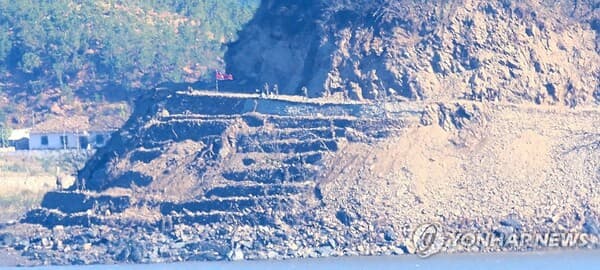
North Korean soldiers carry out border fortification work, including the construction of tactical roads and fences, in Kaepung County, North Korea, as seen from Ganghwa County, Incheon, on Oct. 22.
South Korean military authorities estimate that North Korea has planted approximately 960,000 new landmines in and around the Demilitarized Zone (DMZ) over the past two years, accelerating what Pyongyang calls the "fortification of its border." The figure exceeds the estimated 800,000 mines laid on the North Korean side of the DMZ over more than seven decades since the Korean War. Including the roughly 2 million mines previously laid by both Koreas, the total number of mines in the DMZ is now estimated at nearly 3 million.
A North Korean mine explosion that occurred last month approximately 10 meters south of the Military Demarcation Line (MDL) in the western section of the DMZ has escalated into a diplomatic dispute at the United Nations. On Oct. 22, the South Korean government sent a letter to the president of the UN Security Council, describing the incident as a violation of the Korean War Armistice Agreement and demanding an apology and responsible action from North Korea. Pyongyang responded with a letter from its permanent representative to the UN, claiming that Seoul had fabricated the incident to obstruct its border fortification efforts.
South Korea's Ministry of National Defense formally proposed military-to-military talks with North Korea on Oct. 23 in an effort to manage tensions. In a statement, Kim Hong-cheol, director-general of the ministry's Policy Bureau, called for both sides to clarify the precise location of the MDL, restore military communication lines and discuss ways to prevent accidental clashes along the border. Given the differing interpretations of the MDL's location and the resulting risk of unintended confrontation, the ministry also expressed openness to trilateral talks involving the United Nations Command if necessary.
The government's proposal appears to reflect concerns that North Korea's escalating threats against the South cannot be left unaddressed. Since declaring the two Koreas to be "hostile states" in late 2023, North Korea has reinforced their separation by constructing barriers and fences north of the MDL. South Korean military authorities expect Pyongyang to accelerate construction as much as possible before winter conditions force work to stop.
The proposal has also drawn criticism from South Korea's opposition. In a Facebook post on Oct. 24, People Power Party leader Jang Dong-hyeok accused the government of begging for dialogue even though North Korea had yet to apologize for the mine incident. Jang argued that the government's security policy was disconnected from geopolitical realities, citing North Korea's substantial earnings from troop deployments to Russia and arms exports, as well as its deepening ties with China.
The Ministry of Foreign Affairs plans to approach major countries individually to explain Seoul's position, given the limited prospects for securing a UN Security Council resolution. On Oct. 22, the ministry briefed the diplomatic corps in South Korea on the findings of a joint investigation into the mine explosion. It is also reportedly considering unilateral cyber sanctions against North Korea, although the Ministry of Unification is said to oppose the move over concerns about its effectiveness.
The prospects for inter-Korean military talks remain uncertain. Kim Yo-jong, director of the General Affairs Department of the Workers' Party of Korea, has previously declared that North Korea has no intention of engaging face-to-face with the South, casting doubt on whether Pyongyang will respond to Seoul's proposal.
মূল প্রতিবেদনে যান ↗