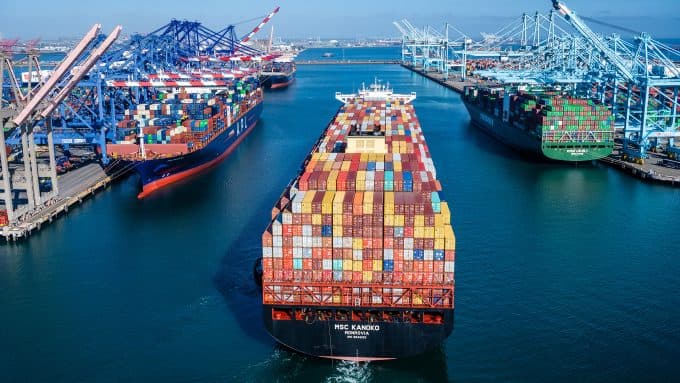
Pier-300-channel-aerial Port of Los Angeles.
Deployed capacity on the transpacific and Asia-Europe trades during this year’s Golden Week holiday was the highest on record, according to new analysis from Sea-Intelligence.
Port congestion in Asia, caused by a succession of typhoons, led to vessel bunching at loading ports, and subsequently resulted in a series of “double sailings”, which cancelled out carriers’ blanking strategy during the holiday period when they typically look to skip voyages due to a lack of cargo sitting on Asia’s docks
“Double sailings are essentially two departures on a liner service in a week,” analysts at Sea-Intelligence said. “Liner services work on weekly departure frequencies – ie, one vessel departs the origin region every week.
“When vessels get delayed, they bunch up – the delayed departure that moved from week 1 to week 2 is now sailing along with the original week 2 departure, hence a ‘double sailing’,” the consultancy explained.
This meant deployed capacity during the Golden Week period – which Sea-Intelligence defined as taking place between weeks 40 and 42, to account for the lag in inland transport work unable to take place because drivers were on holiday – was this year higher on the transpacific and Asia-Europe trades than ever before.
For example, according to Sea-Intelligence, the Asia-US west coast trade would normally see less than 300,000 teu in weekly capacity deployed during the Golden Week holiday period, whereas this year it saw 393,000 teu of weekly capacity deployed.

Source: Sea-Intelligence Consulting
Meanwhile, between 2012 and 2019, the average deployed capacity during the Golden Week holiday period would see an 8% reduction on Asia-US west coast, a 6% reduction on Asia-US east coast, a 16% reduction on Asia-North Europe, and a huge 21% on the Asia-Mediterranean trade.
However, this year, Asia-Mediterranean capacity during Golden Week was up 18%, compared with the rest of the third quarter, while the Asia-US east coast trade was up 15%, and the Asia-US west coast and Asia-North Europe routes were both up 4%.
While this could suggest carriers have “abandoned the traditional seasonal capacity reductions”, the analyst instead lays the blame on the number of “double sailings” this month and those scheduled for November, and which have reached historically high levels on all four of the major trades.
“This massive influx of double sailings is a direct symptom of severe vessel bunching caused by ongoing port congestion and schedule unreliability in Asia.
“Vessels that were originally scheduled to depart during Q3 were heavily delayed and subsequently cascaded into the October and November loading windows.
“This then unnaturally inflates the baseline of active sailings for the week, which artificially increases deployed capacity, and mathematically suppresses the blanked capacity percentage – shipping lines have not necessarily abandoned their capacity management strategies for Golden Week in 2026; rather, their networks are simply too heavily congested with bunched vessels to execute those strategies effectively,” Sea-Intelligence added.
Underneath it all is, of course, the continuing poor schedule reliability that is making life increasingly difficult for shippers and their forwarders to plan accordingly, as noted by UK forwarder Metro Shipping.
“Following China’s Golden Week, around 95% of scheduled container sailings were expected to operate, suggesting relatively modest capacity withdrawals.
“However, conditions vary considerably between Asia–Europe and transpacific trades. Carrier schedule adjustments, congestion and disrupted vessel rotations continue to affect reliability, even where overall capacity appears sufficient,” it said today.