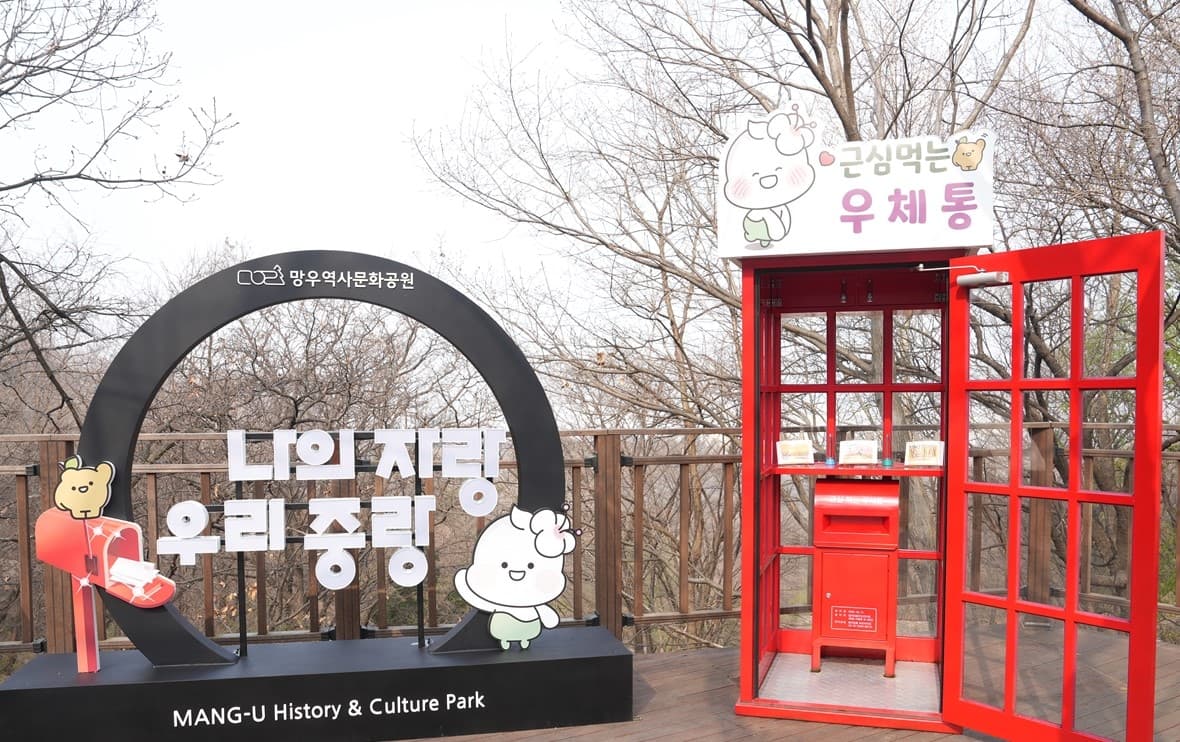
Walking through Mangwoo History and Culture Park, I find myself thinking that to live in one's own era is, in the end, to take on the worries of that era. Among those buried here are two doctors who worried about the human body and human life: Ji Seok-yeong, known by the pen name Songchon, and Yu Sang-gyu, known as Taeheo.
In the 19th century, when Ji lived, smallpox in Joseon was called "mama" and was an object of dread. Many children died of the disease, and finding a way to prevent it was an urgent task. Born in 1855, Ji developed an interest in medicine while studying under Park Yeong-seon, a practitioner of traditional Korean medicine. He read Western medical texts translated in China and took particular note of Jenner's method of vaccination. In 1879 he traveled to Jesaeng Hospital in Busan, where he spent two months learning the technique. He obtained vaccine material and a vaccination needle, and on his way home stopped in Chungju, where his wife's family lived, and vaccinated some 40 people against smallpox. The following year he accompanied the second diplomatic mission to Japan, where he learned how to produce and store vaccine material before returning home.
His path, however, was not smooth. During the Imo Incident of 1882, an order was issued for his arrest on the grounds that he had introduced foreign medicine, and the vaccination center he had worked to establish was destroyed by fire. Still he did not give up. He rebuilt the center, opened a smallpox vaccination office, and published "Udusinseol," the first Korean book on vaccination. Even in exile on an island in the south, he did not stop administering vaccinations. When a medical school opened in 1899, he served as its first principal, and he also argued for the use of Hangul so that anyone could learn easily. Throughout his life he demonstrated that preventing illness matters as much as curing it, and that sharing such knowledge widely matters just as much.
Yu Sang-gyu belonged to the generation that followed. He entered Gyeongseong Medical College in 1916, took part in the March 1 Independence Movement, and then suspended his studies to go to Shanghai, where he worked as secretary to Ahn Chang-ho, known as Dosan, then interior minister of the Provisional Government of the Republic of Korea. He later spent about six months as a laborer in Japan, returned to school in 1925 and graduated in 1927. He treated patients in the surgical department of his alma mater's affiliated hospital, taught younger students, and promoted public health and hygiene through newspaper columns and lectures. In 1930 he took part in founding the Korean Medical Association.
But in 1936, while preparing to pursue a doctorate, he contracted a streptococcal infection while treating a patient and died at the age of 38. His funeral was arranged by Ahn Chang-ho. When Ahn died two years later, he had wished to be buried beside Yu, and the two were laid to rest at Mangwoo-ri. In 1973 Ahn's grave was moved to Dosan Park, separating the two, but the extraordinary bond between teacher and student remains at Mangwoo History and Culture Park to this day.
Ji Seok-yeong and Yu Sang-gyu lived in different times and walked different paths. Yet they closely resembled each other in taking the protection of human life as the compass of their own lives. They worried themselves, they did not turn away from the worries of those around them, and they thought deeply and acted.

These days, whoever I meet and whatever we talk about, the conversation drifts naturally toward health. Even as medicine has advanced and life expectancy has lengthened, health remains — perhaps more than before — a major preoccupation and a source of worry for residents. We have come through an era when war and hunger were the greatest concerns, but the costs of rapid growth and urbanization have been no small matter either: sanitation and health, air pollution and the like. We have lived through infectious diseases such as MERS and COVID-19, and now, along with population aging, chronic illness, dementia, unspoken mental suffering and a growing need for care remain both a personal assignment for each of us living in Seoul and a task for the community.
People with no time to look after their bodies amid busy days. People whose mobility has grown difficult with age. People who endure their inner pain alone through the night. People who cannot fully live their own lives because they are nursing a family member. All of them live together in this city of Seoul.
So how can we live more healthily? It is said that it takes about 10 years for a good habit to settle into the body. First, start the day by rising at a set time and loosening up with light movement. Eat vegetables, protein and carbohydrates in balance while avoiding overeating, and drink water often. Set a target suited to your own fitness, but walk roughly 8,000 steps a day. Sleep regularly and sufficiently, and do not skip regular health checkups. Preventing illness in advance and catching it early — that is the secret to health.
Aging, of course, cannot be avoided. So the older one gets, the more there is to attend to. For heart health, eat less salt, keep moving steadily, quit smoking, cut back on alcohol and keep watching cholesterol levels. To guard against sarcopenia, the loss of muscle mass, it is good to take in ample protein every day. For lean diabetic patients, adding strength training is said to be especially helpful in managing blood sugar.
Good habits cannot be maintained by individual effort alone. Health is shaped by many conditions: socioeconomic circumstances such as income and work, the physical environment where one lives, and the health care services available nearby.
That is why the community must step in together. A healthy city, I believe, is a place where people can look after their health before they fall ill, receive help in time when they do, and continue to live among neighbors without isolation as they grow older.
In "The Death and Life of Great American Cities," Jane Jacobs wrote that streets where people pass and encounter one another keep a city alive. A street good for walking not only makes the body healthier but also brings neighbors together. In last year's Community Health Survey, Jungnang District ranked first nationwide in the share of residents who walk regularly, at 77.7%. Green space accounts for 40% of the district. Those numbers can be read as a sign that walking is seeping into residents' daily lives. People walk along Mangwoo Mountain, Yongma Mountain and the Jungnang Stream. For those heading outdoors, the district is connecting paths, creating places to rest, and building comfortable routes such as barrier-free trails that can be climbed even by those who find it somewhat difficult. If one can walk a good path with good company, what greater pleasure is there?
Forests and parks also create health. Urban forests not only clean the air and cool the heat but also let the body and mind of those walking within them rest together. I believe everyone should be able to move their body and tend to their mind within walking distance of home. The steady improvement in Jungnang residents' health indicators across many areas since 2018 is, I believe, the combined result of a cleaner environment, streets that are good for walking and conversations shared with residents.
Because habits formed in childhood last a lifetime, the district works with the community on everything from nutrition for infants and toddlers to nutrition and obesity management for children and adolescents and physical activity. The mind is no different. That is why we attend to the mental health of older adults, adolescents and those who provide care.

Not long ago I spoke with older residents about the secret to good health among Jungnang residents aged 100 and over. What they had in common was that they went out of the house, met people, talked with them and stayed active. The older I get, the more deeply I feel how precious an ordinary day of soaking up sunlight and asking after a friend can be. This is precisely why I emphasize the importance of places where neighbors sit down together and talk — traditional markets, public squares and senior centers — and why we keep them in good order.
For those who have trouble caring for themselves because of physical difficulty, because they live alone or for financial reasons, it is not enough to stress habits. The necessary support must be found. Local government is responsible for reviewing public health care resources and for researching and planning health policy. It must also keep asking what minimum responsibilities the public sector must bear to protect a life of human dignity, and keep seeking ways to meet them. Consider the moment after discharge from a hospital, when meals, medication and even moving around each become a burden. If help does not reach that person then, they end up readmitted or forced to leave the home they have grown attached to. Jungnang has an "in-between home," where people can stay for a set period after discharge to recover and prepare to return to daily life.
Technology can help with health management as well. If artificial intelligence in the home continuously monitored an older person's health, emotional state and safety and connected them directly to the services they need at the first sign of trouble, and if care robots helped with physically demanding tasks such as moving, bathing and eating, the burden on caregivers would be considerably lighter. Of course, however far AI advances, the emotional empathy of holding a hand, meeting someone's eyes and recognizing their feelings will ultimately remain the work of people.
Older adults these days want to receive care in the home where they have lived and to end their lives there. If health care, health management, long-term care, support with daily living and housing assistance are linked around a single person's life, those who are ill should not have to go from one institution to another repeating the same circumstances.
In the era of Ji Seok-yeong and Yu Sang-gyu, there was little choice but to accept a short life. Enduring pain and suffering was part of daily existence. But our society today exists thanks to people who refused to leave the worries of their era untouched and who kept watch and sought solutions — not only in medicine but in culture, institutions and welfare.
Seoul is now working to make prevention and care the default, weaving a dense community welfare network so that no one is left alone in a blind spot of health. This cannot be accomplished by administration alone. Volunteers, local care networks, neighborhood clinics and welfare centers must each do their part while joining hands closely. Fortunately, Jungnang has networks that the private sector has built on its own over many years, along with a solid public-private cooperation system. It is no accident that in this first year of integrated care, Jungnang was the first district to meet the initial care targets each autonomous district had set.
I imagine Jungnang 10 years from now. Just as a habit changes the body over a decade, I believe that if the small practices residents are building now — on the streets and in their relationships with neighbors — accumulate, then in 10 years Jungnang will be a neighborhood where residents look after their own health and lead the way for Seoul's health.
Walking through Mangwoo History and Culture Park, one encounters deaths as sorrowful as the lives were brilliant. Looking at the graves of those who died young — Yu Sang-gyu at 38, Bang Jung-hwan, known as Sopa, at 31, and Takumi Asakawa at 39 — I wonder what might have been had they been able to live longer. At the same time, I seem to hear a voice telling us today to live longer, healthier and well. I am grateful to have Mangwoo History and Culture Park nearby, a place that speaks of life and death at once. I hope that all of us, in our own homes and neighborhoods, can look after our own health and watch over our neighbors, and stay healthy for a long time.
