

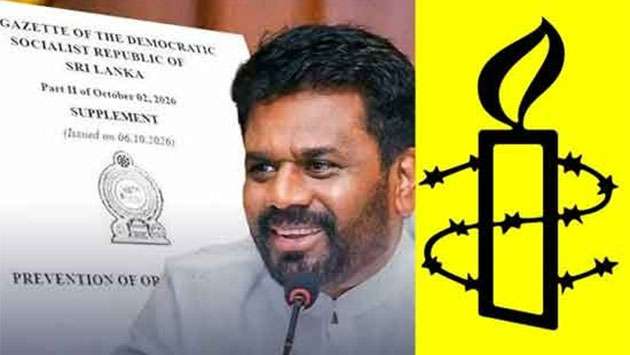
Colombo, Oct. 27 (Daily Mirror) - A new bill before Sri Lanka’s parliament that grants the authorities sweeping arbitrary powers to tackle ‘organized crime’ and deny suspects’ human rights should be immediately withdrawn, Amnesty International said today.
The Prevention of Organised Crimes bill, tabled in Sri Lanka’s parliament on 6 October, contains provisions that would make confessions extracted under duress admissible in court, enable the detention of suspects for up to two years without trial, and ban the media from reporting on court proceedings. The bill also confers the police with wide powers to conduct searches without a warrant, and imprison people for not providing information to authorities.
The bill mirrors many elements of Sri Lanka’s repressive Prevention of Terrorism Act (PTA), which has been misused since the 1970s to target minorities and repress dissent.
“This extraordinary bill is the most alarming in a string of repressive laws proposed by the National People’s Power (NPP) government. It reintroduces most of the very worst elements of the PTA and applies them to a wide range of offences,” said Smriti Singh, Amnesty International’s South Asia Director.
We urge the Sri Lankan government to withdraw the bill in its entirety
Smriti Singh, Amnesty International’s South Asia Director
“The bill entrenches impunity and risks reviving the conditions that enabled arbitrary detention, torture and other ill-treatment under the PTA, including the use of coerced statements to secure convictions. It allows what effectively amounts to secret trials and it removes virtually all the safeguards designed to prevent the abuse of police power. The international community, which saw and decried the abuses under the PTA, should shudder.
“We urge the Sri Lankan government to withdraw the bill in its entirety and engage in meaningful public consultations around how to tackle organized crime while protecting human rights.”
The bill also empowers police to obtain personal information from telecommunications, satellite, digital and data service providers – including subscriber identities, call records and device location data – without a court order. This would infringe on the right to privacy and create significant risks of abuse, including the surveillance of journalists’ contacts, lawyers’ communications, and organizers of lawful assemblies.
The bill covers offences already criminalized under Sri Lankan law, including intellectual property violations, Penal Code offences such as obstructing public servants and secret wrongful confinement, but subjects them to fewer due process safeguards when committed by an organized criminal group, to support prosecutions.
An organized criminal group is defined in the bill as “a structured group of three or more persons, existing for a period of time and acting in concert… in order to obtain, directly or indirectly, a financial or other material benefit”.
To determine whether an individual is a member of such a group, courts are allowed to consider a range of circumstantial evidence including their “style of dress, hand signs, language or tattoos used by known members of the organised criminal group” or whether they visit places known to be used by organized criminal groups. Courts are also allowed to consider past conduct and association as admissible evidence to prove membership of an organized criminal group.
Statements made before a magistrate by persons who can’t be cross-examined – on account of their being dead or because they cannot be found – are also permitted as evidence of criminal conduct, while a provision in the bill making it an offence to knowingly do “any other act… in furtherance of a common criminal object borne by the members of an organised criminal group” is extremely vague, and subject to possible abuse.
“Criminal guilt must be based on actual evidence of individual wrongdoing from objective factual circumstances defined by law with sufficient precision, not appearance, association or suspicion. Provisions that allow people to be branded members of criminal groups based on how they dress, whom they know or where they go risk discriminatory profiling and undermine the prohibition of arbitrary detention and the right to a fair trial,” said Smriti Singh.