
Even with a bright Moon in the sky, you can easily trace this “waterfall” of stars to its end in the spray of open cluster NGC 1502.
Looking for a sky event this week? Check out our full Sky This Week column.
October 26: Observe the October Hunter’s Moon
The Moon’s bright light washes out dimmer targets, but not all deep-sky objects are out of reach. Late this evening, the constellation Camelopardalis sits in the north, to the right (east) of the Little Dipper and sandwiched between Cassiopeia and Ursa Major.
In Camelopardalis’ southwestern region is a 6th-magnitude open cluster called NGC 1502. Stretching about 8’ across, this compact group of young stars lies about 9° south of magnitude 4.6 Gamma (γ) Camelopardalis and is visible in binoculars or any telescope. But it’s only the beginning: NGC 1502 lies at one end of a line of stars known as Kemble’s Cascade. This asterism resembles a waterfall with NGC 1502 serving as the spray of water coming from the pool at its base. From NGC 1502, look for a snaking line of nearly two dozen stars roughly 2.5° long, shining between about 7th and 10th magnitude and stretching up toward the northwest. You’ll want binoculars or a finder scope to take them all in at once, or you can slide slowly along the line within the smaller field of view of your telescope.
The asterism is named for Father Lucian Kemble, who described the pattern in a letter to astronomy popularizer Walter Scott Houston.
Sunrise: 7:24 A.M.
Sunset: 6:04 P.M.
Moonrise: 6:47 P.M.
Moonset: 9:20 A.M.
Moon Phase: Waning gibbous (95%)
*Times for sunrise, sunset, moonrise, and moonset are given in local time from 40° N 90° W. The Moon’s illumination is given at 10 P.M. local time from the same location.
The Moon passes 5° north of Uranus at 6 A.M. EDT the morning of October 28. You’ll find our satellite hanging above the Pleiades (M45) in Taurus, roughly 45° high in the west around 6 A.M. local daylight time. Together with Uranus, the Moon and Pleiades form a triangle in the sky that slowly sets as twilight approaches.
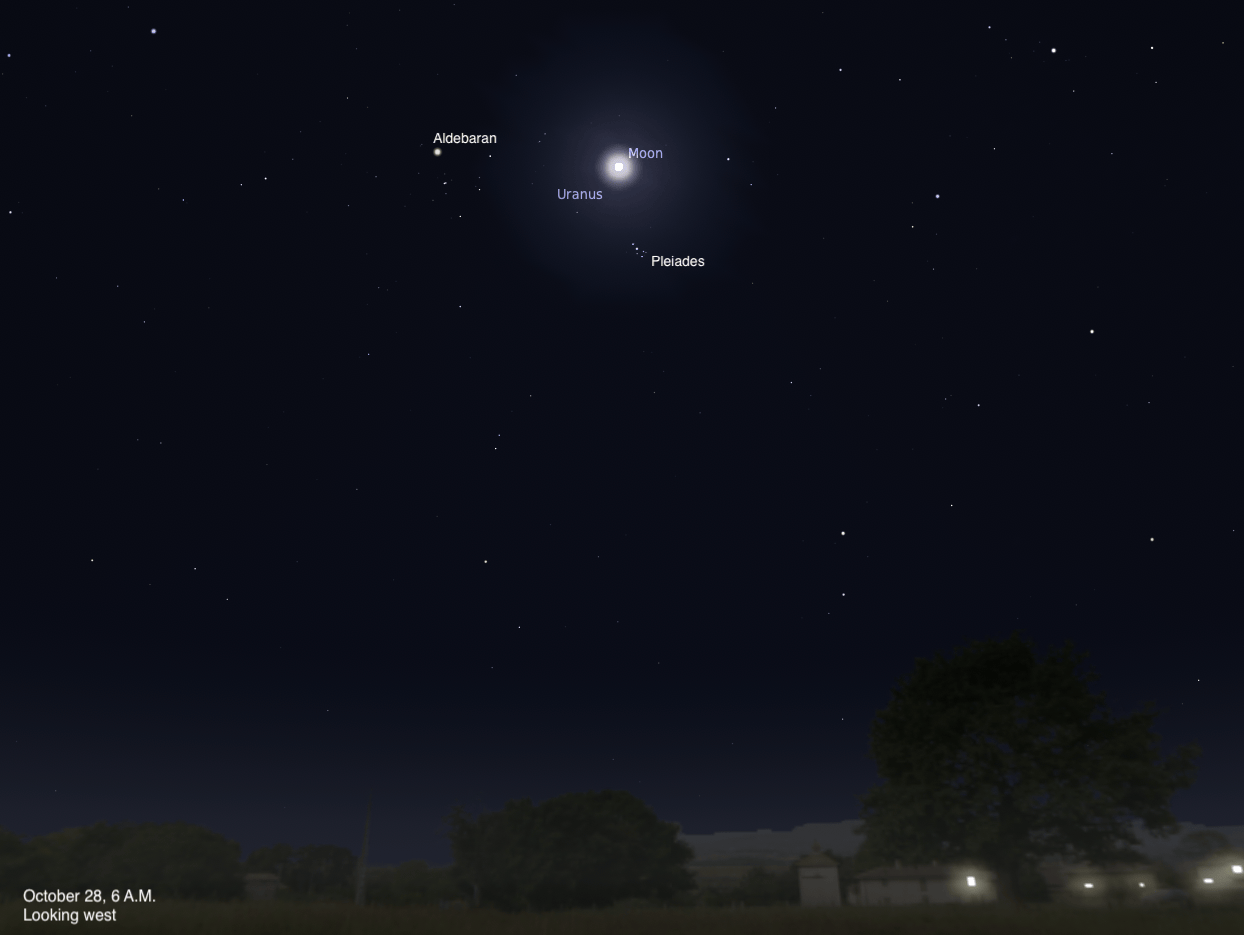
If you want to view Uranus, you’ll need some optical aid — technically its magnitude of 5.6 puts it within naked-eye range, but the bright Moon nearby will wash it out. You can find the ice giant 5° to the lower left of the Moon as they sink, or about halfway along a line drawn from the Pleiades toward the upper left and ending at the bright star Aldebaran.
Magnitude 0.9 Aldebaran (Alpha [α] Tauri) is typically envisioned as the eye of Taurus the Bull. The red giant is the 14th brightest star in the sky, shining with a luminosity more than 400 times that of the Sun from a distance of roughly 67 light-years. Despite its brightness, its surface temperature is quite cool, which results in the reddish color. Compare its orangey-red hue to that of Mars in the east.
Alison Klesman is senior editor of Astronomy magazine. She holds a Ph.D. in astronomy and has studied a variety of topics, from minor planets to supermassive black holes.