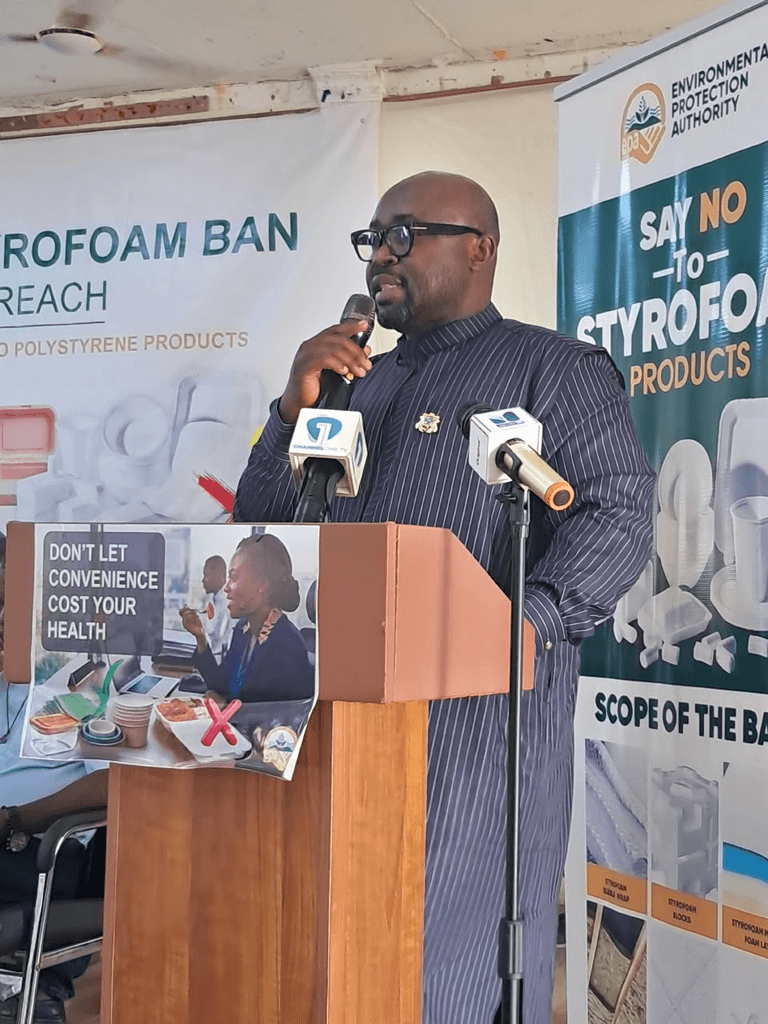
The Savannah Regional Minister, Salisu Be-Awuribe, has reaffirmed the region’s commitment to enforcing the nationwide ban on Styrofoam products from January 1, 2027, warning that the production, importation, distribution, sale and use of the products will no longer be permitted after the deadline.
He said the enforcement forms part of the government’s efforts to protect the environment, improve public health, reduce flooding and preserve the region’s tourism potential.
The Minister made these remarks during a Styrofoam Ban Outreach programme, where he called on residents, traders, food vendors, manufacturers and business operators to prepare for the implementation of the policy.
Mr Be-Awuribe said the Savannah Regional Coordinating Council, the seven Metropolitan, Municipal and District Assemblies (MMDAs), the Environmental Protection Agency (EPA), the Ghana Police Service and customs officers at checkpoints would be expected to ensure strict compliance.
He further warned that vehicles transporting prohibited Styrofoam products would not be allowed into the region after the January 2027 deadline.
The Minister expressed concern over the growing use and improper disposal of Styrofoam takeaway containers in communities across the region, including Damongo, Bole, Sawla, Buipe, Salaga and Daboya.

According to him, the products have become a major source of litter, with discarded takeaway containers choking gutters, obstructing drains and contributing to flooding.
He also warned that Styrofoam waste poses a threat to domestic animals and wildlife, particularly elephants at the Mole National Park, which could mistake the discarded materials for food.
He added that burning Styrofoam releases harmful smoke that can affect human health and pollute the environment.
The regional Minister also raised concerns about the potential health risks associated with placing hot foods in certain Styrofoam containers, stressing the need for safer food-packaging alternatives. The specific health risks, however, depend on the materials used and the conditions under which they are heated.
The Minister maintained that the region could not achieve its tourism ambitions while communities and roads remained littered with takeaway containers.
“Savannah Region cannot develop tourism with litter. No tourists will come to see Mole if the road from Fufulso to Damongo or from Bole to Mole is littered with takeaway containers,” he said.

Recognising the potential financial challenges the ban could pose to food vendors and traders, the Regional Minister said the EPA’s Savannah Regional Office had been directed to engage stakeholders across markets and communities to educate them on affordable alternatives.
He identified paper packaging, biodegradable containers, reusable bowls and traditional food-wrapping materials as possible substitutes for Styrofoam products.
He, however, encouraged young people in the region to take advantage of the policy by investing in the production and supply of environmentally friendly packaging materials.
He said government programmes, including those operated by the Ghana Enterprises Agency (GEA) and the Youth Employment Agency (YEA), could provide opportunities for young entrepreneurs interested in developing local alternatives.
Hon. Be-Awuribe further indicated that the government was working to reduce the cost of paper packaging by supporting local factories.
He urged traders and food vendors to cooperate with the authorities during the transition, emphasising that education and partnership would be prioritised over punishment.
As part of preparations for the enforcement deadline, the Minister announced a regional clean-up and public education campaign to run from October through December 2026.

The campaign will target chop bars, restaurants, hotels, guest houses, shops, plastic retailers, schools, lorry stations and other businesses and public spaces.
Mr Salisu Be-Awuribe revealed that EPA would engage affected groups in local languages to ensure that residents understand the reasons for the ban, the products affected and the alternatives available.
The Minister cautioned that offenders could face sanctions under the applicable environmental laws, referring to fines of up to GH¢50,000 or imprisonment of up to two years, as outlined in his address.
”The government’s primary objective was to secure voluntary compliance rather than impose penalties on individuals and businesses.
“I do not want any individual, groups, institutions, or businesses to be fined. I want TOTAL compliance through partnership and understanding,” the Minister reiterated
He recalled that President John Dramani Mahama publicly announced the policy on World Environment Day, June 5, 2025, and subsequently declared nationwide enforcement from January 2027 on May 25, 2026.
He described the ban as an important step towards improving environmental cleanliness and protecting communities from the consequences of improper waste disposal.
Mr Be-Awuribe also highlighted the Savannah Region’s importance as Ghana’s largest region by land area, its contribution to food production in northern Ghana and its tourism assets, particularly the Mole National Park.
He called on traditional authorities, local government officials, civil society organisations, the media, traders and the general public to support the initiative.
The Minister concluded by urging residents to take collective responsibility for maintaining a clean environment, declaring that a cleaner region would contribute to better health, stronger tourism and improved economic opportunities.
“Clean Savannah, healthy Savannah, rich Savannah,” he said, calling on residents to work together to keep the region clean.
The outreach programme forms part of efforts to intensify public education ahead of the January 1, 2027 enforcement deadline, as authorities seek to prepare businesses and residents for the transition away from Styrofoam products.