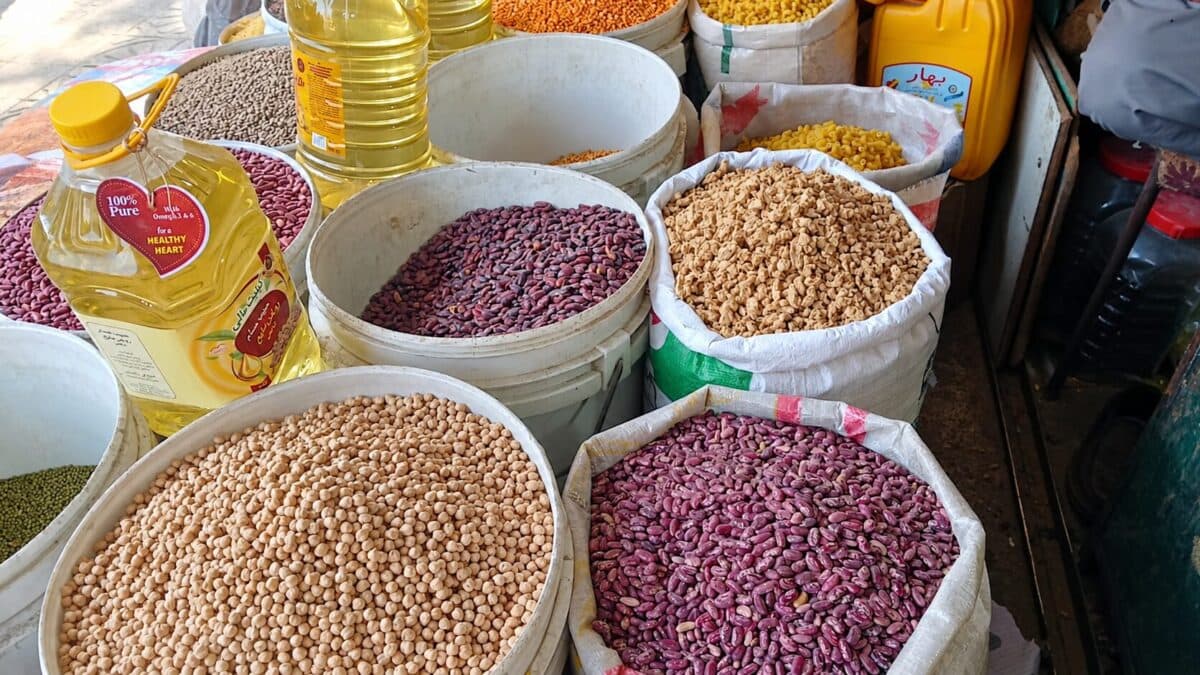
A shop in Parwan province, Archive,
A stronger afghani has helped ease pressure on imported commodity prices, but the cost of several staple foods, fuel and agricultural inputs remains well above year-ago levels, according to the World Food Program’s latest market report.
The afghani traded at an average of 64.9 to the U.S. dollar in the third week of October, making it 3% stronger than a year earlier and 7% stronger than its three-year average, the report said.
Despite the stronger currency, WFP data show that prices for several essential commodities remain elevated, while disruptions to regional trade routes and slower imports have put additional pressure on some goods.
Rice recorded some of the largest year-over-year increases. According to the report, Sholae rice averaged 72 afghanis per kilogram, 32% higher than a year ago and 21% above its three-year average.
Palawi rice averaged 122 afghanis per kilogram, up 18% from last year and 19% above the three-year average.
WFP said rice and cooking oil continued to face supply-side pressures because of disruptions to regional trade routes and slower imports.
Cooking oil averaged 122 afghanis per kilogram, 13% higher than a year ago and 18% above its three-year average, according to the report.
Wheat prices also remained higher than last year. Wheat grain averaged 28 afghanis per kilogram, up 12% year over year and 6% above the three-year average.
Lower-priced wheat flour was 11% more expensive than a year earlier, while higher-priced flour was up 7%, WFP data show.
The report also showed sharp differences among other food commodities. Potato prices were 22% higher than a year ago and sugar was up 9%.
Some foods, however, were cheaper. Tomato prices were 51% lower than a year earlier, pulses were down 12%, onions were 7% cheaper and bread prices were 3% lower, according to WFP.
Fuel costs remained elevated despite a slight decline from the previous week.
Diesel averaged 79.9 afghanis per liter, 2% higher than a year ago and 13% above its three-year average, the report said. Compared with the period before the August 2021 change in government, diesel prices were 119% higher.
WFP said elevated fuel and fertilizer prices continued to put pressure on agricultural production, transportation costs and household purchasing power.
Farmers also faced substantially higher prices for some agricultural inputs.
According to the report, urea fertilizer averaged 2,003 afghanis per 50 kilograms, 23% higher than a year earlier and 17% above the three-year average.
DAP fertilizer averaged 4,527 afghanis per 50 kilograms, 8% higher than both a year ago and the three-year average.
Prices for some other agricultural inputs declined. Improved seed was 9% cheaper than a year earlier and 12% below its three-year average, while animal feed was down 6% year over year and 11% compared with the three-year average. WFP attributed the declines partly to limited demand and increased local availability.
The report also showed that the cost of WFP’s in-kind food basket stood at 5,463 afghanis in the third week of October, 3.7% higher than a year earlier.
The cash food basket used to assess assistance transfer values cost 6,064 afghanis, 4.6% above WFP’s current transfer value of 5,800 afghanis, which was last revised in October 2025.
WFP said, however, that the increase had not met the required consecutive thresholds for adjusting the transfer value.
The report also pointed to continued pressure on workers’ incomes and employment opportunities.
An unskilled worker earned an average of 295 afghanis a day, 5% less than a year earlier and 6% below the three-year average, according to WFP.
Work for unskilled laborers was available for an average of two days a week, 12% lower than a year ago and 20% below the three-year average.
The report said the real purchasing power of unskilled workers was 25% lower than a year earlier and 30% below the three-year average.
Livestock-dependent households also experienced weaker purchasing power. According to WFP, a pastoralist could exchange a one-year-old female sheep for the equivalent of 257 kilograms of lower-priced wheat flour, 13% less than a year ago and 8% below the three-year average.
WFP says its weekly market monitoring tracks prices, wages, labor availability, exchange rates and other economic indicators across Afghanistan’s 34 provincial capitals.