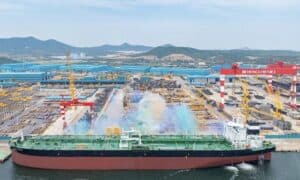

The VLCC sector is heading for its biggest delivery wave in half a century, with more than 100 new supertankers scheduled to enter service annually in both 2028 and 2029, according to Hartland Shipping Services.
The scale recalls the supertanker boom of the 1970s. BIMCO’s historical figures put the all-time record at 116 VLCCs delivered in 1974. Since then, even the 68 deliveries recorded in 2019 represented a four-decade high.
The historical precedent is worth noting. A wave of tankers ordered during the early 1970s boom arrived just as the 1973 oil shock devastated demand. Between 1974 and 1975, global oil trade plunged 23% while tanker capacity grew nearly 16%, according to UNCTAD. Freight rates collapsed. The reopening of the Suez Canal in 1975 further shortened voyages. By year-end, 573 tankers representing 47.8m dwt were laid up, according to INTERTANKO. Owners faced financial ruin, newbuildings went straight into lay-up and the industry endured a prolonged depression.
Hartland now counts 319 VLCCs on order, equivalent to 34% of the existing fleet, rising to 42% when sanctioned ships are excluded. Yet just 20 are scheduled for delivery over the next six months. Only six VLCCs delivered last year and just one in 2024. Of the current orderbook, 138 ships are not due until 2029 or later. BRS paints a similarly picture, allocating 283 of its 351 VLCC orders to 2028 onwards.
Whether this unprecedented modern influx destroys earnings or simply replaces an ageing fleet is debatable. Hartland notes that 47% of VLCCs are already at least 15 years old.
Investment bank Jefferies is among the optimists, arguing last week that “we see most newbuilds as replacements”. It expects tanker rates to ease more slowly than the market anticipates, potentially extending the cycle beyond 2029.
The difficulty with this argument is that owners are showing little appetite for scrapping. Banchero Costa records just four VLCC demolitions during the first nine months of 2026, despite 172 new orders over the same period.
Clarksons currently values a 15-year-old VLCC at $165m, considerably more than the $131.5m required to order a newbuilding. Extraordinary earnings and secondhand prices are keeping ageing tonnage trading.
Banchero Costa projects net VLCC fleet growth of 4% this year and 5.7% in 2027, compared with just 0.2% in 2025. Meanwhile, seaborne crude loadings fell 6% year-on-year during January-September.
Demand could become an equally serious problem. Braemar warns that today’s exceptionally expensive freight is already encouraging Asian refiners to favour shorter-haul Middle Eastern crude over Atlantic barrels, eroding tonne-mile demand. It also identifies a growing surplus of VLCCs in the Middle East as ship-to-ship activity slows.
For now, geopolitical disruption and limited vessel availability are sustaining extraordinary earnings. The danger is that today’s supply shortage is encouraging the ordering spree that could eventually bring the boom crashing down.
“This could be an upcoming supply disaster or merely some much needed fleet replacement,” Hartland stated in its latest weekly report.
Follow Us


Sam Chambers
Starting out with the Informa Group in 2000 in Hong Kong, Sam Chambers became editor of Maritime Asia magazine as well as East Asia Editor for the world’s oldest newspaper, Lloyd’s List. In 2005 he pursued a freelance career and wrote for a variety of titles including taking on the role of Asia Editor at Seatrade magazine and China correspondent for Supply Chain Asia. His work has also appeared in The Economist, The New York Times, The Sunday Times and The International Herald Tribune.
Newsletter
Read Next
October 23, 2026
Sierra Leone launches Chinese-backed national shipping company
October 23, 2026
Splash Wrap: Sanctions, spreadsheets and shipyards
October 22, 2026
Maersk Tankers lines up EU backing for four VLAC ammonia conversions
October 22, 2026