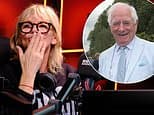
Zoe Ball's father Johnny has blasted the BBC for its ageism, claiming she lost her coveted job as a BBC Radio 2 host because she was 'over 50.'
The radio star, 55, stepped down from the channel last year, quitting the coveted Breakfast Show in 2024 and her Saturday afternoon show just months later.
The BBC has previously been accused of age discrimination by former stars, with a group of former news presenters even taking the corporation to a tribunal, before dropping their case.
Johnny, who is now 88, took a swipe at the BBC for being ageist and not wanting to keep its older – and more experienced – TV stars in favour of young ones to appeal to Gen Z.
Promoting his new book An Autobiography: Stories That Have To Be Told at The Dorchester Literary Festival, he told the audience: 'I did Play School for 17 years, I wrote nearly all of Play Away then I did Think Of A Number and Think Again.
'I loved every minute of it. But what happens when you are 50 at the BBC? Gone! Zoe was 54. Gone! You cannot believe it because we gave so much to the BBC.'
Zoe Ball's father Johnny has blasted the BBC for its ageism, claiming she lost her coveted job as a BBC Radio 2 host because she was 'over 50'
Johnny also weighed in on Strictly Come Dancing's new hosts Emma Willis, Johannes Radebe and Josh Widdicombe, after his daughter Zoe auditioned and missed out on the coveted job.
He said: 'Josh is not a Bruce Forsyth. He is a lovely bloke and I have met him a couple of times but he is not a domineering comedian as some comedians like Bruce Forsyth were.
'When I did Strictly, and I only did three shows, but on each show I gave Brucie a joke and he used them and he said to me ''I have got a writer here and he does b****r all so thanks very much''.
'And he said to me ''You should never have gone out'' but that's another story.'
Prior to quitting the Radio 2 Breakfast Show, Zoe had been one of the Corporation's highest-paid female stars, taking home £950,000 a year.
After an extended break following her mother's death, she returned to the show for just a few months before announcing her departure at the end of 2024.
She took over the Saturday afternoon slot but also quit that less than a year later in December 2025.
She also told how suffering from 'crippling anxiety' while coping with the grief of her mother's death and going through perimenopause left her struggling to get through the shows.
Johnny, who is now 88, took a swipe at the BBC for being ageist and not wanting to keep its older – and more experienced – TV stars in favour of young ones to appeal to Gen Z
BBC Radio 2 has also been accused of 'rank ageism' in the past, as in 2022 four of its stars were replaced by presenters who were on average 25 years younger.
Vanessa Feltz, Paul O'Grady, Craig Charles and Steve Wright – whose ages ranged from 58 to 68 at the time – announced their departures.
A BBC insider told The Daily Mail: 'It's so blatant what is going on here – these younger hosts are being tested out over the summer which is the perfect time to do so.
'But the age difference between them and the outgoing lot is massive.'
Former BBC radio presenter David Hamilton said of the decision to axe Steve Wright, who died in 2024, from his show: 'You can't be sexist, you can't be racist, but it seems you can be ageist.'
Strictly Come Dancing was also famously accused of ageism, when Arlene Phillips was axed from the judging panel in 2009, and replaced by Alesha Dixon.
The show has also faced claims of favouring younger professional dancers, with older pros, such as Karen Hauer and Nadiya Bychkova, axed from the show to make way for fresh faces.
Last year, four BBC broadcast news presenters, Martine Croxall, Karin Giannone, Kasia Madera and Annita McVeigh, dropped their tribunal over age and sex discrimination allegations on unknown terms.
Karin Giannone confirmed to The Daily Mail the case has been dropped, saying in a statement on behalf of the four: 'We can confirm that we have reached a resolution with BBC management that avoids the need for a tribunal hearing in respect of our employment-related claims.
'A protracted process lasting almost three years is now over. We've been deeply moved by the support we've received.
'We look forward to contributing further to the success of BBC News, especially to live programming and the growing streaming services that are so important to our audiences.'
The BBC is aiming to save £500million by 2028, with a statement from the corporation adding that the decision had been made 'due to the sustained financial pressures facing the organisation'.
Around 100 staff are also set to lose their jobs in the broadcaster’s newsroom, with a number of roles also expected to be cut as a result of the TV channel closures – including ten in Scotland.
Last week, it was also announced that BBC Three and BBC Scotland will become online-only services next Spring, with Radio 4 Extra also set to close.
Previous reports suggest the BBC planned to cut some 2,000 jobs on its quest to save £500million over the next three years.