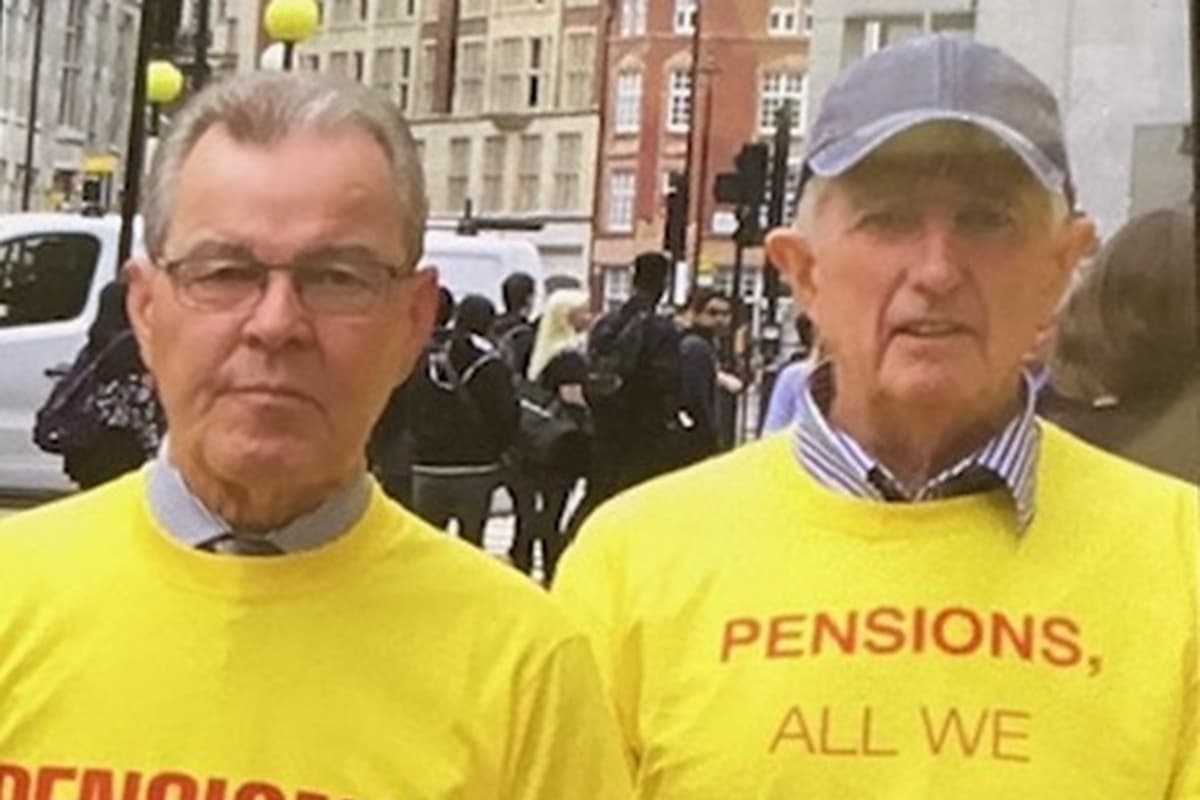
Eighteen ministers. Twenty-four years of campaigning.
John Benson and Phil Jones
It’s January 2025, and a 5am alarm is not the best start to a day when you are in your 70s and 80s and struggling with the effects of age and ill health.
But once again, we are making the long journey by car and train from our Cardiff homes to Whitehall to meet another pensions minister.
Torsten Bell is the eighteenth pensions minister we have met since ASW collapsed in July 2002. As we write this in 2026, our campaign has lasted 24 years—and we are still battling for “fairness and justice”, as new Prime Minister Andy Burnham would say.
This latest meeting was arranged by Cardiff MS Rhys ab Owen, who has been championing our plight as ASW workers who lost their full pensions following the collapse of the Cardiff Bay steel company on 10 July 2002. Rhys follows a long line of Welsh politicians who have campaigned for justice. His late father, Owen John Thomas, similarly campaigned for us in the early days of the Welsh Assembly.
The trudge from Paddington station down to Whitehall via the Tube is not easy during London’s morning rush hour, but we both know the journey very well. We have made the trip to Westminster countless times over the last two decades—all, incidentally, at our own cost. Struggling with weakening joints and breathing difficulties, we nonetheless continue to fight for our dwindling band of former colleagues and their loved ones. It’s not just politicians we continue to battle—increasingly, it’s our age.
We are lucky today, as there are no real travel disruptions. As for our impending meeting with the minister, we’ve been let down so many times that we keep any sense of optimism firmly locked away.
Our 10am meeting is supposed to take place at the magnificent Treasury building. The imposing centre of the most powerful department in government covers an entire city block and is recognised for its monumental English Baroque Revival architecture. It’s a huge contrast to the noise, dust and danger of our long-lost ASW steel plant in Cardiff Bay.
Some last-minute miscommunication leads us to believe the meeting is being held at Caxton House, the rather dated, bland and unassuming offices of the Department for Work and Pensions.
After attempting to check in, we are told that reception staff have no record of our meeting. Rhys ab Owen tries to confirm where we are supposed to be. Suddenly, a staff member from Torsten Bell’s office appears and tells us they are expecting us back at the Treasury. So much for the efficiency of central government.
We are quickly escorted back to our original destination. John is left busily trying to rearrange a photo with a BBC news team that had been alerted to the meeting.
By now, we have been joined by fellow pension campaigners Terry Monk and Richard Nicholl, who have travelled from the south-east of England and the Shropshire–Staffordshire border. Sadly, it hasn’t been a great start for Terry, who has managed to dink his car in the station car park.
Both have worked alongside us on behalf of fellow victims of the pension scandal in England. We are deeply appreciative of their work and support. More than two decades of campaigning builds more than a casual working relationship. In many ways, it’s a kind of brotherhood.
As we enter the Treasury, we stop for our team photograph. Due to our advancing ages and lack of resources, we have no social media presence or profile. It’s another depressing by-product of the length of our battle. Social justice campaigns are now fought on TikTok, Facebook and X. This is a world that has sadly passed us by. We grab any opportunity to get our plight into what many now call the legacy media.
Just as we set foot in the enormous Treasury building, Chancellor Rachel Reeves enters ahead of us, flanked by numerous aides. We don’t get a chance to speak to her, and she doesn’t stop to ask who we are. Ironically, it wouldn’t be too long before she would lose her job. It seems only social justice campaigners endure in today’s turbulent and fast-moving political times.
As she sweeps in, Phil remarks: “I think she can probably relax in the knowledge that her parliamentary pension is secure.”
By now, we are concerned that we have lost some twenty minutes of our scheduled meeting time. Ministerial meetings are run tightly, with little room to overrun. After passing through security, we finally sit down at 10.20am.
The meeting room is functional, anonymous and utterly sterile, much like any corporate or government meeting space. Its lack of personality feels starkly at odds with the deeply personal suffering experienced by those we represent. But perhaps that’s the point—it helps dilute any sense of compassion and allows the business of government to be conducted without emotion.
Polite introductions follow, and we are offered tea and coffee. It’s probably our advancing ages, but we are immediately struck by the youthful appearance and energy of Labour’s policy guru and rising star.
Joining Torsten Bell are two senior officials from the DWP. As is common in such proceedings, the minister refers to them when he is unsure about something we raise. After more than two decades of campaigning, it’s not unusual for campaigners and victims to have a greater command of the issues and facts than ministers, who have enormous portfolios and move from one meeting to another, while sometimes lasting just months in a role.
Much remains unspoken in such meetings, leaving us to wonder who truly makes the decisions when ministers and governments change but policy doesn’t. As in many struggles for social justice, the powerful UK Treasury is often seen as an immovable barrier to redress. Once again, it would play a decisive part in the outcome of our meeting.
During the discussion, it becomes clear that the minister is not familiar with some details of the Financial Assistance Scheme (FAS). He seems disturbed by one important shortcoming we highlight regarding an incorrect payment. At one point, he asks his officials whether the details are correct. They confirm our account.
Civil servants always take a back seat in such meetings, even when they clearly have a greater command of the facts and issues than the minister.
We then provide emotional testimony about our individual circumstances. Facing deteriorating health and struggling to support our devoted partners, we explain that our days are increasingly taken up with appointments with physicians and consultants.
Our appeals are deeply felt, but we always wonder whether this brutal reality registers with ministers and officials who have no personal investment in the issues they are addressing. They certainly don’t have to worry about their future pensions. We once read that the nearby Bank of England’s employee pension fund is one of the best-funded in the UK.
The cordial meeting takes a slight turn when we argue that our long-running crisis has parallels with the Post Office and infected blood scandals. This prompts a swift and direct response from the minister. Leaning forward, he says words to the effect that, as no one at ASW had died or gone to jail, it is not an appropriate analogy. It feels like a small but telling indication of where our appeals might end up.
Richard Nicholl explains to Mr Bell that he is the eighteenth pensions minister we have met. Somewhat surprisingly, he laughs. The minister jokingly asks whether our team believes he will not last long in the role.
Richard responds that we are simply fed up with ministers who make encouraging statements but then do nothing. Perhaps the minister’s response is a sign of nervousness or a hint of political or intellectual arrogance. We will never know. But there are times during the meeting when we feel somewhat patronised, given what we have been through and what we understand about political and government processes.
We know that the minister has had a privileged upbringing that places him at the centre of the Labour Party elite. Influential academic parents—his father taught at Swansea University—followed by Oxford, where he studied philosophy, politics and economics, and appearances as a Fabian Society speaker: the Labour equivalent of Eton, Oxford and the Guards.
Then there are his roles as a trustee of the Child Poverty Action Group and a fellow of the Academy of Social Sciences. His credentials as a leading policy thinker were cemented by seven years at the Resolution Foundation, focusing on poverty.
On paper, the meeting should be an open door to justice. But, as we have so often learnt, attaining power has a blunting effect on politicians and their willingness to challenge injustice.
Richard presents a set of detailed technical issues and concerns. He gives the minister a folder setting out our members’ circumstances and losses, the background to our campaign, evidence about the original FAS arrangements and the levels of pension indexation.
He concludes by explaining the devastating impact of the lack of inflation protection for pensions earned before 1997, which lies at the heart of our demands.
As ever, Richard demonstrates an impressive command of the facts and figures. Our case has been supported by elected politicians from across the political spectrum and through successive governments in Wales and England.
Richard sets out possible solutions and the benefits to the government of providing pre-1997 inflation protection, along with the need for swift action. Significantly, he points out that 3,232 FAS members died in 2024. He presses for action.
With some irony, we highlight a recent news item suggesting that even prisoners will receive a 6.6% “pay rise”, as announced by the then Prime Minister Keir Starmer. Yet we would receive a maximum increase of 2.5%, and only on the part of our pensions earned after 1997.
As is always the case in such meetings, Torsten Bell listens carefully and respectfully but gives nothing away. For someone regarded as a star policy expert and possible future Labour leader, he seems to know the basics of FAS and the Pension Protection Fund, but not some important details.
He says he will investigate the shortcomings and make a decision when he has all the facts. Significantly, but not surprisingly, he cannot guarantee anything. He says he understands the problems we have explained, will do his best to do whatever is possible and will let us know his decision.
It is all very familiar pensions minister speak.
We later reflect on a previous meeting with pensions minister Paul Maynard in February 2024. He never once had a smile on his face. He similarly took our questions seriously and answered them with respect and honesty.
Like Torsten Bell, he never promised us anything. But Mr Maynard did publicly agree that the reasons we were not receiving our full pensions included flawed legislation, a failure to ensure safeguards after the Daily Mirror pension scandal and Gordon Brown’s unfair tax on occupational pensions between 1997 and 2010.
Our disaster happened after Robert Maxwell’s infamous raid on the Daily Mirror workers’ pension fund in 1991. He siphoned some £450m from the fund to prop up his ailing business empire. Most people believed that subsequent pension reforms and legislative changes would prevent further scandals. How wrong we all were.
Our time is soon up. Sixty minutes, with another five minutes of grace, to explain more than two decades of injustice to a new minister is a hard and frustrating task. It is even more so when we know we are speaking to another politician who may not be in the role the next time we visit.
We thank the minister and his team for their time and leave the building. After saying our thanks and goodbyes to Rhys, who travelled separately to London, we retire to a local Westminster pub to review the meeting.
We share impressions and agree that it will be an uphill battle to get Torsten Bell to do anything substantial. He is clearly very bright and has lots of energy. Despite his propensity to laugh too much, which irritated us, he listened carefully and came across as personable. But we have met many previous ministers who displayed the same qualities.
We are accustomed to ministers expressing empathy for the injustice we, our former colleagues and their families face, only to take no action to address its root cause.
After more than two decades, we don’t want empathy, sympathy or understanding. We want action. As with so many injustices, including Grenfell, the Post Office scandal, infected blood and WASPI, what is lacking can be summed up in two words: political will.
We feel we have again presented our case factually and constructively. We have given deeply emotional accounts of the difficult circumstances many of our members face and highlighted the race against time to help ageing and frail widows and pensioners.
Having met so many ministers over the years, we conclude that Torsten Bell will simply be the latest addition to a long list of impotent ministers. Given his dual role as a Treasury minister and policy insider—and the message across government that no money is available—we expect him to follow the government line and take no decisive action to end the injustice.
Perhaps we might have been better off trying to doorstep Rachel Reeves as she walked into the Treasury.
We then face another long journey home via Paddington. We know we may have many more such journeys to make to reach our goal. We will keep going until our ageing bodies tell us otherwise.
Meeting postscript
Following our meeting and a further period of review, the minister announced a partial improvement to the pre-1997 inflation protection missing from our FAS awards.
However, the change applies only from January 2027 onwards. There is no provision for backdated payments, which would be substantial for many of our long-suffering members, including both of us. It means our battle must continue.
In September 2025, Terry and fellow campaigner Alan Marnes met the minister again during scrutiny of the Pensions Bill. They received the same ministerial courtesy and a promise of another meeting, which sadly never materialised.
The minister subsequently rallied his Labour colleagues to oppose retrospective increases when the Pensions Bill passed through the House of Lords, where a supportive amendment had been proposed.
In a letter sent in January 2026 to the then Welsh finance minister, Mark Drakeford, Torsten Bell acknowledged the limits of the government’s response to Welsh ASW pensioners: “I appreciate that this proposal may not go as far as some would like.”
In August, the new Secretary of State for Wales, Stephen Kinnock, wrote to Phil and acknowledged “that many former ASW workers remain disappointed that the changes do not go further”.
The post The day we met the pensions minister appeared first on Nation.Cymru.