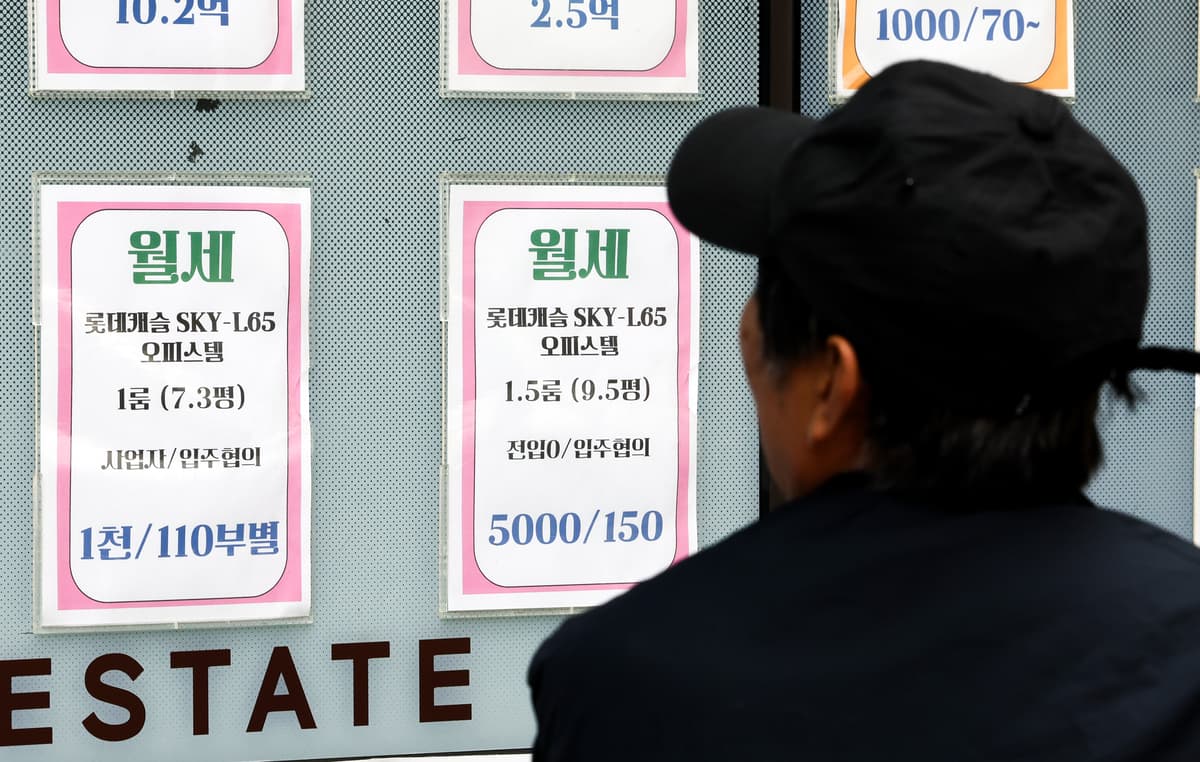
Monthly rents above 1 million won ($690) have become commonplace in Seoul's apartment rental market. More than seven of every 10 leases on 84-square-meter apartments, the size most commonly sought by Korean families, now exceed that level. As jeonse (a Korean lease system requiring a large lump-sum deposit instead of monthly rent) listings shrink, the burden of monthly rent is spreading beyond luxury buildings into ordinary family-sized homes.
Seoul recorded 180,867 apartment lease transactions between Jan. 1 and Oct. 22 this year, according to the Ministry of Land, Infrastructure and Transport's actual transaction price disclosure system on Oct. 26. Of those, 92,070 were monthly-rent contracts, accounting for 50.9% of the total and outnumbering the 88,797 jeonse contracts.
Among monthly-rent contracts, 38,090 carried rent of 1 million won or more, or 41.4% of all such leases. Another 16,098 contracts were set at 2 million won or more, and 7,322 at 3 million won or more. The share of high-rent contracts has held between 38% and 45% every month since January, suggesting high monthly rents have taken root across Seoul's rental market rather than reflecting a temporary swing.
The burden was especially pronounced in small and mid-sized apartments. Units of 85 square meters or less accounted for 31,275 of the leases at 1 million won or more, or 82.1% of the total. Among 84-square-meter apartments, 71.5% of monthly-rent contracts were at 1 million won or above, as were 53.9% of 59-square-meter units. For 84-square-meter apartments, 36.1% of contracts were set at 2 million won or more.
Rent alone does not capture the full cost for tenants. Among contracts with rent of 1 million won or more, the median deposit was 150 million won and the median monthly rent was 1.7 million won. That means many tenants are paying substantial monthly rent on top of a deposit running into the hundreds of millions of won.
Seocho at 67.4%: Half of New Tenants Pay Over 1 Million Won a Month
High rents were not confined to the affluent districts south of the Han River. Seocho District posted the highest share of leases at 1 million won or more, at 67.4%. Seongdong (63.9%), Gangnam (63.2%), Jung (60.5%), Yongsan (54.5%), Songpa (53.5%) and Jongno (50.9%) districts all exceeded half. The share approached half in Mapo (49.5%), Seongbuk (46.5%) and Seodaemun (46.1%) districts as well.
The three districts of Seocho, Gangnam and Songpa together accounted for just 32.9% of all high-rent contracts. That indicates apartments renting for 1 million won or more are no longer limited to a handful of expensive neighborhoods but are found across the city.
Tenants signing new leases faced steeper costs. Contracts of 1 million won or more made up 47.8% of new leases, 16.2 percentage points higher than the 31.6% share among renewals. Those entering the market now must shoulder relatively higher rents than tenants already in place.
Renewing a lease offered little relief. Of 11,670 renewal contracts at 1 million won or more, 9,969, or 85.4%, came with higher rent than before. The median increase was 140,000 won. In 1,597 cases, rent had been below 1 million won previously but rose above that level upon renewal.
Rent Tax Credit Falls Short; Government Says Supply Is the Answer
Critics say government housing-cost support cannot offset surging rents. The rent tax credit applies a 15% to 17% deduction on annual rent payments up to 10 million won, equivalent to roughly 830,000 won a month. Based on the 1.7 million won median rent among contracts of 1 million won or more, annual rent comes to 20.4 million won, leaving more than half of it above the deduction ceiling.
The government also views the shift from jeonse to monthly rent, and the resulting housing costs, as a structural change in the rental market. "The shift from jeonse to monthly rent is less a sudden development than a structural change in the rental market, driven by the rise in single-person households and the fallout from jeonse deposit fraud," Land Minister Hong Ji-sun wrote on social media on the 21st.
Hong outlined the rent tax credit, eased income thresholds for the youth monthly rent program and a public tender for a lease-deposit trust program, while stressing that "the fundamental answer is supply." The minister added: "The biggest driver of rising jeonse and monthly rent prices is the drop in new homes ready for occupancy caused by weak construction starts. About 100,000 public housing units in the greater Seoul area will be ready for occupancy by the end of next year."