SINGAPORE - Building a balanced relationship with China requires Germany and Europe to be united, innovative and competitive, said German Chancellor Friedrich Merz.
“Wise China policy begins at home,” he said on Oct 27 in a lecture in Singapore where he is on a two-day official visit, amid trade tensions between Europe and China that has threatened to escalate into an all-out trade war.
“We will be better equipped to build balanced relations with China if we ourselves are united, strong, resilient, innovative and competitive.
“We are working systematically towards that goal, both in Germany and at the European level,” he said, as he delivered the 49th Singapore Lecture organised by the ISEAS-Yusof Ishak Institute.
Europe-China talks earlier in October resulted in China agreeing to cap hybrid electric vehicle exports to the European Union over a four-year period. Brussels is alarmed at a ballooning trade deficit that reached €360 billion (S$515 billion) in 2025 - or about €1 billion a day.
China’s manufacturing might is causing frictions with European industries, in sectors from electric vehicles to chemicals, pharmaceuticals and industrial machinery.
Germany has advocated for stronger defensive trade tools against what it views as unfair trade practices by other countries. Merz visited Beijing in February to address issues such as Germany’s growing trade deficit and Chinese industrial overcapacity.
Speaking at the Singapore Marriott Tang Plaza Hotel in Orchard Road, Merz said that it is imperative to continue dialogue with great powers, “even where our interests and values only align in part”.
“This also applies to China. Our view of Beijing has become more nuanced. China’s pivotal role in world politics raises deep questions regarding trade, security and international order,” he said, adding that dealing with these challenges is a major long-term strategic task for Europe.
But decoupling “would be a big mistake”, he said, as doing so would make Germany neither safe nor more prosperous. “Instead, we are pursuing de-risking and diversification.”
How Germany intends to manage its growing strains with China was a key theme of Merz’s lecture, alongside the existential nature of the Russia-Ukraine war for Europe, and advancing cooperation in research, technology and people-to-people exchanges.
His 20-minute speech was titled Germany and the Indo-Pacific: Partnership, Competitiveness and Resilience in a Changing World.
‘New geopolitical era’
He described a “new geopolitical era” shaped by new dynamics among great powers, technological revolutions and by the erosion of an international order. This erosion is “at odds with our fundamental values and interests”, he added.
Nowhere was this more evident than in Ukraine, he said, as Russia – “a great power pursuing a militant, revisionist agenda” – invaded Ukraine, its neighbour, unprovoked.
He reiterated European calls for China to play a greater role in restraining Moscow.
“As a permanent member of the Security Council, China bears a particular responsibility for upholding international law. China’s voice carries weight in Moscow. We encourage China to use her power to help bring about a just peace in Ukraine, rather than enabling Moscow’s war of aggression.”
Merz said that Germany intends to play its part for order, peace and security in the Indo-Pacific, with the German government’s “continued adherence to its One-China policy” with regard to Taiwan.
“We know as well as our partners in the region: Any escalation or violent change to the status quo in the Indo-Pacific would have grave consequences for global security and prosperity.”
Merz is on five-day tour of Singapore, Japan and South Korea, which he described as “three of our most important partners in the region”. Germany is also forging closer ties with India, Indonesia and Vietnam, he added.
His lecture was chaired by Minister for Digital Development and Information Josephine Teo, who said that Germany is one of the most important trading partners with ASEAN within the EU, as well as the largest exporter of goods to the region.
With the international rules-based order and globalisation coming under great strain, Germany is a trusted and reliable partner for the region in cooperation to support international law, free trade and economic resilience, said Teo.
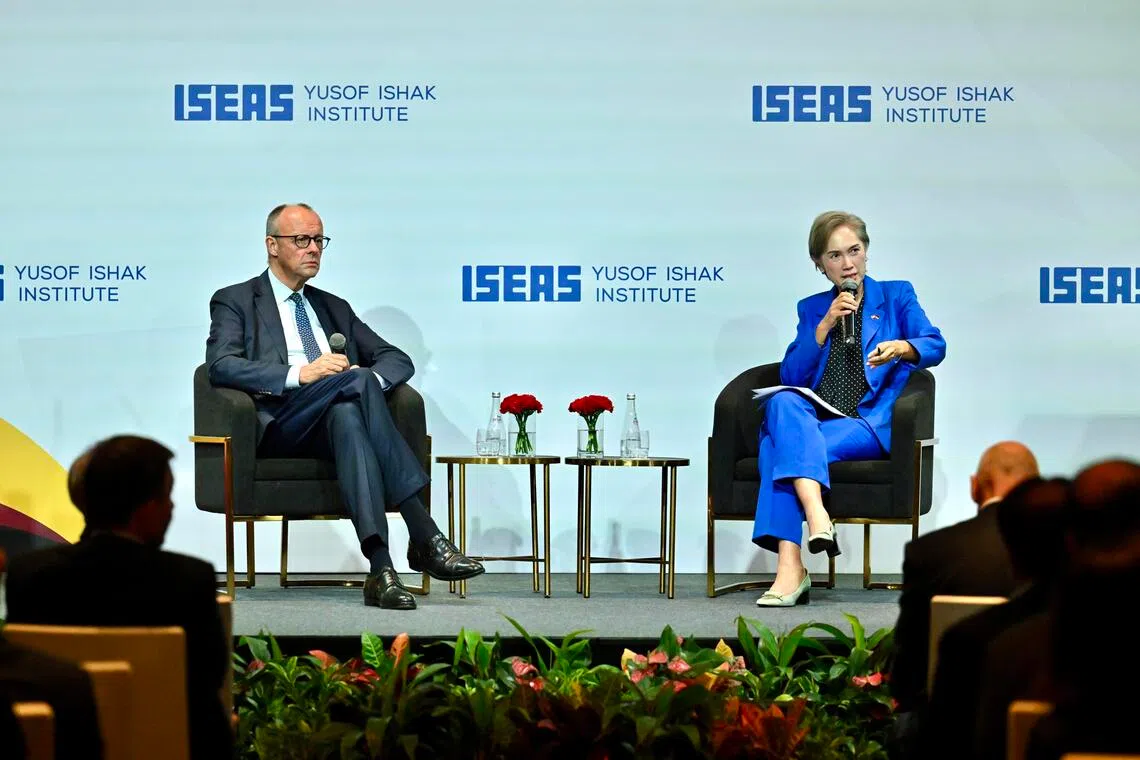
Minister for Digital Development and Information Josephine Teo said Germany is one of the most important trading partners with ASEAN within the EU, as well as the largest exporter of goods to the region.
ST PHOTO: DESMOND FOO
In a question-and-answer session following his speech, Jens Ruebbert, chairman of the EU-ASEAN Business Council, asked the German leader if the German government could do more to advance a bloc-to-bloc free trade agreement (FTA).
He cited the initial FTA deal between the Philippines and the EU reached in September, which could pave the way for an eventual ASEAN-EU FTA.
Merz said he was in favour of such an FTA, “provided we have enough in common to do it fast”.
“If not, I would like to see as a step in between to have preliminary FTAs with those who are in this area and willing to move forward. But the best way to move forward would be a bloc-to-bloc agreement.”
Ian Storey, a researcher at the ISEAS-Yusof Ishak Institute, asked about speculation that US President Donald Trump, Chinese President Xi Jinping and Russian President Vladimir Putin may meet at the APEC summit in November to discuss the Russia-Ukraine war.
What steps are Germany and its European partners taking to ensure that Europe plays a central role in this peace process, Storey asked.
Merz said Europe was trying to find ways which they can engage Russia, not just involving the so-called E3 grouping of the United Kingdom, France and Germany, but also others such as Poland, Italy and Norway.
While the US and Russia might negotiate, “they can never find solutions without Ukraine”, he added.
“This is absolutely not acceptable - that one day Russia, perhaps China and the United States of America, find a way to bring this war to an end without having Ukraine at the table.”
“I want to make no doubt that this is in our European interest to defend this country, because we’re not just defending the territorial integrity of this country, we’re defending the entire political order of the European continent, and that’s the reason why we’re still engaged.”