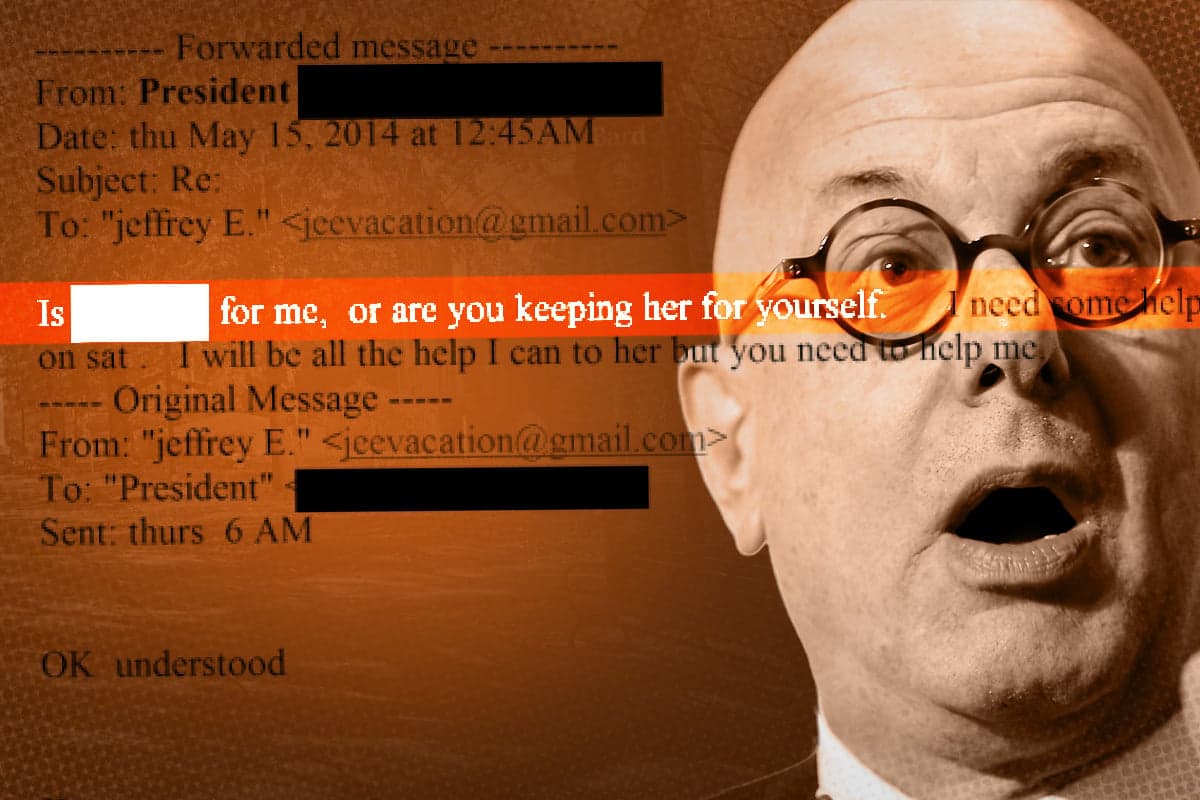

Investigators flagged several oddities within the email exchange. For one, it is nested in a forwarded message from Epstein to himself.
Inside Higher Ed | Jemal Countess/Getty Images | peterspiro/iStock/Getty Images
A forensic investigation into a consequential email exchange between former Bard College President Leon Botstein and the late sex offender Jeffrey Epstein concluded there is a “strong substantive basis for questioning the authenticity, integrity, and origin” of the correspondence.
“While it is not possible at this time to establish with certainty that the exchange was entirely fabricated, indicators are clear that it is highly suspicious,” FTI Cybersecurity, the consulting firm hired by the Bard Board of Trustees to investigate the email, wrote in its Oct. 19 report.
The email exchange in question—which FTI calls the “disputed emails”—was publicized earlier this month by U.S. Rep. Jamie Raskin, who has been investigating Botstein’s and others’ ties to Epstein since June. The May 2014 exchange—redacted versions of which are public in the Department of Justice’s Epstein Library—includes a question from Botstein to Epstein about a woman Epstein trafficked, called Jane Doe. Botstein purportedly asks Epstein, “Is [Jane Doe] for me, or are you keeping her for yourself.”
Most Popular
Botstein denied that he wrote the email, but announced on Oct. 7 that he had resigned from all of his remaining positions at Bard because he did “not want to see even false allegations about me put the institution I have served for more than half a century at any risk.” In an emailed statement about the FTI investigation, Botstein reiterated his denial. “As I previously said, I did not author or send that email,” he wrote. “I appreciate the effort to find the truth.”
In a statement, a Bard spokesperson said the college retained FTI to “determine the veracity” of the email exchange.
“Bard is a community that believes in transparency and the right to due process,” the statement read. “Our review of the other claims in Representative Raskin’s letter remains ongoing, and we are committed to establishing the facts. In the meantime, we will continue our work to provide a secure and respectful learning environment for everyone at Bard, a campus that embraces robust debate and diverse viewpoints.”
According to FTI’s report, investigators did not find the disputed emails on Bard’s own servers, including the college’s Google Vault records, “available historical correspondence” or logs from a 2017 server migration. “These reviews establish that, as of July 2017, the Disputed Emails did not exist on Bard’s servers,” investigators wrote.
Investigators also flagged several oddities within the email exchange. For one, it is nested in a forwarded message from Epstein to himself—the original email from Botstein to Epstein is not in DOJ’s Epstein Library.
“The quoted correspondence was not accompanied by the native transmission metadata or independently preserved source records necessary to establish the original sender, message chronology, or integrity of the quoted content,” the FTI report states. “Because quoted email text can be modified without altering the transport headers of the forwarding message, the existence of the forwarded record did not, by itself, authenticate the underlying exchange.”
The report also points to a strange dateline in the quoted email, which reads “Sent: thurs 6 AM.” The date formatting does not match that of other emails between the two men, which include weekdays, calendar dates, year and time stamps to the second, investigators wrote. “This difference raised questions about whether the disputed header was generated through the same email-reply process reflected in the authenticated correspondence or was subsequently shortened, modified, or reconstructed,” they continued. Further, the datelines appear to be out of order, with Botstein responding to Epstein more than five hours before Epstein’s original email was supposedly sent.
If the emails were altered or fabricated in some way, it’s unclear who would have changed them or why. Epstein had been accused of writing falsehoods about his acquaintances in emails before; in 2013, he sent a series of emails to himself that suggested Microsoft co-founder Bill Gates had an extramarital affair and sought illicit drugs. Those emails were never sent to Gates, and Gates denied the allegations.
Asked about the inconsistencies in the disputed email exchange between Botstein and Epstein, a spokesperson for Raskin said that the congressman’s investigation draws from more than just one exchange.
Editor's Picks
“As our letter makes clear, the email in question comes from DOJ’s file release under [the Epstein Files Transparency Act]. We have confirmed that the email in this document, despite DOJ’s coverup and redactions, was Botstein’s work email address,” the spokesperson said. “Moreover, we are not relying on this email alone but on a trove of other email exchanges between Botstein and Epstein, and Epstein and Jane Doe.”
In his Oct. 7 letter to the Board of Trustees, Raskin also said he’d received “deeply troubling whistleblower reports that Botstein used his position on Bard’s campus to influence Title IX proceedings and protect sexual predators on the Bard faculty.”
Since the letter was made public, Bard students and alumni have protested against sexual abuse on campus. One alumna alleged that Kyle Gann, a composer and music professor who has taught at Bard since 1997, assaulted her while she was a student in 1998. Gann has been placed on administrative leave while the college investigates the allegation.
“Ensuring a safe environment for every member of the Bard community is our top priority,” a college spokesperson said in a statement Monday. “Following the publication of certain information and evidence that the College did not previously have, the College determined that it would investigate this matter. An independent, external investigator is investigating the allegations made by an alum, and the relevant faculty member has been placed on administrative leave, consistent with Bard procedures. While we cannot comment on ongoing investigations, it is our steadfast commitment to the Bard community that allegations of misconduct will be investigated fairly and thoroughly.”