
Oct 26, 2026
|
Google’s partnership with Ignite Energy Access has enabled over an estimated 160 kT CO2e reductions in the first half of 2026.
Irwin Boutboul
Startups for Sustainable Development Lead
Yasha Wallin
Manager, Strategic Communications, Sustainability Advocacy
Learn more
Sign up for the latest sustainability news from Google.
SubscribeAcross sub-Saharan Africa, nearly half the continent’s population — over 600 million people — live without electricity. Families rely on costly kerosene and candles for basic lighting to study, do chores, or move safely around the home.
Off-grid solar power offers one of the cleanest and fastest ways to bridge this gap.
In order to reach millions of dispersed households with this technology, we must solve three critical challenges: locating unmapped homes without formal addresses, navigating difficult rural terrain to deliver solar hardware, and identifying installations remotely despite the limits of satellite imagery.
To help on-the-ground climate innovators solve data and logistical barriers beyond our own operational footprint, Google spent the past three years collaborating with Ignite Energy Access through our Startups for Sustainable Development program. An off-grid clean energy pioneer aiming to connect 100 million people throughout Africa to electricity by 2030 Ignite worked alongside Google researchers, engineers, and data specialists across more than 100 dedicated advisory sessions,to transform these logistical roadblocks into a repeatable blueprint for expanding energy access.
Solving last-mile logistics
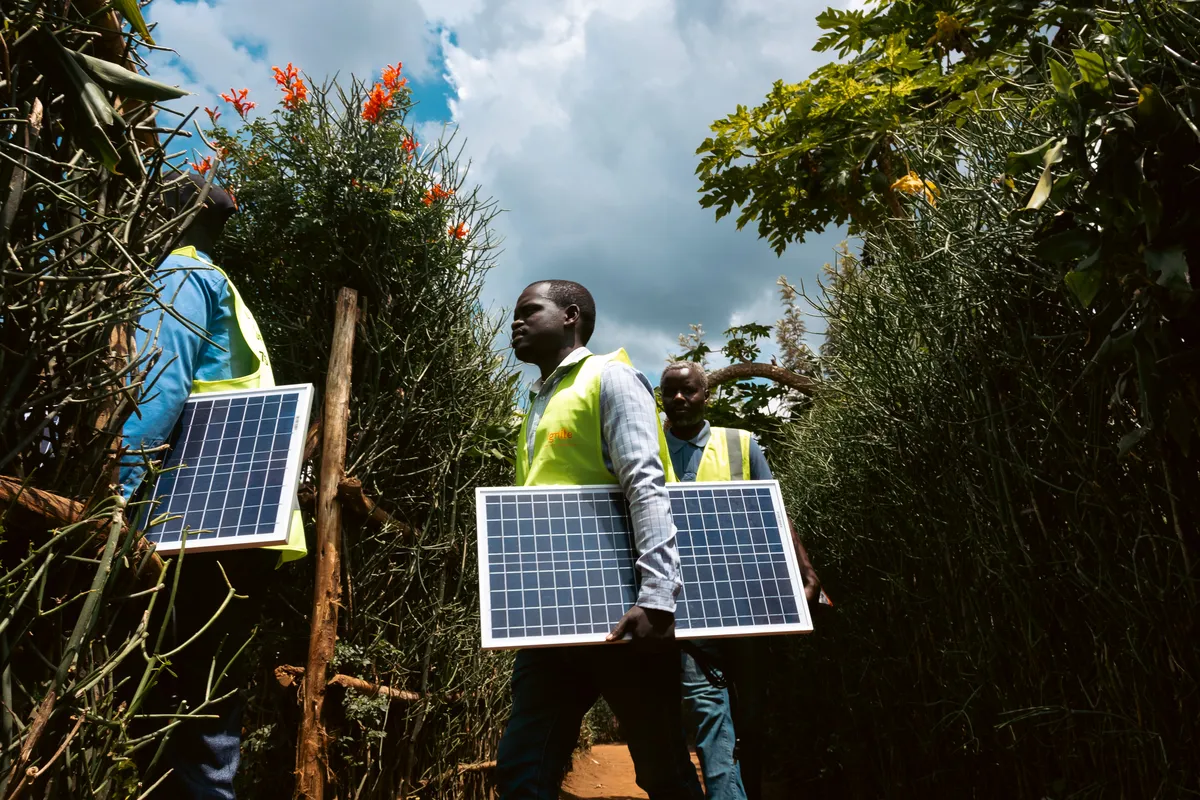
Most rural communities are only connected by unmapped dirt paths across rugged terrain. To expand access to off-grid solar, the first step is pinpointing households that need it, and these homes don’t appear in standard mapping apps. To locate these, our joint team combined satellite imagery and Google’s Open Buildings dataset with smart routing algorithms.
The field teams then need to reach these remote households. Google researchers are developing advanced geospatial models that identify rural paths and incorporate them into real-world routing constraints.
Google's Operations Research (OR) models are helping to optimize Ignite’s end-to-end supply chain. By evaluating potential network configurations, the system identifies where central warehouses and local mini-hubs should go while carefully balancing operational constraints such as transportation costs, delivery routes, vehicle capacities, and inventory holding expenses.
Scaling electrification from space
As electrification ramps up across Africa, operators need to know where micro-solar systems (usually consisting of a single rooftop panel) are already active. Mapping these installations allows teams to identify underserved villages, deploy resources strategically, and plan future rollouts.
However, standard satellite imagery only registers a single rooftop panel as barely one pixel, so visual targeting is nearly impossible at scale.
To solve this, Google researchers are developing computer vision models using Gemini for Science and fine-tuning them with ground-truth drone imagery provided by Ignite to map solar setups from orbit. The team is testing thousands of code variations to increase precision and recall rates, turning satellite data into a strategic compass for future clean-energy deployment.
Transforming local economies
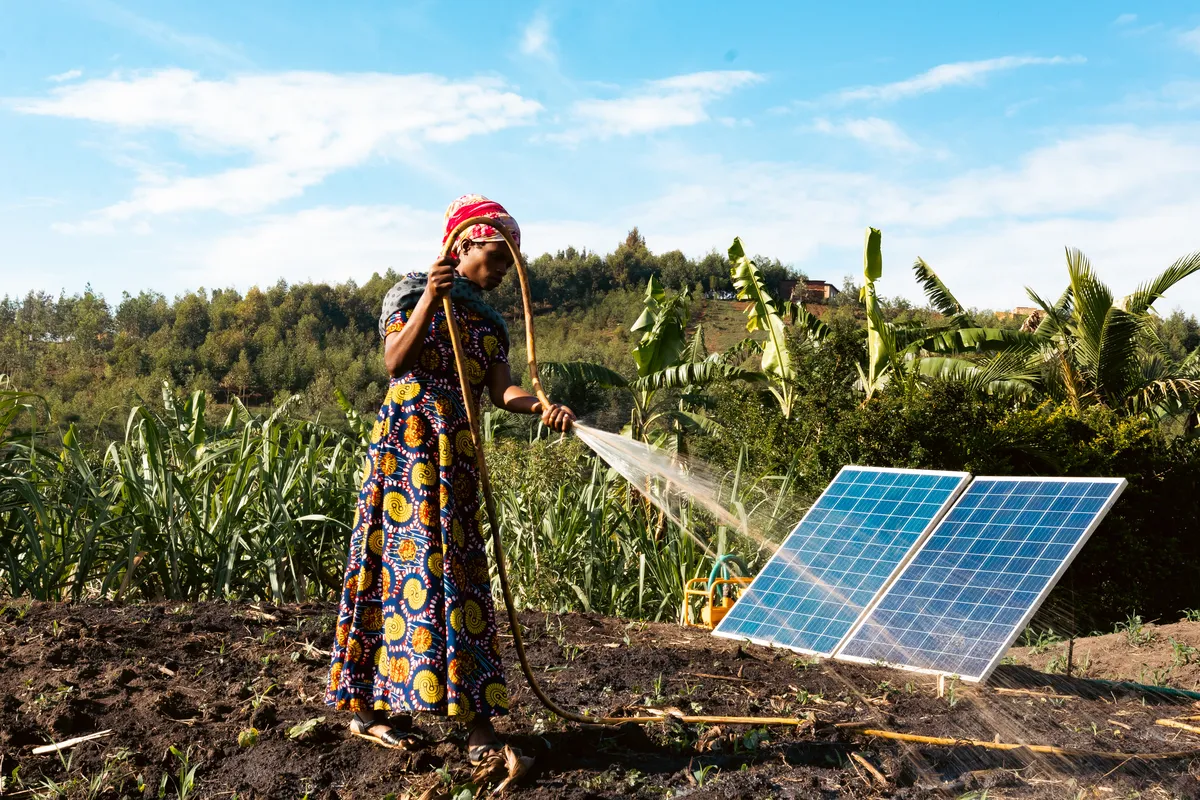
Together, what began as a set of isolated friction points — unmapped dirt paths and single-pixel satellite signatures — is evolving into a playbook for expanding energy access while cutting emissions in emerging markets worldwide.
The environmental impact is already measurable: In the first half of 2026 alone, we estimate our partnership with Ignite Energy Access has enabled over 160,000 tCO2e in emissions reductions, driven by 3.7 million solar devices delivered across the region since 2023. 1 These milestones bring us closer to Google’s aspiration to help partners collectively reduce one gigaton of carbon-equivalent emissions annually by 2030.
Laying the groundwork
Google and Ignite are already preparing for the next phase in the energy transition: clean cooking.
Millions of rural families still rely on wood and charcoal for meals, filling homes with harmful smoke and requiring hours of daily fuel collection, a burden disproportionately affecting women and girls. Modern electric cookstoves eliminate these indoor toxins, but they require far more power than what an individual rooftop solar kit can generate.
To address this challenge, our partnership is modeling community-level micro-grids capable of delivering the energy required to power clean electric cooking. The goal is a comprehensive energy system that not only lights rural homes, but also protects family health and drives down household emissions.
Are you a founder or developer building technology for climate action? Explore how you can collaborate with us through the Startups for Sustainable Development program or access open-source resources like the Open Buildings dataset.
Get the latest news from Google in your inbox
Sign up for our newsletters with product updates, event information, special offers, and more.
Your information will be used in accordance with Google's privacy policy. You may opt out at any time.
Learn more
Sign up for the latest sustainability news from Google.
Subscribe