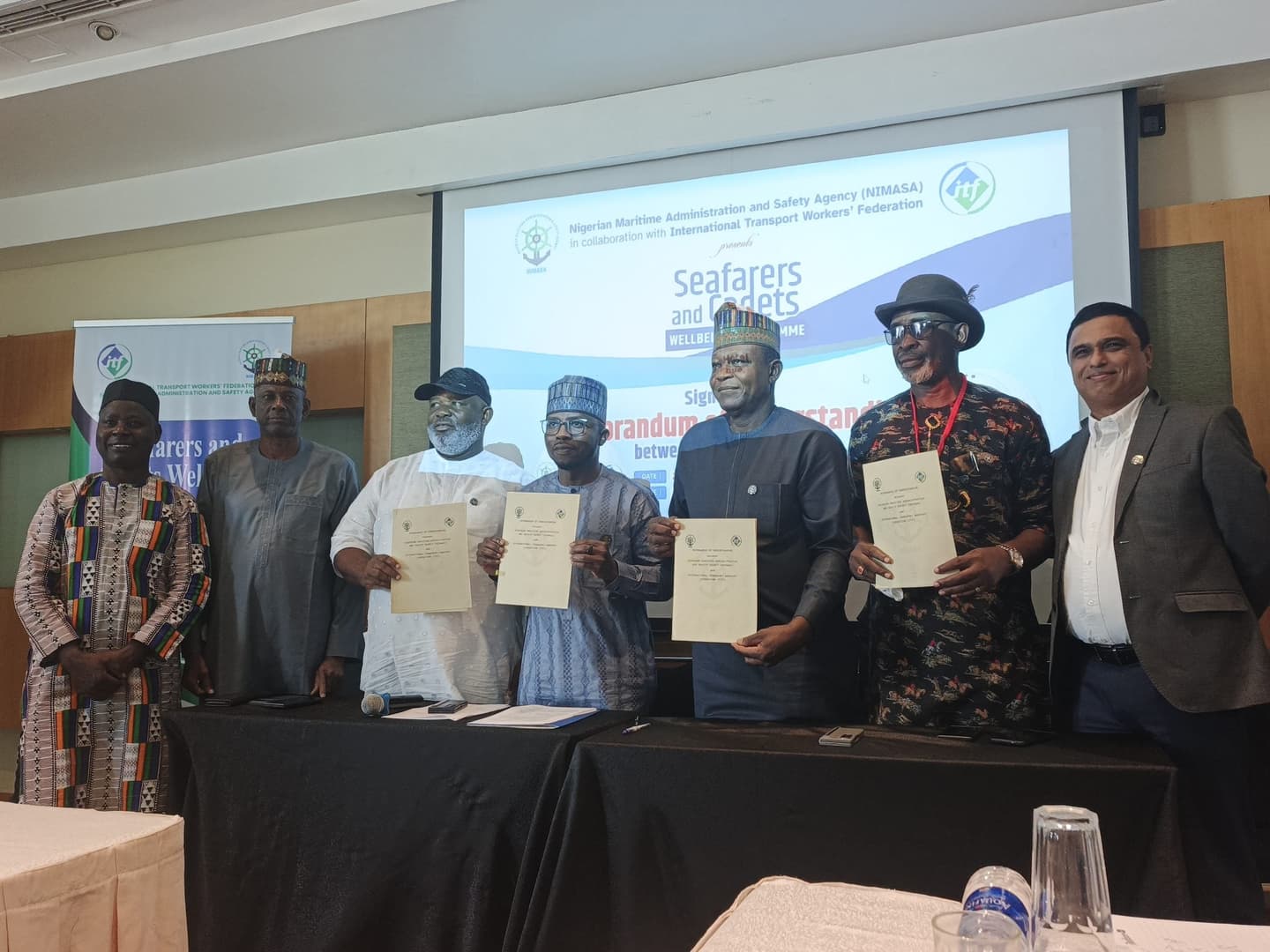
The Nigerian Maritime Administration and Safety Agency (NIMASA) and the International Transport Workers’ Federation (ITF) have signed the first-ever Memorandum of Understanding (MoU) in Africa on seafarers’ wellbeing and mental stress management.
Speaking in Lagos on Monday during the ceremony themed “Stress: Understanding, Early Management and Coping”, the Director-General of NIMASA, Dr. Dayo Mobereola, explained that for many years, maritime training in Nigeria focused primarily on the technical skills required to operate ships safely and efficiently, with little attention given to the people who crew them.
Represented by the agency’s Executive Director of Maritime Labour and Cabotage Services, Jibril Abba, Mobereola noted: “I am honoured and pleased to welcome you to the opening of this three-day Awareness and Training of Trainers Programme on ‘Stress: Understanding, Early Management and Coping,’ and to the signing of the Memorandum of Understanding between NIMASA and the International Transport Workers’ Federation.
“To our friends from the ITF who have travelled from across the world to be with us: you are most welcome to Nigeria, and to Lagos. We are grateful for your partnership and for the commitment over the past months.
“For many years, maritime training in Nigeria, as in many parts of the world, has focused on the technical skills required to operate ships safely and efficiently. Comparatively little attention has gone to the people who operate them: seafarers and cadets.
“Life at sea entails distinct pressures, including extended working hours, irregular sleep patterns, prolonged periods away from family, multicultural crews, and, at times, challenging working conditions. If left unaddressed, these pressures may develop into chronic stress, anxiety, depression, burnout, and substance misuse, and, in the most tragic cases, loss of life. A 2019 study commissioned by the ITF and conducted in collaboration with Yale University found that one in four seafarers surveyed exhibited signs of depression, while approximately one in six exhibited signs of anxiety. The COVID-19 crew-change crisis exacerbated these challenges.
“These are not merely distant statistics. They represent the young men and women enrolled in our cadet programmes, as well as the seafarers who carry Nigeria’s flag and engage in trade worldwide. Their well-being is fundamental to safe shipping. Under the Merchant Shipping Act 2007 and the Maritime Labour Convention 2006, as amended, the agency is responsible for protecting the occupational health, safety and welfare of maritime workers, both ashore and on board. The STCW Convention also requires seafarers to demonstrate competence in ‘Care for Persons Onboard,’ including the ability to recognise signs of distress and identify where to seek assistance.
“This programme responds to that call. Through the ITF Wellbeing curriculum, we are equipping faculty at our Maritime Education and Training Institutions (METIs), the agency’s officers, and our union partners to identify stress at an early stage, manage it effectively, and provide psychological first aid when necessary.
“Dear participants, the upcoming sessions will be interactive. I encourage you to participate fully, listen respectfully, and immerse yourselves in this training. I would also like to emphasise that this is a Training of Trainers programme. Accordingly, each participant is here not only to learn but also to teach. The knowledge gained over the next three days should be shared upon your return to your classrooms, offices, and vessels, and conveyed to every cadet and seafarer you serve.
“As part of NIMASA’s regulatory obligations, the ITF and NIMASA will sign a Memorandum of Understanding to formalise their partnership. The MoU will provide a framework for training and capacity-building for METI faculty and agency officers, and will facilitate the integration of the wellbeing module into the academic curricula of our Maritime Education and Training Institutions.
ALSO READ: Ondo deputy gov donates musical instruments to visually impaired
“Lagos represents the initial phase. With support from the ITF, we intend to extend the programme to Port Harcourt, enabling it to reach nearly all maritime training institutions across the country. Once our faculty have completed their training, the agency will issue the appropriate Marine Notice, making this module a permanent component of the preparation of Nigerian seafarers for life at sea.
“Distinguished ladies and gentlemen, a healthy seafarer is a safe seafarer, and a safe seafarer is the strength of our maritime industry. With that, I welcome you once again and wish you a rewarding and productive training session.”
Other dignitaries present at the ceremony included the ITF Africa Regional Secretary (Nairobi, Kenya), Safiyanu Daudu Mohammed; the President-General of the Maritime Workers Union of Nigeria (MWUN), Francis Bunu; and the President of the Nigerian Merchant Navy Officers and Water Transport Senior Staff Association, Engr. Bob Joseph Yousuo.
WATCH TOP VIDEOS FROM NIGERIAN TRIBUNE TV
- Relationship Hangout: Public vs Private Proposals – Which Truly Wins in Love?
- “No” Is a Complete Sentence: Why You Should Stop Feeling Guilty
- Relationship Hangout: Friendship Talk 2025 – How to Be a Good Friend & Big Questions on Friendship
- Police Overpower Armed Robbers in Ibadan After Fierce Struggle