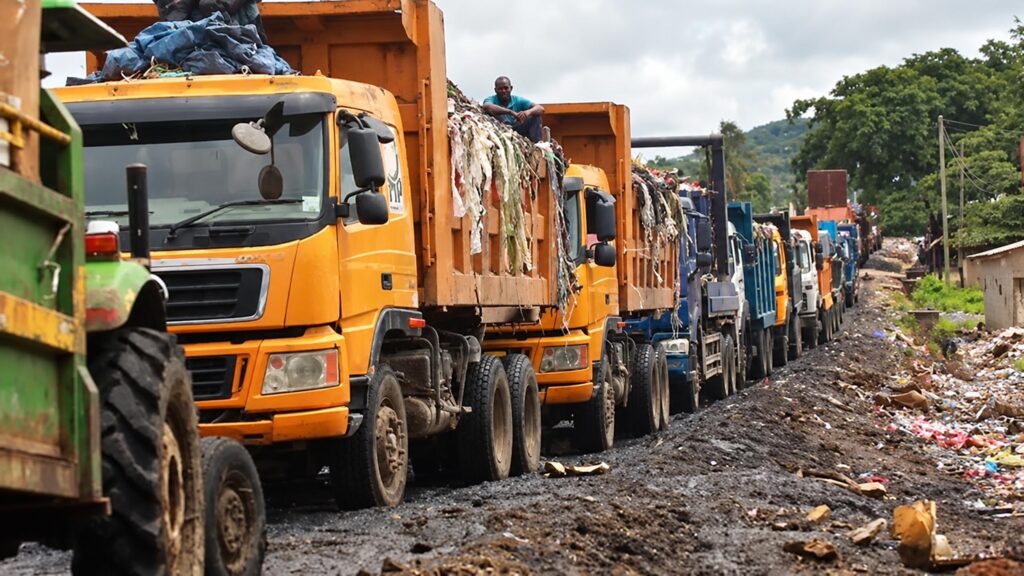
DAR ES SALAAM, Tanzania — The smell of burning garbage wafted into Ester Kayombo’s bedroom, jolting her awake with the fear that her house was on fire.
Nearby, heaps of rubbish were burning at the Pugu Kinyamwezi dumpsite, sending plumes of smoke billowing across the neighbourhood.
Kayombo, a mother of three, feared for her three-year-old daughter, Eliza, who has asthma. She wedged a wet cloth under the door and opened a rear window, hoping to clear the smoke. She clutched Eliza’s inhaler and listened anxiously as her daughter breathed.
“The smoke was so thick that my daughter struggled to breathe,” Kayombo said.
Kayombo, a street cook selling Ugali, rice, beans, meat and vegetables near the Pugu cattle market, is not considering leaving the house despite frequent fires, smoke and the strong smell from the dumpsite.
Like millions of poor city dwellers across Sub-Saharan Africa, she faces a difficult choice between environmental health hazards and economic survival.
“My landlord is very kind. If I’m late paying the rent, he understands,” she told Health Policy Watch. “I rely on this market for my livelihood. I have nowhere else to go.”
Governance failure
The Pugu Kinyamwezi fire burned for a week, engulfing the impoverished neighbourhood in smoke. Firefighters struggled for days to control the blaze. A senior firefighter, speaking on condition of anonymity, revealed the critical operational deficits facing emergency services.
“We don’t have enough water tankers, fire retardant foam, and protective gear for longer chemical fire exposure,” he told Health Policy Watch.
Over six million people live in the city, one of the fastest growing on the continent. Many people live in informal settlements, and there is a serious waste management crisis.
The city produces roughly 5,600 tonnes of waste daily, but less than 40% is formally collected, according to Dar es Salaam City Council Statistics. Across crammed neighbourhoods, trash – including food and plastic bottles – often litters the streets, clogging drains and increasing flood risk in the rainy season.
The Pugu Kinyamwezi dumpsite sprawls across 65 hectares and receives about 2,500 tonnes of mixed rubbish a day, which is beyond its capacity.
“We receive more rubbish than we can handle. Food waste and organic matter release methane, which often causes fires in the dry season,” said Philip Benno, head of the City Council’s Waste Management Directorate.
Benno said the government is seeking investors to modernise the dump, aiming to turn it into a sanitary landfill that is capable of generating energy from waste.
However, policy analysts say progress has been stalled by regulatory hurdles and delayed public-private partnership (PPP) frameworks.

Air quality data
Burning mixed municipal waste releases fine particles, heavy metals and toxic gases into the air, environmental health experts say.
A study by researchers from the Dar es Salaam Institute of Technology and Stockholm Environment Institute analysed measurements from 14 monitoring stations between May 2021 and February 2022.
Daily average concentrations reached up to 130.45 micrograms per cubic metre (µg/m³) for fine particles (PM2.5), and 184.15 µg/m³ for the coarser PM10.
The monitoring station at Pugu ‘Dampo’ recorded the highest pollution levels. The peak PM2.5 reading was almost nine times WHO’s 2021 guideline of 15 µg/m³ over 24
“While our study did not collect direct patient data, the measurements clearly showed concentrations several times above WHO safe limits,” said Jacqueline Senyagwa, an SEI researcher and co-author of the study.
Health impacts
Globally, air pollution causes 7.9 million premature deaths annually, with over 90% occurring in low- and middle-income countries, according to the World Health Organisation.
Aside from the human toll, the World Bank estimates that air pollution costs the global economy nearly 5% of global GDP, and targeted policies could lower the number of people exposed to dangerous levels by 2040, with economic benefits of up to $2.4 trillion.
At the local level, health facilities bear the direct brunt of pollution spikes.
“During landfill fires, we see a rise in paediatric outpatient visits for acute asthma attacks, bronchitis, and upper respiratory tract infections,” said Dr Daniela Tarimo, a physician at Kivule District Hospital.
“Children are disproportionately vulnerable because their lungs are still developing and they breathe more air per kilogram of body weight than adults.”
Local clinics report that stocks of basic bronchodilators and paediatric nebuliser kits often run dangerously low during extended fire episodes, leaving low-income families to purchase medications out-of-pocket at commercial pharmacies.
More than a third of respondents reported burning their rubbish in a survey of 217 households in Dar es Salaam’s Tandale, Manzese and Tandika wards, exposing a gap in waste disposal services with implications for public health.
The study, by Felician Andrew Kitole and colleagues, found that 61% of households had no access to waste collection services. As a result, 35.9% burnt their waste, and 41.9% used open dumpsites.
Respiratory infections were reported in 14% of households, which researchers linked to waste burning and poor air quality. Other illnesses included diarrhoeal diseases (39% of households), malaria (28%), typhoid (9%), skin infections (5%) and cholera (3%). Researcher linked these conditions with some of the consequences of poor waste management, including contaminated food and water, stagnant water that provides mosquito breeding sites, and contact with polluted materials.
The authors recommended more frequent rubbish collection, community-led waste programmes and subsidised bins and waste bags. However, the study captured conditions at a single point in time, and did not establish how many people across Dar es Salaam were affected by waste-burning pollution or prove that burning caused the reported infections.
Struggling with rubbish
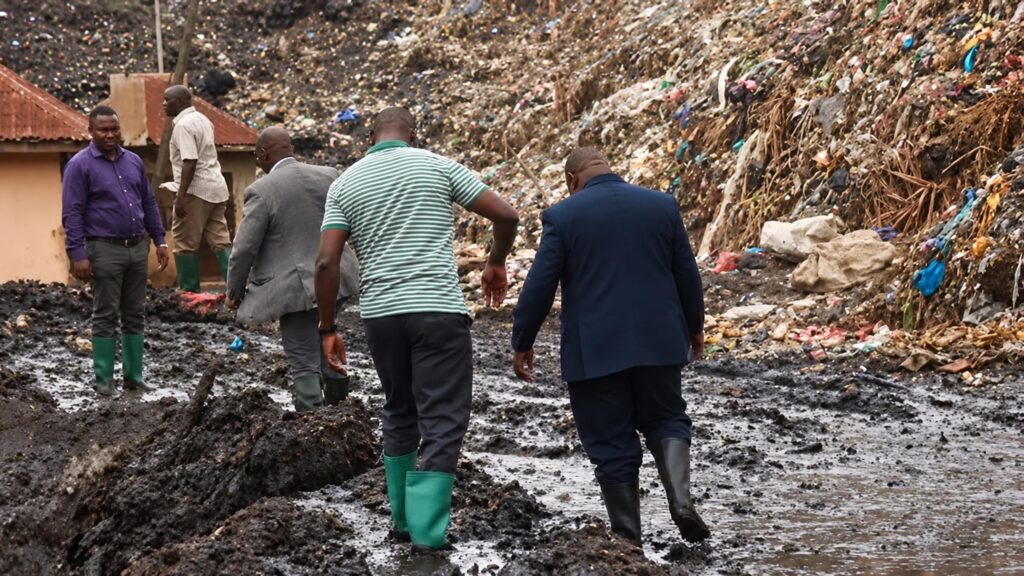
Environmental experts say dumpsite fires are caused by deliberate or accidental burning, flammable materials and heat generated by organic waste.
Zainabu Katima, who lectures in environmental sanitation at the University of Dar es Salaam’s College of Engineering and Technology, said household rubbish, discarded plastics and rubber can cause hard-to-control fires.
“When different types of waste are dumped together without being sorted, a small fire can spread quickly,” she told Health Policy Watch.
The WHO links air pollution to heart disease, stroke, chronic obstructive pulmonary disease and lung cancer. Fine particles can travel deep into the lungs and pass into the bloodstream.
“When plastics and other synthetic materials burn with household rubbish, they can release fine particles and harmful gases into the air,” said Regina Kilima, an environmental health researcher at the National Environmental Management Council
For children with asthma, such as Eliza, smoke exposure can worsen symptoms and trigger severe breathing difficulties.
Weak monitoring
Tanzania has environmental laws and air quality regulations, but limited monitoring and overlapping institutional responsibilities hamper pollution control, experts say.
Despite weak enforcement, poorly coordinated oversight, and a lack of pollution monitoring equipment, community groups in Dar es Salaam are devising their own mechanisms to tackle air pollution.
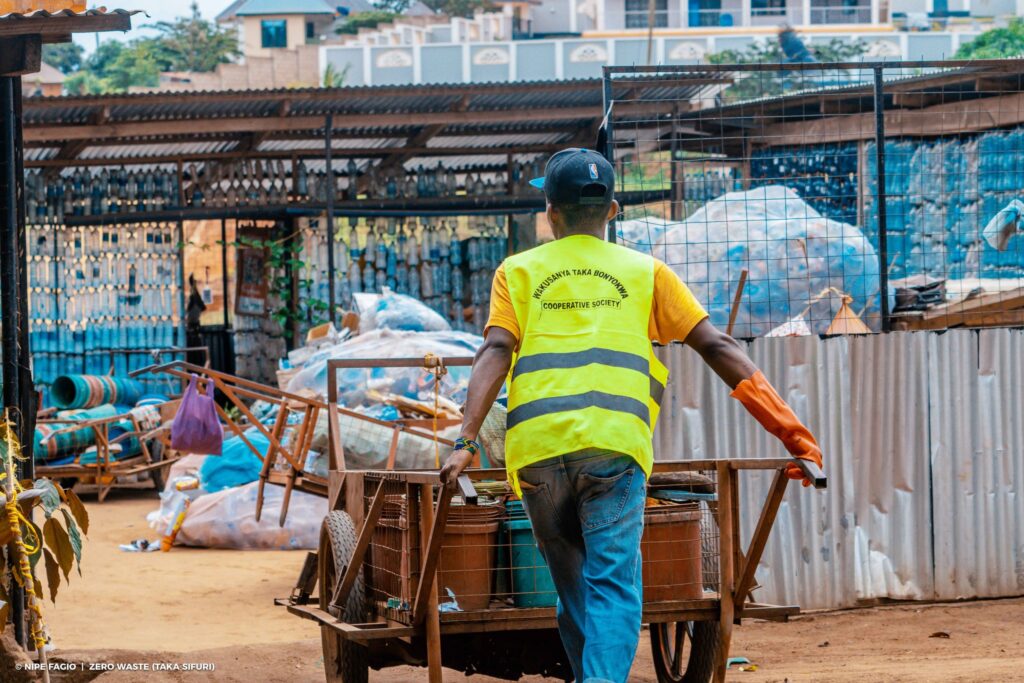
In the densely populated Kimara neighbourhood, the Tanzanian environmental organisation, Nipe Fagio (Swahili for “Give Me a Broom”), has organised women to collect household waste and separate organic matter, recyclables and hazardous materials. The work provides income and reduces the amount of waste sent to dumpsites.
It supports Zero Waste cooperatives, made up of waste pickers, women and youth, that generate income from collecting waste, recyclables, maggot farming, composting and urban farming.
“Community initiatives prove that sorting waste at home is possible, but we need municipal-scale investments to bridge the gap,” said Wilyhard Shishikaye, a coordinator with Nipe Fagio.
Making clean air a public health priority
Health policy experts are calling on Tanzania to expand air pollution monitoring in urban areas and make the readings publicly available. They also recommend upgrading open dumpsites such as Pugu Kinyamwezi into sanitary landfills with proper waste handling and methane collection systems.
This would require environmental regulators, local councils and health authorities to work more closely together. Experts say the National Environment Management Council and councils need the staff, equipment and funding to enforce restrictions on waste burning. Health centres also need clear procedures for treating patients with breathing difficulties during severe pollution episodes.
Residents living near garbage dumps need to receive timely warnings about fires and clear advice about how to reduce their exposure to smoke and access to medical care.
Their ability to protect themselves often depends on what they can afford. Some families may be move away, but many cannot afford to.
For Ester Kayombo and her daughter Eliza, structural reforms cannot come soon enough. As long as urban waste management remains underfunded, the burden of toxic smoke will continue to fall heaviest on those unable to escape it.
Image Credits: Zuberi Mussa, Nipe Fagio.
Combat the infodemic in health information and support health policy reporting from the global South. Our growing network of journalists in Africa, Asia, Geneva and New York connect the dots between regional realities and the big global debates, with evidence-based, open access news and analysis. To make a personal or organisational contribution click the donate button below.