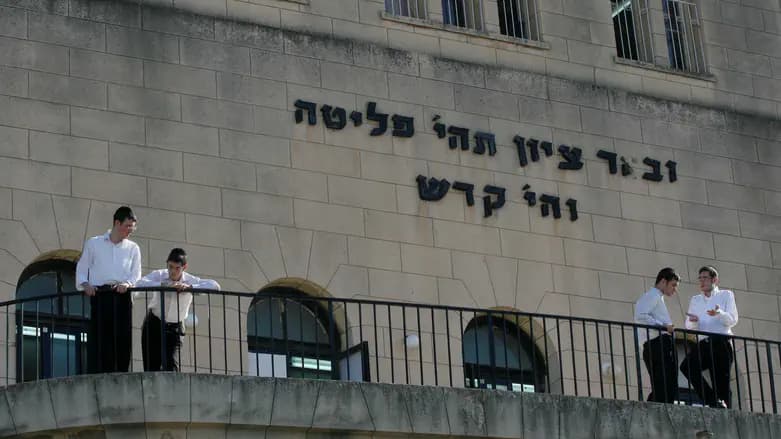
The Israeli Supreme Court heard an appeal on Monday regarding the ongoing legal dispute between two factions in the Ponevezh Yeshiva in Bnei Brak. During the hearing, the court rejected the demand that the camp led by Rabbi Shmuel Markovitz leave the yeshiva.
Supreme Court Justice Ofer Grosskopf rejected the demand by the Kahaneman family's representatives to order the opposing camp's immediate departure, stating that it is not possible to evict an educational and Torah institution of such scope in the middle of the school year.
Accordingly, the court ruled that the earliest possible eviction date would be postponed until the end of the current academic year, on the 10th of Av, 5787 (August 13, 2027).
During the hearing, the judge also addressed the NIS 10 million fine imposed on the faction led by Rabbi Markovitz as part of arbitration proceedings conducted before Judge David Cheshin.
Grosskopf expressed reservations about the size of the fine, noting that imposing such a sum on a public institution raises substantial concerns. He said it would be difficult to approve a fine that could effectively lead to the institution's financial collapse.
Meanwhile, the request to expand the appeal challenging the eviction order itself was referred for a separate hearing before Supreme Court Justice David Mintz.
The hearing is the latest in a long series of legal proceedings that have been ongoing for years between the rival factions at Ponevezh Yeshiva, concerning control of the yeshiva's institutions, the use of its properties, and the management of the campus.
A year ago, retired judge David Cheshin, acting as an arbitrator between the factions, ruled that the yeshiva would remain under the exclusive management of Rabbi Eliezer Kahaneman, whose faction is known as "The Haters," and that the faction of Rabbi Shmuel Markowitz, known as 'The Terrorists,' would vacate the yeshiva’s main buildings.
The ruling stated that the Markowitz faction has no property or institutional rights in the yeshiva, and that its longstanding physical presence in the buildings does not grant it any legal standing.
The arbitrator ordered the evacuation of the yeshiva’s main hall, the platform, the Ark, the dormitories, the public areas, the kitchen, and the library within a defined timeframe. He also stipulated that both sides must avoid provocations or confrontations during implementation.
The decision further states that the Markowitz faction has the right to establish a new, independent yeshiva-but only outside the historic Ponevezh campus and entirely separate from its name and brand. Any attempt to use the name “Ponevezh" or claim continuity was explicitly prohibited.
Cheshin also appointed a supervisory mechanism to oversee implementation of the ruling and instructed both sides to maintain mutual respect, refrain from defamation, and avoid incitement in the media. The decision concludes with an expression of hope that the parties will fully comply with the ruling and internalize the weight of their public and educational responsibility.