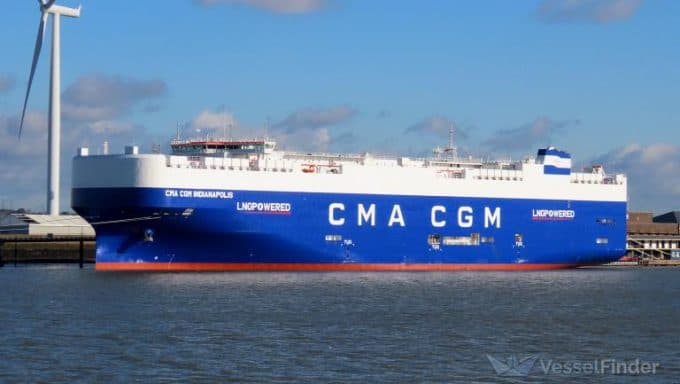
Ceva has deployed four car carriers, chartered by CMA CGM Photo: VesselFinder
The orderbook for pure car and truck carriers (PCTCs) has surged amid booming Chinese vehicle exports and elevated charter earnings, raising concerns that an expanding fleet could outpace demand as European restrictions on Chinese vehicle imports threaten to curb a key source of cargo growth.
Greek brokerage Intermodal said last week that 82 PCTCs were contracted in the first nine months of 2026, compared with just nine vessels ordered throughout 2025 and a 10-year annual average of 35 vessels.
The orderbook-to-fleet ratio has consequently risen to 26%, well above its historical average of 14%, pointing to a substantial expansion in carrying capacity over the coming years.
CMA CGM boss Rudolphe Saade said in a recent interview with Lebanon’s L’Orient-Le Jour that the French line targets to have 21 PCTCs in the coming years. Currently, its 3PL arm, CEVA Logistics, operates 11 PCTCs.
Fuelling the surge in newbuilding orders is the growth in Chinese vehicle exports, which totalled 8.2m units in the first nine months of 2026, up 66% year-on-year.
However, the immediate impact is likely to be limited, with 64% of the orderbook, measured by tonnage, scheduled for delivery from 2028 onwards. This backloaded delivery schedule should help defer much of the supply pressure.
China’s rapidly expanding automotive exports have kept charter rates elevated, with ships being fixed for $95,000 per day, near levels last seen in 2024.
Subdued domestic demand and intense price competition have encouraged Chinese manufacturers to seek overseas markets. Domestic NEV sales contracted by 9.4% year on year, reinforcing the industry’s reliance on exports to absorb production.
The resulting increase in long-haul shipments, particularly from China to Europe and Latin America, has boosted car-mile demand, while limited backhaul cargoes and diversions around the Cape of Good Hope have lengthened voyages and tied up vessel capacity.
Yet the demand outlook faces mounting risks from European trade policy.
In October 2026, the EU and China reportedly reached a preliminary understanding on proposed restrictions covering Chinese-built conventional and plug-in hybrid vehicles. Under the proposed four-year arrangement, which could take effect in December subject to formal implementation, annual imports would initially be capped at 350,000 units, with the quota increasing by 6% annually.
Battery-electric vehicles would remain subject to separate EU anti-subsidy duties.
Intermodal said: “Against projected Chinese hybrid imports of around 800,000 units in 2026, these measures could significantly constrain shipment growth along the China-Europe corridor. The impact on car-mile demand will largely depend on manufacturers’ ability to redirect exports to alternative markets.”
Meanwhile, Chinese automakers like BYD and SAIC Motor are expanding their own shipping fleets, potentially reducing their reliance on vessels chartered in the open market. This could further alter demand for third-party tonnage even if China’s overall vehicle exports continue growing.