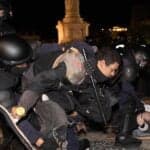
The president of Portugal’s Bar Association believes an inquiry must be carried out into the security forces’ actions at the protest camps in Lisbon and Porto on Sunday, as the “only way” to establish the truth.
Speaking to Lusa news agency, João Massano said that, although he did not have “sufficient knowledge of what actually happened, beyond what has been reported in the media”, he considers it “essential and necessary to ascertain what actually happened and whether limits were exceeded during the police intervention, and exactly what happened with regard to the protesters”.
In this context, he also pointed out that, “in a state governed by the rule of law, we cannot accept that lawyers are kept outside a police station” while “those in need of legal protection are kept inside”.
For the President of the Bar Association, “both the right to demonstrate and the right to ensure, and the obligation to ensure, public order are fundamental, and it is truly necessary to find out what happened”, which “can only be achieved through an inquiry”.
IGAI (the general inspectorate of Internal Administration) will carry out an inquiry, which the president hopes “will truly establish whether limits were exceeded, particularly with regard to police intervention.
“I think the police themselves have a stake in this and naturally have an interest (…) in ensuring that everything is investigated and properly clarified so that there are no doubts about what was done,” he said, adding that “sometimes there are situations that need to be contained and, in fact, there are sometimes instances of excessive force.
“We all need to remain very calm now” and “not get drawn into a narrative that politicises this situation”, he went on, suggesting this would be “the worst thing that could happen…
“I do not want to, nor should I be the one to defend the police; what I do think is that, at the moment, we are in a situation where we tend to see only one side of the story, and we know that there are situations where what appears to be the case is not quite the reality, and something may have happened that could have led to a particular situation”. We must be “very careful, because the right to protest is important, but we also need security forces to ensure that everything proceeds normally”, although, naturally, we “do not want those limits to be exceeded”.
Massano acknowledged that some of the footage broadcast “without context or any understanding of what might have led” to some police officers’ reaction “seems to suggest there was a lack of proportionality” in the security forces’ actions.
To better understand the facts, the Bar Association president advocated using body cameras by the security forces.
If they used them, “it would be easier”, and it would be the “effective” way to establish the facts in such situations, he maintained.
Partly because of what happened at the Rato police station, Massano also expressed concern about “detention conditions in police stations and access to legal representation” – an issue the Bar Association has long raised beyond the country’s current situation.
He acknowledged having received reports from detainees at the protest camps who were allegedly told by security forces that it was not necessary for them to be accompanied by lawyers while being taken to police stations.
“There were some situations reported to me which I will naturally have to ask the relevant authorities to investigate, and which in fact further convince me of the need for close legal representation at police stations and for the defence of lawyers’ rights to accompany their clients and detainees,” he emphasised, adding that this was “yet another reason» to establish the truth of the matter.
“I am not saying that it happened or that it did not happen, but it is important to know whether it did happen and whether anything took place at the Rua da Palma police station that could have been handled better than it was.
“If there is one thing that we, in a state governed by the rule of law, naturally cannot accept, it is that lawyers are left outside a police station while their clients, or at least those who need legal protection, are kept inside,” he concluded.
Source: LUSA