Business Korea · অর্থনীতি
[Opening Market] KOSPI Opens Lower Below 5,500 Amid Investor Tug-of-War
২৬/১০/২০২৬
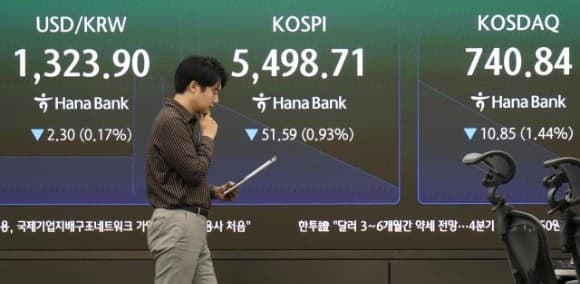
On the morning of Oct.26, the won-dollar exchange rate, KOSPI and KOSDAQ indices are displayed on the electronic board at the dealing room of Hana Bank headquarters in Jung-gu, Seoul. (Yonhap)
On the morning of Oct. 26, the domestic stock market opened mixed as the volatility of the global stock market from the previous week and caution over major companies’ earnings announcements intertwined. At the beginning of the week, the KOSPI index repeatedly showed slight fluctuations, displaying a weak flat trend or limited movements, while the KOSDAQ market relatively increased its decline, showing an aspect of undergoing a correction.
The KOSPI index, which started at 5499.05, down 51.25 points (0.92%) from the previous close, is trading at 5490.60, down 59.70 points (1.08%) from the previous trading day as of 9:50 a.m.
While the recent steep streak of breaking yearly lows has entered a breathing room phase, market participants are keeping a close watch on the third-quarter earnings announcements of major listed companies that begin in earnest this week and the direction of foreign investor supply and demand. In particular, the stock price direction of the top two domestic semiconductor companies (Samsung Electronics and SK Hynix), whose large-scale share buyback schedules have concluded, appears to be acting as a key variable determining the upward movement of the entire index.
At the same time, the KOSDAQ index started at 742.17, down 9.52 points (1.27%), and continues a weak trend in the early 740 range.
Tense Tug-of-War Unfolds among Foreign, Institutional, and Retail Investors
As of 10:00 a.m. in the KOSPI market, a tense tug-of-war is unfolding among foreign, institutional, and retail investors. Foreign investors are leading the index decline by selling off 137 billion won (about $103.51 million). Retail and institutional investors are absorbing the volume, net buying 38.8 billion won and 84.2 billion won, respectively.
Foreign investors have shown a selling dominance in the KOSPI market from the beginning of the session, capping the upper end of the index. They are taking a wait-and-see approach or releasing some volume in both the index futures and spot markets, maintaining a cautious stance on the influx of active buying despite the recent stable downward trend of the exchange rate.
Institutional investors are participating in some low-end buying to defend against further index correction, but they are simultaneously defending the index and realizing profits while showing a distinctly differentiated market by sector and stock.
Retail investors are stepping up as the main players defending volatility by bringing in low-end buying (the so-called extension of the Donghak Ant Movement) to defend the index in both the KOSPI and KOSDAQ markets, but an atmosphere of caution due to the expansion of short-term volatility also coexists.
In the KOSDAQ market, it was tallied that foreign and institutional investors showed a combined selling dominance, pushing the index down with a downward pressure of around 1%. At the same time, foreign and institutional investors are burdening the index by net selling 64.1 billion won and 17.3 billion won, respectively. Retail investors are alone buying 81.3 billion won.
Mixed Stock Price Trends of Samsung Electronics and SK hynix Cause Confusion in KOSPI’s Direction
The top domestic market capitalization stocks are showing mixed stock price trends in early trading, causing confusion in the direction of the index.
Samsung Electronics is recording a sideways trend, engaging in a flat or slightly weak tug-of-war compared to the previous day. In the absence of clear supply and demand momentum following the completion of its large-scale share buyback, some foreign selling is emerging amid concerns over the peak-out of the memory semiconductor industry conditions and the process of adjusting earnings expectations.
On the other hand, SK hynix is showing a decoupling phenomenon from Samsung Electronics, with low-end buying flowing in or attempting a slight upward transition during some periods of the morning session. Expectations for its competitiveness in High Bandwidth Memory (HBM) for artificial intelligence (AI) are acting as a driving force supporting the downside, but its momentum is limited due to the lack of momentum in the overall index.
As of 10:00 a.m., Samsung Electronics is showing a downward trend (-0.70%), while SK hynix is rising (0.63%). Samsung Electronics Preference Shares (-1.37%) are also showing a downward trend.
Among the top KOSPI stocks at the same time, automobile (Hyundai Motor, Kia) and secondary battery (LG Energy Solution, etc.) related stocks are generally fluctuating in a weak flat range in the aftermath of concerns over a global demand slowdown and exchange rate volatility, failing to support the upward momentum of the index.
Hyundai Motor (-1.69%), Kia (-0.84%), LG Energy Solution (-1.44%), Hanwha Aerospace (-3.41%), HD Hyundai Heavy Industries (-1.97%), Doosan Enerbility (-1.85%), KB Financial Group (-1.31%), Shinhan Financial Group (-1.14%), Celltrion (-1.03%), SK Square (-0.77%), and SK (-0.64%) are falling in unison. In contrast, Samsung Life Insurance (1.43%), Samsung Biologics (1.23%), and SK Hynix (0.63%) are rising.
The KOSDAQ market is showing a deeper weekly decline than the KOSPI, and the perceived economic sentiment is somewhat frozen.
The bio sector (Alteogen, EcoPro BM, HLB, etc.), which includes top KOSDAQ market capitalization stocks, is mostly recording a downward trend due to individual corporate issues and a supply and demand vacuum. Secondary battery materials-related stocks are also showing a decline rate in the 1% to 3% range compared to the previous day due to the aftermath of a general supply and demand exodus, contributing to dragging the KOSDAQ index down to near the 750 mark. On the other hand, an extreme stock-specific market is unfolding where only some stocks with expectations for individual earnings improvement and thematic stocks are showing selective strength.
Specifically, PSK Holdings (-5.37%), Jusung Engineering (-5.00%), and PSK (-4.00%) are falling by more than 4%, while the declines of HLB (-3.00%), Wonik IPS (-2.82%), Simmtech (-2.73%), EO Technics (-2.72%), EcoPro BM (-2.59%), HPSP (-2.52%), and EcoPro (-2.48%) are standing out. On the other hand, Robotis (11.33%) and Rainbow Robotics (2.13%) are on the rise.
Won/Dollar Exchange Rate Starts with a Slight Rebound (Weak Won) Compared to the Previous Trading Day
In the Seoul foreign exchange market, the won-dollar exchange rate temporarily halted its recent streak of breaking yearly lows and started with a slight rebound (weak won). The won-dollar exchange rate traded at 1,323.5 won as of 9:00 a.m. on this day.
Although concerns over the profitability of export companies had been raised as the exchange rate fell significantly (strong won) over the past three months, on this day, the exchange rate is showing a movement to find stability near the mid-1,320 won range due to a slight rebound in the global dollar and the influx of low-end buying.
Experts analyze that while the calming of the rapid downward trend in the exchange rate may provide breathing room for export-oriented large-cap stocks, it will have a neutral impact on the strength of additional foreign fund inflows.
Securities industry experts diagnose that the domestic stock market has entered a process of confirming a short-term bottom this week, yet they point out that it lacks a leading entity (large-scale momentum) sufficient to drive an active index rebound.
An official from the financial investment industry suggested, “The low-end buying capacity of domestic institutional and retail investors seeking to defend against intraday declines is being confirmed, but in order for the fundamental supply and demand direction of foreign investors to turn to net buying, the third-quarter earnings report cards of major domestic companies continuing this week will need to meet market expectations.
Therefore, it is advised that investors need to maintain a conservative portfolio centered on risk management by taking a selective approach focusing on stocks with high earnings visibility rather than making unreasonable chase purchases.
মূল প্রতিবেদনে যান ↗