
Finding the constellation Lacerta the Lizard
Lacerta the Lizard is a small, faint constellation in the northern sky. It’s best seen on autumn evenings, when it climbs high above the horizon. But this unassuming patch of sky holds something extraordinary: BL Lacertae, a blazar powered by a supermassive black hole in a distant galaxy. One of its powerful jets jets points nearly toward us, making it appear unusually bright, giving astronomers a powerful way to study the black hole’s activity.
BL Lacertae looks like a faint, variable star, but it’s actually the bright center of an active galaxy. Its brightness changes over time, and astronomers have named an entire class of objects after it: BL Lacertae objects.
Lacerta isn’t an ancient constellation. Astronomer Johannes Hevelius created it in the late 1600s. Its name means lizard in Latin.
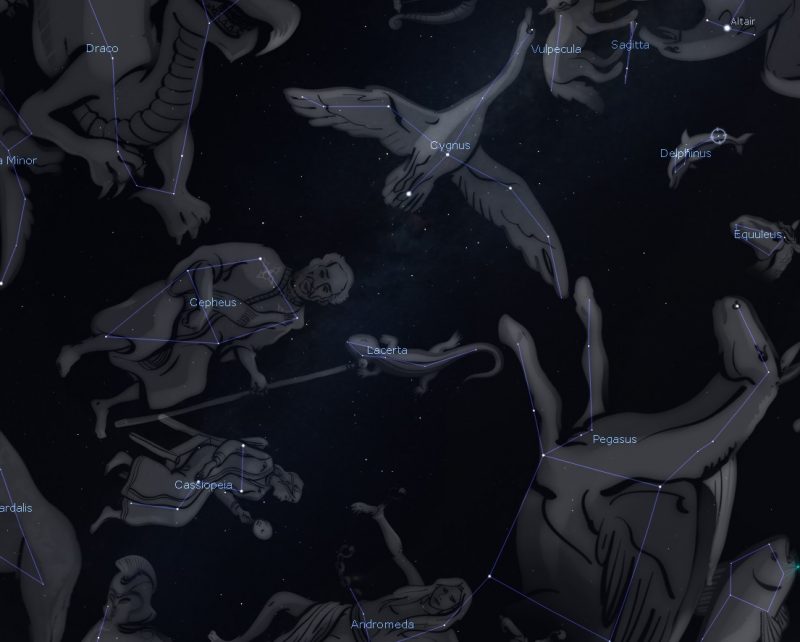
Do you know how to spot the Great Square of Pegasus, the W-shaped Cassiopeia, the house-shaped Cepheus, or Cygnus the Swan? If you do, you can find Lacerta in the dark patch of sky surrounded by these four constellations.
Some people refer to Lacerta as the “little W,” due to its shape. The “big W” is, of course, Cassiopeia. Can you see the Big and Little Ws next to each other in the sky? Others see Lacerta in the shape of a skinny kite. Perhaps you can spot the form of a lizard among its stars.
Lacerta is a fairly small constellation, only taking up 200 square degrees in size. It’s the 68th largest of the 88 constellations.
The stars of the Lizard
Only one star within the constellation’s borders is brighter than magnitude 4: Alpha Lacertae at -3.76.
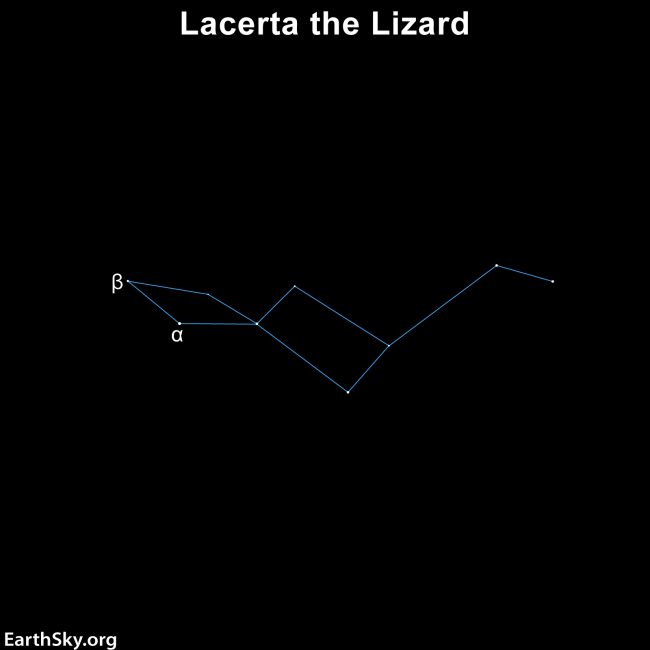
Lacerta now has several officially named stars. Its brightest star, Alpha Lacertae, received the name Stellio in 2024. Alpha Lacertae lies 102 light-years away.
To find Alpha Lacertae, start with Cassiopeia, the W- or M-shaped constellation. Then look toward Cygnus the Swan, between them is Lacerta the Lizard. Use the star chart to pinpoint Alpha Lacertae, but you will need to get away from bright streetlights to see the faint little lizard shape!
Stars of 4th magnitude lie on all sides of Alpha Lacertae. The star in the direction of Polaris from Alpha Lacertae is Beta Lacertae. Beta Lacertae is another star in the constellation identified by a Greek letter. It has a magnitude of 4.42 and lies 170 light-years away.
Star clusters in Lacerta
The majority of the constellation Lacerta lies within the swath of the Milky Way. Yet, there are no Messier objects within it. The brightest star cluster in Lacerta is NGC 7243, which lies 2.5 degrees from Alpha Lacertae in the direction of Cygnus. NGC 7243 is magnitude 6.4, meaning that you can spot it in a pair of binoculars. It lies about 2,800 light-years away and displays some large foreground stars juxtaposed over the hazy Milky Way.
The next brightest cluster lies on the border of Cygnus and Lacerta. This cluster, NGC 7209, is magnitude 6.7 and has the nickname the Star Lizard Cluster. This loose, spread-out cluster lies a similar distance from Earth as NGC 7243.
Draw a line from Alpha through Beta Lacertae and extend it for an equal distance as Alpha and Beta are apart. You will arrive at two star clusters, NGC 7245 and IC 1442. IC 1442 is 9th magnitude and NGC 7245 is magnitude 9.19. So they are best viewed through a telescope. This pair lies only 20 arcminutes apart.
Exoplanet in Lacerta the Lizard
Several stars in Lacerta are known to host exoplanets.
One example is HD 213472 b, a gas giant discovered in 2021. The planet has about 3.5 times Jupiter’s mass and orbits its star at an average distance of approximately 13 astronomical units (AU). It takes about 46.6 Earth years to complete one orbit. The exoplanet and its star lie 210 light-years from Earth.
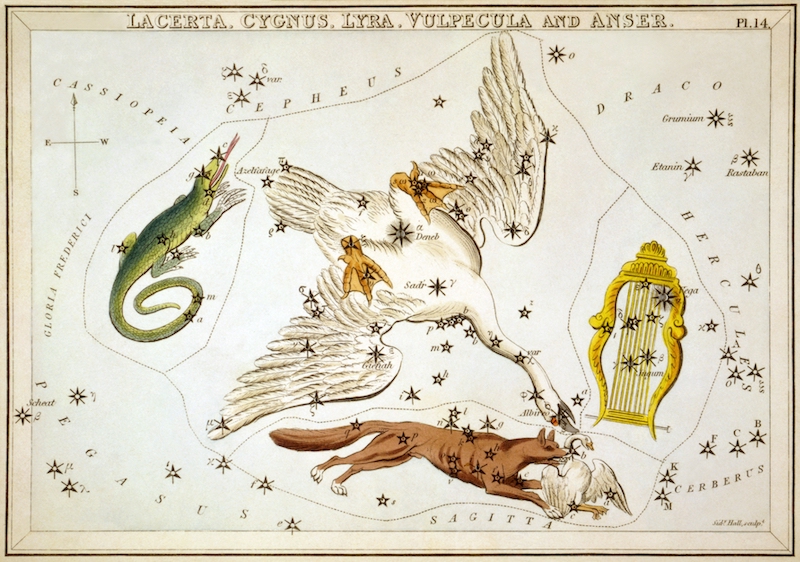
Bottom line: Lacerta the Lizard is a small, dim constellation in the fall sky that contains a blazar, an active galactic nucleus with a jet aimed toward Earth.
The post Lacerta the Lizard, home to a blazar first appeared on EarthSky.