Musa Ilallah
When Nigerians think of their Navy, the images that come to mind are usually warships on patrol in the Gulf of Guinea, special forces boarding a hijacked tanker, or operations against crude oil thieves in the creeks of the Niger Delta. It is important work, which has helped keep Nigeria off the global maritime piracy list for more than 1,600 unbroken days.
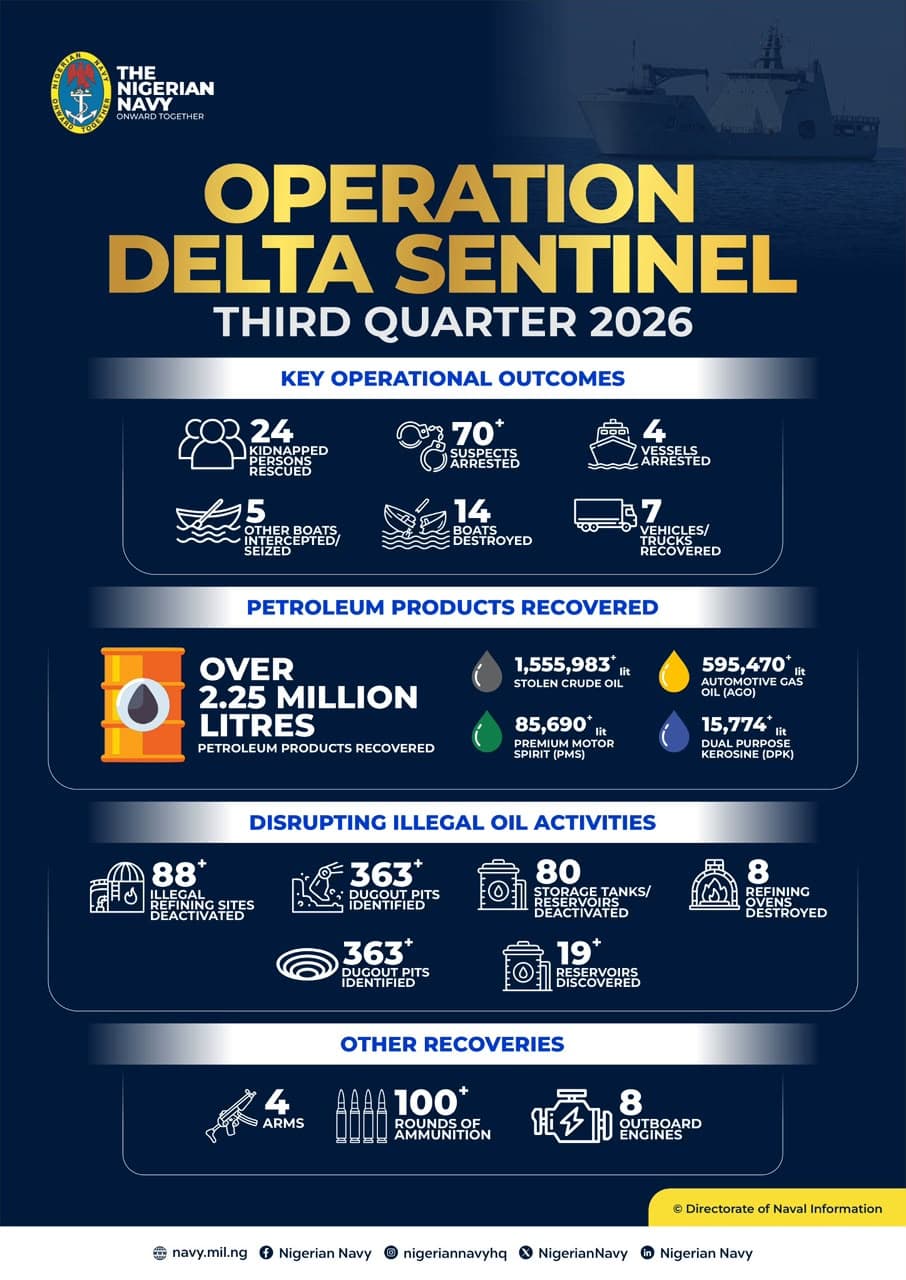
Operation DELTA SENTINEL, launched in January 2026, equally shows what that work looks like on the ground, in communities across the Niger Delta. Since its commencement, the Navy has recovered more than 7.48 million litres of suspected stolen crude oil and illegally refined petroleum products, disrupted over 241 illegal refining sites and networks, and arrested more than 230 suspects.
The momentum has risen steadily through the year, from more than 183 operations in the first quarter to over 580 intelligence-driven operations in the second. In the third quarter alone, the Navy recovered over 2.25 million litres of petroleum products, including more than 1.55 million litres of crude oil, and rescued 24 kidnapped persons.
The results are increasingly visible in Nigeria’s national accounts: provisional Central Bank of Nigeria data show crude oil export earnings rising from $8.11 billion in the first quarter of 2026 to $9.39 billion in the second, an increase of almost 16 per cent. Arrests are also translating into accountability, with the Federal High Court in Uyo recently convicting nine crude oil thieves.
These milestones have been recorded under the leadership of the Chief of the Naval Staff, Vice Admiral Idi Abbas, who marks his first year in office this week. He took command with a vision of building “a modern, agile and professional naval force” working in synergy with other security agencies.
As well as launching Operation DELTA SENTINEL on 13 January 2026, barely two and a half months after taking office, he has pushed for technology transfer to expand indigenous shipbuilding and kept a sustained focus on personnel welfare. He has also consistently charged officers and ratings to build and maintain cordial relationships with civilians, reflecting his conviction that the Navy’s standing rests as much on how it treats citizens as on the firepower it commands.
Beyond that firepower, there is another, less familiar side to the Nigerian Navy: a rapidly expanding footprint of people-focused impact in communities across the country. This is the Navy’s soft power in the 21st century, and it is proving just as important to national security as any anti-theft operation or patrol frigate.
Soft power, a term coined by the Harvard scholar Joseph Nye, describes the ability to shape outcomes through attraction and persuasion rather than force. For a military institution, it means winning trust, building goodwill and earning the cooperation of the people it exists to protect.
There is a growing consensus in Nigeria that security cannot be achieved by firepower alone. It depends to a significant extent on communities that share information, support operations and see the armed forces as partners rather than strangers. All the guns, warships and drones in the world can only go so far in communities that are hostile to, or distrustful of, security personnel. Nigeria saw the power of community collaboration first-hand a few months ago, in the operation that freed the abducted victims of Oriire in Oyo State, which featured the active involvement of the Navy’s special forces, the SBS.
The Nigerian Navy’s Quick Impact Projects (QIPs) are perhaps the clearest expression of this thinking. Modest in scale but significant in impact, they deliver tangible benefits directly to communities: boreholes, electrification projects, clinics and dispensaries, classrooms, sports facilities and more. They stretch across all six geopolitical zones, reaching dozens of communities including Balanga in Adamawa, Irepodun in Kwara, Manga in Plateau, Takum in Taraba, Gwale in Kano, Bagudo in Kebbi, Nkanu East and West in Enugu, Umuahia in Abia, Ikot Abasi in Akwa Ibom, Obudu in Cross River, Epe in Lagos and Ogbomosho in Oyo.
Complementing the QIPs are free medical outreaches. A recent one by the Nigerian Navy College of Accounts and Finance (NNCAF) benefited residents of Umuochala and surrounding communities in Owerrinta, Abia State, with Umuochala community leader, Chief Kenneth Nzeoma, conveying the beneficiaries’ deep gratitude. Similar outreaches have taken place in Imo, Ondo, Delta, Lagos and the FCT in the last six months.
What stands out is the geography of these interventions. They are not limited to the coastal or riverine communities where one might expect naval projects to be sited. Many are hundreds of kilometres from the sea, in places where people may never before have seen a naval uniform or vessel.
For the Nigerian Navy, “Onward Together” is no longer just an internal slogan; it has come to mean carrying communities and people along. These efforts reflect a modern understanding of what a navy is for: a navy that builds schools and brings water and electricity is a navy that Nigerians are more likely to trust, support, share intelligence with, and join.
There is, of course, room to do more. Documenting the impact of QIPs over time would multiply their value, as would involving communities in choosing projects and sharing these stories more widely.
The Nigerian Navy began 2026 rated as having Africa’s strongest fleet. That position is set to strengthen, with recent and forthcoming inductions of new vessels, backed by President Tinubu’s commitment to the welfare and capacity of the Armed Forces.
The Navy will continue to project power across the seas. But it is equally making its presence felt in homes, classrooms, clinics and sports facilities in communities across Nigeria, quietly winning hearts in the nation it serves.
*Musa Ilallah is a public affairs analyst based in Abuja. He can be reached at musahk123@yahoo.com.