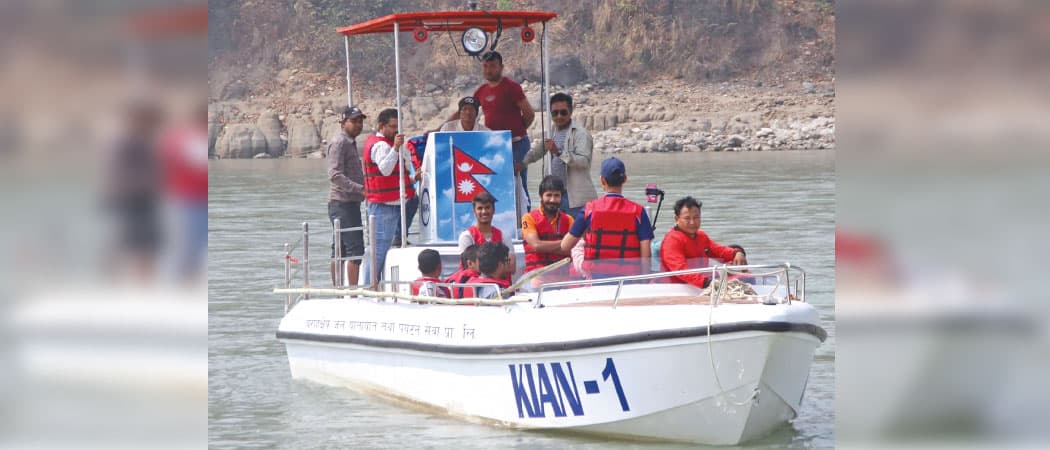
By Baburam Karki, Barahakshetra, Oct. 27: Water transport on the Saptakoshi River has become a convenient means of travel for residents of the eastern hill districts. It serves people from southern Bhojpur, southern Dhankuta and some hilly settlements in Udayapur, as well as pilgrims visiting the Barahakshetra Temple.
By reducing travel time and distance, river transport has been supporting religious tourism and local economic activity.
However, a series of recent boat accidents on the Saptakoshi has raised questions about passenger safety, vessel capacity, operating permits, insurance and regulatory oversight. Unless the service is managed systematically, with passenger safety as the top priority, its potential could be undermined by the risks involved.
On 25 October, a boat travelling from Kopche in Bhojpur to Barahakshetra in Sunsari met with an accident on the Saptakoshi River, killing three people and leaving three others missing. Several passengers were injured. Divers from Nepal Police and the Armed Police Force were deployed to search for those missing.
The incident has renewed concerns about the types of boats operating on the river, their passenger capacity and the safety measures in place.
According to Bimal Man Shrestha, chairman of Barahakshetra Water Transport and Tourism Services Pvt Ltd, the boat involved in the accident was not a jet boat but a conventional motorboat fitted with an outboard motor (OBM).
He said jet boats and conventional motorboats differed in their design, size and safety arrangements. He added that the engine had reportedly stopped during the accident, potentially leaving the boat beyond the crew's control in the river's strong current.
Shrestha said the Saptakoshi has a powerful current and that particular caution is needed around confluences, where rivers meet. Although mechanical problems can occur, he said, the driver's preparedness, the boat's technical condition, passenger safety measures and rescue arrangements are crucial to preventing such problems from turning into disasters.
He added that jet boats generally have additional crew members alongside the driver, who can assist in rescuing passengers when necessary. However, he stressed that a boat's size or price alone should not be taken as an indication of its safety.
Previous accidents
The Saptakoshi has witnessed boat accidents in the past. On 12 September 2019, a jet boat operating on a trial basis from Chatara towards Kopche in Bhojpur met with an accident. Of the nine people on board, eight survived, while one crew member went missing.
Shrestha said the wreckage of the boat was never recovered.
The latest accident on 25 October, in which three people died and three went missing, has once again raised serious concerns about the safety of river transport.
According to Shrestha, the river is more than 70 feet deep in some places along the route between Chatara and Kopche in Bhojpur. He said the river's depth, strong currents and the confluence of waterways required special precautions when operating boats towards the hill districts.
Permits and regulation
The accident has also raised questions about the permits required to operate river transport services, the monitoring of vessels and the responsibilities of the authorities concerned.
Poshan Lamichhane, assistant chief district officer and information officer at the District Administration Office in Sunsari, said the office had not issued permits for jet boats operating on the Saptakoshi. He added that he was unaware of any permits issued by local governments or other agencies.
This highlights the need for greater clarity among the relevant authorities regarding the registration of boats operating on the river, operating permits, accountability and safety standards. It must be clear which agency is responsible for issuing permits, conducting regular inspections and assuming responsibility in the event of an accident.
The sale, registration and use of boats operating as public transport also need to be properly regulated. Manufacturers and sellers should pay attention to the intended purpose of their vessels and how buyers plan to use them. Registration, insurance and operating procedures should be transparent.
A river transport operator said boat insurance and passenger insurance could be separate matters, making it essential to clarify insurance arrangements to protect passengers and property in the event of an accident.
Barahakshetra Water Transport and Tourism Services Pvt Ltd said it had insured its boats in the past. However, although insurance companies had recently been unwilling to insure its boats, the company said it continued to provide accident insurance for passengers.
Ensuring safe operations
As the potential for water transport on the Saptakoshi grows, safety must remain a priority. Operators should not be allowed to carry more passengers than a boat's designated capacity. Every passenger should be provided with a life jacket and required to wear it.
Regular inspections of engines and other technical components are also essential. Drivers and crew members should receive training to handle emergencies, while boats must carry appropriate rescue equipment. An effective mechanism for conducting prompt rescues in the event of an accident is equally important.
Assessing river currents, water levels and weather conditions before operating boats could also help reduce risks.
Water transport on the Saptakoshi has considerable potential to improve access to the eastern hill districts while supporting religious tourism and the local economy. Clarifying permit and insurance requirements and effectively enforcing safety standards would help make the service safer and more reliable.
Shrestha said the jet boats operating on the Saptakoshi were registered with the Office of the Company Registrar, the Inland Revenue Office, the Cottage and Small Industries Office and the Department of Tourism.
More than a dozen jet boats and motorboats operate between Chatara in Barahakshetra Municipality-1, Sunsari, and Kopche in Hatuwagadhi Rural Municipality-9, Bhojpur.
Water transport services generally begin operating in the first week of Kartik and continue until the end of Jestha, according to the report.
How did you feel after reading this news?