
Charles Leclerc's comments after finishing runner-up in the United States Grand Prix perfectly sum up much of Ferrari's 2026 Formula 1 campaign.
He said it was a "shame" that "we came short of winning".
Austin typified a bit of a running theme for Ferrari this year. Strong throughout practice, in contention early on in qualifying, underwhelming in Q3, recovering in the race but often leaving it too late to take the victory.
It is an assessment that team principal Fred Vasseur did not dispute.
"I think the weekend went well and everything is working as expected on the [upgrade] package," he said. "But the issue is that we did all the laps, from the first lap of FP1 to the last lap of the race, in good shape except the last two laps of Q3 on both cars. It's probably where we missed something."
What the US GP highlighted for not just Ferrari but all those fighting at the front is that, if everything is not nailed perfectly, the consequences from losing the smallest amount of time in qualifying can define weekends.
Fourth and fifth on the grid for Leclerc and Lewis Hamilton was a disappointment in terms of the final positions and the impact that would then have on their hopes for the race.
Yet Hamilton's fifth-fastest time was just 0.097 seconds off what Max Verstappen had been able to deliver to put himself on the front row.
As Vasseur said: "We don't have to draw a conclusion because we are P5 and we are three tenths off P1. It’s not a disaster. You can be P5 and be eight tenths off P2."
The deficit that defined Ferrari's weekend is not about a chassis/engine package lacking something fundamental; it’s about extracting the full potential from it in critical moments such as Q3.
And when it comes to not letting thousandths slip away, not all the elements can be controlled, and it's a problem that Ferrari is not alone in experiencing.
A lot of drivers struggled to improve on their second Q3 runs at the Circuit of the Americas, and McLaren's Lando Norris reckoned he had a car quick enough for second but ended up eighth on the grid (held back partly by a track-limits breach).
Vasseur added: "What is true is that with the cars and the tyres, the window is very narrow. And as soon as you are a bit out, quickly you lose two or three tenths.
"Today in F1 for the top eight, two or three tenths can be six positions. It means that you can move from a super result to nowhere for a gust of wind, or you slide a little bit too much in the outlap, or you have to slow down a bit too much and stick to your pace."
The Ferrari's traits
It's well understood that Ferrari's car characteristics make it harder for it to fire up the tyres for qualifying than others, so Leclerc and Hamilton always have a much tougher time finding that ideal sweet spot with operating temperatures.
And their headaches can increase if, as happened at Austin, the clouds come over and the temperature drops even just a few degrees. Leclerc said the impact of this in Q3 was like a "night and day" difference for him in terms of how even the outlap felt.
It is not just about tyres though, because Hamilton paid the price for set-up choices made over the US weekend.
He had not hit the ground running in FP1, went in the wrong direction in FP2 and from then on, although things were better by Saturday morning, was in catch-up mode as he chased a balance that had enough on the nose.
And having not gone far enough before the race, the front washing out too much in the early stages put paid to his hopes of matching Leclerc.
"I think we've just been under-hitting it, continuously under-hit it, for some reason," said Hamilton.
He only got his car anywhere near where he needed the balance to be for the final stint of the race, by which stage it was too late to do anything. But as the graphic below shows, the deficit to Leclerc was slashed considerably.
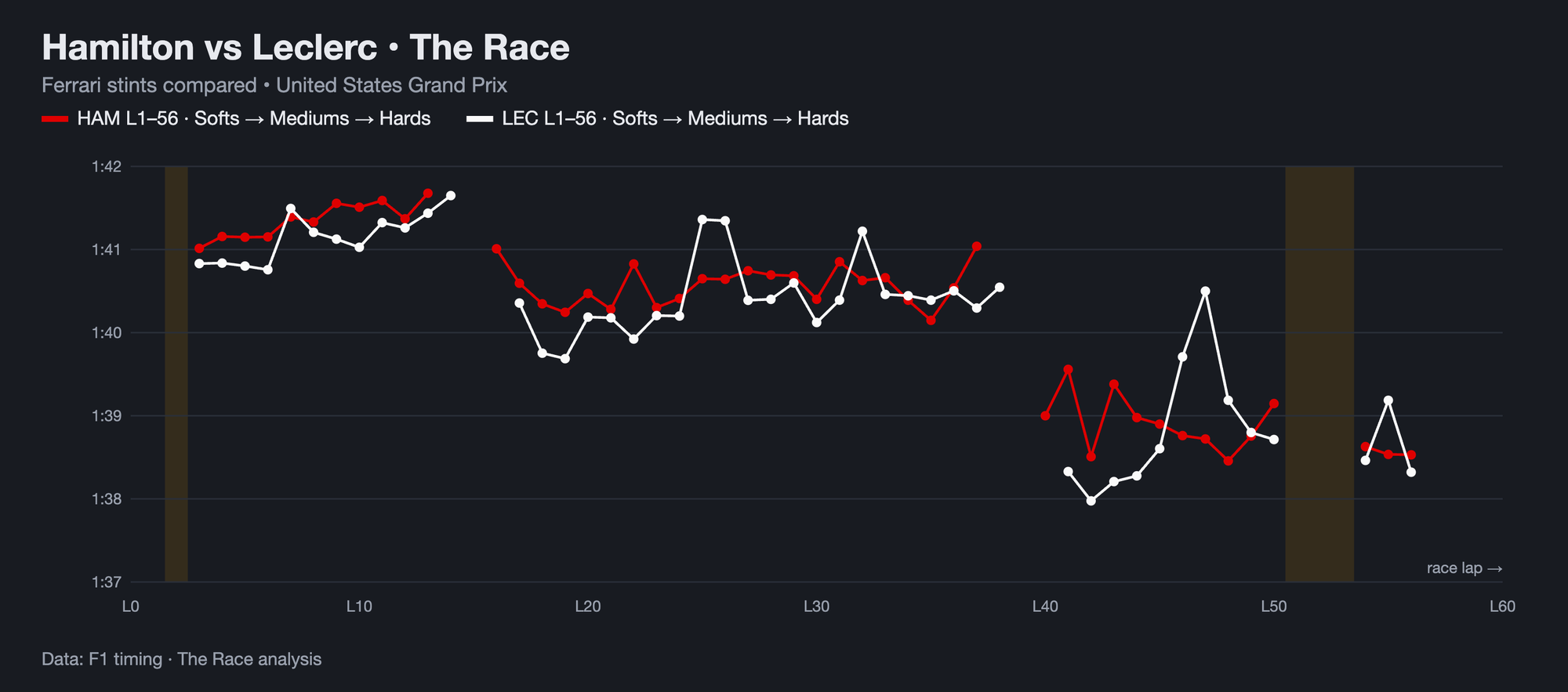
Reflecting on adding more and more front wing throughout the race, Hamilton said: "Through the pitstops, I added four clicks. The next pitstop, added another four clicks, and even then, I'm still another four clicks too short.
"It's crazy, like to be 12 clicks down. We really need to look in how we are getting to that point."
He added: "I think if I had had the balance that I need, even if I just had the balance in the last stint, I would have been right in the fight all the way to the end."
Leclerc himself felt that a set-up he has managed to dial into the car - and his tolerance with a pointy car is well-known - has been the key to progress he has made.
"These cars are very specific and unique, and I feel like, over the last two or three races, I've unlocked something again in terms of driving, and particularly set-up with my driving," he said.
A pivotal moment
The lesson from Austin that Ferrari needs to nail everything at the right moment comes at an important time as it begins committing to its concept choices for next year's car.
And this is something that Hamilton is laser-focused on ensuring he feeds his opinion into.
"I see a pivotal moment in terms of steering the car in the right direction for next year," he said.
"So I'm really working on areas that we need to improve for next year's car, so that's part of the discussion this weekend, the next couple of weekends."
It does not need a revolution for Ferrari to find the progress that is the difference these days between the third row and the front.
More power will help, but it's known Ferrari sacrificed some of that for better chassis performance. However, like with what is happening in Q3, it's the details that are going to count for everything.
Hamilton added: "This is the time where you actually start to need to make decisions and actually fall in line that these are the areas that if you fix these for next year it's half a tenth in every corner.
"These are the areas that we're struggling with. This is where I want the aero balance to be for next year. But there's not a huge amount of things.
"I think we've got a really good package, so it's keeping on the good things of the car and rectifying a couple of these small, subtle differences, and then see about the straightline speed."