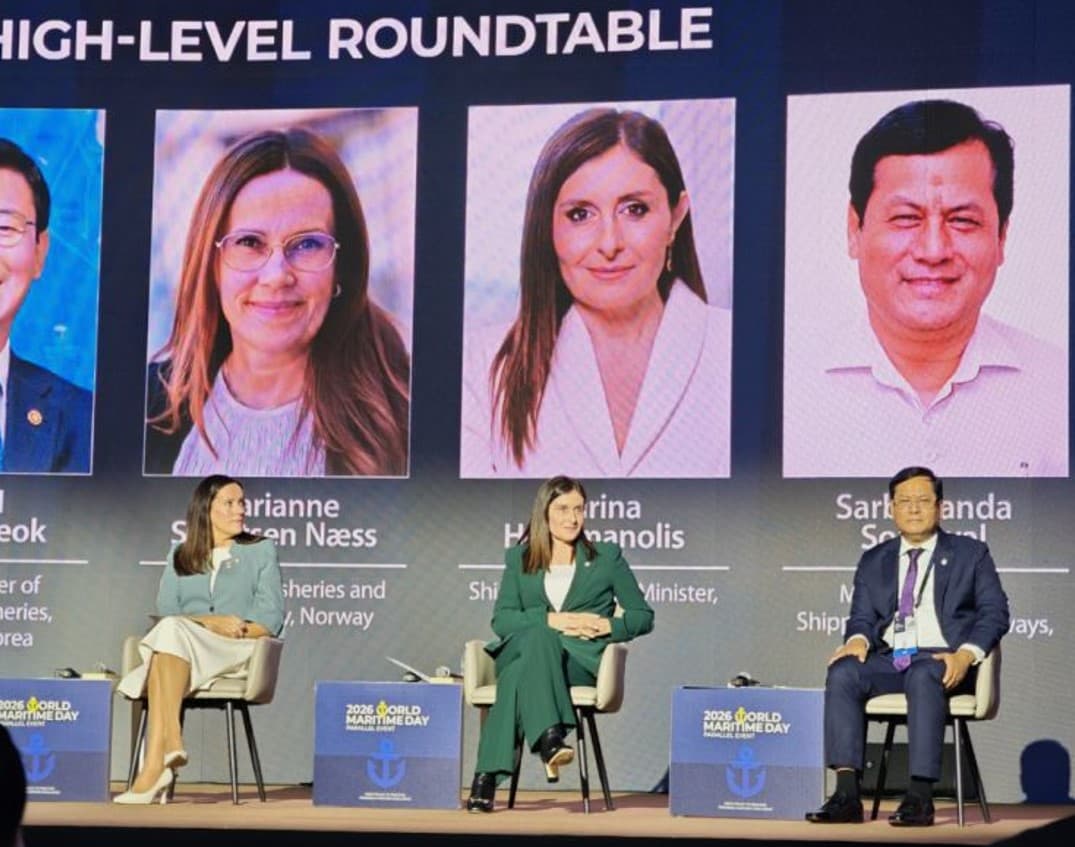
Cyprus emphasised the need for international shipping regulations to reflect national circumstances, as Shipping Deputy Minister Marina Hadjimanolis met her Norwegian counterpart on Monday during high-level maritime discussions in Busan, South Korea.
The meeting with Norway’s Minister of Fisheries and Ocean Policy, Marianne Sivertsen Næss, took place on the sidelines of the World Maritime Day Parallel Event 2026, bringing together government representatives and international maritime officials to examine how global shipping agreements are put into practice.
The two ministers exchanged views on developments affecting the shipping industry, particularly ongoing negotiations within the European Union and the International Maritime Organisation (IMO).
Their discussions also emphasised the importance of international cooperation while recognising the different circumstances facing individual countries when developing and implementing maritime regulations.
Earlier, Hadjimanolis attended the event’s opening ceremony and participated in a ministerial roundtable alongside representatives from South Korea and Norway, as well as IMO Secretary-General Arsenio Dominguez.
The discussion focused on the role of governments in implementing IMO conventions, with particular attention to national legislation, regulatory oversight and the practical difficulties countries encounter when applying internationally agreed standards.
The issue has become increasingly important as shipping companies face stricter environmental requirements, rising compliance costs and uncertainty over future fuel regulations.
Indeed, the IMO’s latest findings show that considerable work remains to be done. Its first mandatory audit cycle, covering 168 member states, found weaknesses in the implementation of maritime conventions, including shortages of technical expertise, gaps in national legislation and inadequate oversight of vessels.
According to the IMO’s assessment, these shortcomings have reinforced the need for better training, technical assistance and cooperation between maritime administrations.


Meanwhile, the Busan discussions come ahead of another round of negotiations on the IMO’s proposed Net-Zero Framework, which has yet to secure final approval following disagreements over emissions pricing and future fuel standards.
The next round of technical discussions is scheduled for November 23 – 27, followed by the Marine Environment Protection Committee meeting from November 30 to December 3. A further session concerning the framework’s adoption is provisionally scheduled for December 4.
For Cyprus, the outcome is particularly significant. As an EU member state with a substantial international ship registry and shipmanagement industry, the country must contend with European environmental legislation while also participating in efforts to establish common global standards.
Shipping companies serving European ports are already subject to the EU Emissions Trading System and FuelEU Maritime, making regulatory coordination an important consideration for investment, fleet renewal and the transition towards cleaner fuels.
At the same time, Cyprus is seeking to strengthen its position in international shipping. Earlier this month, Hadjimanolis announced that the Cyprus Ship Registry had expanded by 27 per cent since September 2023, reaching its highest level in 25 years.
Speaking in Tokyo on October 15, she linked the increase to efforts to improve the registry’s competitiveness, simplify administrative procedures and provide more responsive services to international shipowners.
Her participation in Busan forms part of a wider working visit to Japan, China and South Korea, running from October 14 to 29, aimed at strengthening maritime relations, promoting the Cyprus flag and attracting further shipping business.
The two-day gathering in Busan, hosted by South Korea’s Ministry of Oceans and Fisheries, is being held under the theme From Policy to Practice: Powering Maritime Excellence.
Discussions continue on Tuesday, with shipping and shipbuilding representatives examining compliance with IMO regulations, alongside sessions on maritime training and technical cooperation.