
The wellness industry loves a secret cure. I encountered dozens of them at Dave Asprey’s Beyond Biohacking Conference, held in May on several floors of a hotel in downtown Austin. There were supplements galore, of course: algae tablets for detoxification, ketones for concentration, nitric oxide for circulation. One company claimed that its capsules contained quantum energy. I saw people hooked to IV vitamin drips, sweating inside infrared saunas, and sealed in hyperbaric oxygen chambers. I watched a woman climb into a giant quartz bowl, which someone then struck with a mallet. I tried a pair of inflatable compression pants that rhythmically squeezed my legs to stimulate lymphatic drainage. I also stripped to my boxers and spent a thrillingly miserable two and a half minutes inside a cryotherapy booth.
The main attraction, though, was peptides, the short chains of amino acids now hyped as miracle drugs. In a ballroom packed with several hundred people, Asprey and a fellow health guru, Jay Campbell, extolled the many virtues of peptides, railed against restrictions on their promotion, and predicted a future in which they transform mainstream medicine. Both men are in their 50s, with shredded physiques and zero medical degrees. Asprey is best known for popularizing the trend of dumping butter and coconut oil into your coffee. Campbell made his name advocating for testosterone replacement and now bills himself as one of the world’s leading authorities on peptides. He spoke excitedly about one cutting-edge compound, called Klotho, that can “literally lower your biological age.” He told the crowd that he’s heard from women in their 70s who, after taking Klotho and the peptide FLGR242, started menstruating again. (Instead of imploring them to call their doctor, which is what the American Cancer Society recommends for postmenopausal bleeding, his advice was to “keep injecting.”) As peptides become more readily available over the next few years, Campbell anticipates that disease as we know it will come to an end, including “ontological” mutations. (I’m guessing these are mutations that afflict only philosophers.)
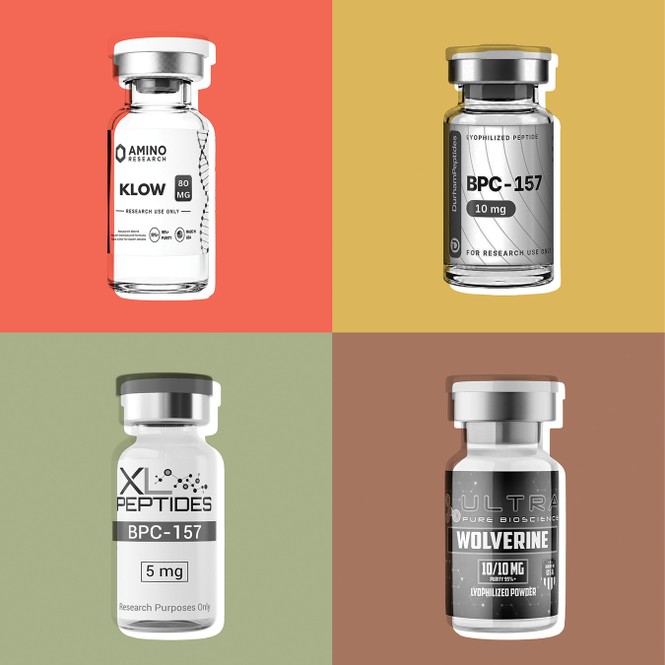
Campbell and Asprey have been promoting underground peptides in their books and on their podcasts for years. Lately, though, these gray-market drugs have started to gain traction with a broader audience. The most talked-about among them goes by the cryptic designation BPC‑157. It’s commonplace enough that asking questions about it immediately tags you as a tourist. BPC‑157 is a component in most of the popular peptide combos, ones with names such as Glow, Klow, and Wolverine (a reference to the comic-book superhero with self-healing powers, not the carcass-eating skunk-bear). It’s rumored to be good for stomach ailments including acid reflux, bloating, and ulcers. Also, sprained ankles. It will reportedly ameliorate arthritis, carpal tunnel syndrome, and sciatica, not to mention hernias and migraines. BPC‑157 has been said to loosen stiff shoulders and repair runner’s knee. Suffering from bursitis? Gingivitis? Road rash? Low libido? Its boosters promise that it can help with all of these conditions and more.
In recent months, BPC‑157’s profile has risen significantly, at least judging by Google searches and Instagram videos, some of which feature a creepy AI-generated character who magically restores torn ligaments. Praise from big-name podcasters such as Andrew Huberman and Joe Rogan has no doubt contributed to its popularity (Rogan declared BPC‑157 “super legit”). Reliable sales figures, though, are hard to come by. Conventional drugs that have been approved by the FDA—including GLP-1s like Ozempic, which are also peptides—are sold by multibillion-dollar global behemoths with legions of researchers and executives. Peptides like BPC‑157 are sold by … honestly, who knows? The companies pop up and disappear. The proprietor of your favorite American peptide supplier might be an enterprising undergraduate who buys in bulk from China, where many peptides are manufactured, and relabels them. A small glass vial of freeze-dried powder arrives on your doorstep; you dissolve the powder in sterile water, draw it into a syringe, and inject it into your abdomen. Peptides are usually advertised as “for research use only,” a wink-wink disclaimer that allows vendors to maintain that they’re not violating federal laws regulating drug sales. Maybe that gives you pause. Or maybe you think that these sketchy transactions are necessary because the establishment—that is, Big Pharma and the United States government—is suppressing the good stuff.
Amid the sellers of red-light panels and blue-light glasses at Beyond, I stumbled on a company marketing a drinkable version of BPC‑157. Its giveaway sticker read We Prefer Oral Peptides, with the word peptides in much smaller letters because haha sex. The representative behind the counter referred to BPC‑157 as “the soccer mom’s peptide” and nonchalantly squirted some from what was essentially a hand-soap dispenser into a tiny plastic cup, then held it out to me. I hesitated, and the peptide hung in the air, unclaimed. “Are you afraid of it?” he asked. The not-so-subtle subtext was that I shouldn’t be, that taking BPC‑157 was equivalent to trying the dissolvable herbal-tea strips a few tables down or giving the giant quartz bowl a whirl. For the record: We were in a hotel hallway and I was being encouraged—dared, really—to try a drug that isn’t FDA-approved, is prohibited by the World Anti-Doping Agency for athletes’ use, and allegedly works throughout the body via some mysterious mechanism that is not entirely predictable. I was being offered an unspecified dose, although I wouldn’t know what dose would be appropriate, because there are no agreed-upon dosing guidelines. I declined the peptide. The representative shrugged and drank it himself.
Perhaps I was being too cautious. Thousands of Americans have ingested or injected BPC‑157. That guy didn’t keel over after he swigged it. Whatever you think of their relevant credentials, Asprey and Campbell appear to be insufferably healthy middle-aged men. Robert F. Kennedy Jr., the secretary of health and human services, is on record as being “a big fan of peptides,” a casually sweeping endorsement of an entire class of drugs. Although Kennedy has stoked vaccine hesitancy for most of this century and argues that Americans are overmedicated, he has a soft spot for these particular shots. The “Make America Healthy Again” movement is officially on board too, which feels strange considering that MAHA is all about treating anything modern and artificial with suspicion. They’re the raw-milk people! They don’t even like Doritos and Coca-Cola! And yet they’ve decided that these highly processed powders, assembled by machines that link amino acids together, are somehow consistent with the nature-knows-best ethos. For MAHA, the renegade cachet of peptides is central to their appeal, and the fact that medical experts are wary of them is a plus. Under Kennedy, the FDA may soon allow six peptides, including BPC‑157, to be made in the United States, which would mean that doctors could prescribe them, and that telehealth companies such as Hims & Hers, best known for discreetly shipping men generic Viagra, could offer them for sale.
[Read: America is about to go over a peptide cliff]
Is there any evidence that BPC‑157 works? Its evangelists like to note that the peptide has several decades of peer-reviewed research behind it. Those papers, more than 200 of them, are packed with charts and citations and have been published in journals that are respectable enough, if not quite top-tier. BPC‑157 has been tested on mice, rabbits, guinea pigs, chickens, honeybees, and, above all else, rats. So many rats. These rats have endured all manner of miseries in the name of science. They have had their tendons severed, stomachs ulcerated, tails amputated, muscles crushed, bowels perforated, spinal cords compressed, blood vessels tied off. The ones that received the peptide consistently fared better, according to the studies: Their wounds closed more quickly, tendons knitted together more completely, ulcers shrank. Overall, they were more likely to survive this catalog of laboratory horrors than the unlucky controls. If the published literature is to be believed, BPC‑157 is a rodent panacea.
When you read the papers, one after another, until you’re bleary-eyed and bewildered, you start to notice some patterns. One is that very few of these studies have been conducted on humans, and humans, famously, are not rats. Another is that, as I’ve already suggested, BPC‑157 is said to work almost every time for almost everything. Behold these triumphant verbs: improves, enhances, promotes, stimulates, accelerates, restores, increases, prevents, abolishes, counteracts, heals, protects. And it seems to yield benefits regardless of the form, or method of application, or which orifice it is delivered into. Also, when you examine the list of authors, you see many of the same names crop up again and again. One name, however, appears at the top of nearly every paper: Predrag Sikirić.
Sikirić is a 72-year-old professor emeritus of pharmacology at the University of Zagreb School of Medicine, in Croatia. I emailed him. I wanted to know where this wondrous elixir, supposedly good for both heartburn and a ruptured Achilles, came from, and why we’re hearing about it only from podcasters. Precisely four minutes later, my phone buzzed. An insistent man with a thick accent wanted to know how quickly I could get on a plane.
The current global hub for BPC‑157 research is a cramped, cluttered room with a single window half-obscured by a tangle of plants. Sikirić’s laboratory is at the university’s medical school, roughly a mile north of Zagreb’s main square, near a small café where future doctors smoke cigarettes and grouse about their workload. These modest quarters are temporary; renovations are under way on a larger laboratory in the building across the street. For now, new experiments are on hold, and Sikirić and his longtime lab assistant are confined to a glorified storage closet with empty rat enclosures stacked next to boxes of small plastic tubes and bags of feed. Among the haphazard decorations—including a foam brain and a hat that reads HAPPY ANIMAL HAPPY HUMAN—hangs a collage of patent medicines from the heyday of cure-alls, back when you could make whatever claims you wished about your restorative tonic without fear of government regulators shutting you down. On a counter sits a large glass bottle of clear liquid, the letters BPC scrawled on the label in blue marker.
The peptide in that bottle is Sikirić’s life’s work. When he was still a student, inspired by the pioneering research of the endocrinologist Hans Selye, who studied the biological effects of stress, Sikirić came to believe that the body produced, in essence, some universal antidote to injury, a molecule that would cue damaged tissue to return to its normal state, regardless of what had caused the harm. He reasoned that the remedy was probably found in gastric juice, because the stomach is constantly adjusting to fresh insults. Sikirić spent the 1980s searching for it, and the decades since trying to convince the world that he found it. Along the way, his work has often drawn eye rolls from colleagues at the medical school, some of whom remain unmoved by the animal evidence he has amassed. Even those who admire Sikirić’s persistence and have known him for years, such as Miloš Judaš, the director of the university’s Croatian Institute for Brain Research, do not share his faith in the curative properties of BPC‑157 (“We are not sure whether it really works or not,” Judaš told me). Sikirić’s discussions with pharmaceutical companies have repeatedly stalled. The recognition he believed would be forthcoming from the scientific community has never materialized, despite his prolific scholarly output.
But none of that has deterred Sikirić in his effort to, as he told me, “bring BPC to mankind.” He’s just kept plugging away at this singular line of research, coaxing generations of graduate students to join him in the mission, and dreaming up new experiments to test his theory. Now the world is seeking him out. Along with reporters like me, he hears from peptide promoters eager to brag about being buddies with the discoverer of BPC‑157. How his peptide took center stage, Sikirić isn’t sure. For a long time, BPC‑157 wasn’t really known outside his lab except among readers of niche scientific journals such as Digestive Diseases and Sciences and the European Journal of Pharmacology. In the mid-2010s, it began appearing on bodybuilding forums and in biohacking guides, where it was touted as a way to speed healing and recovery. But it remained on the fringes until recently. Testimonials from Rogan and Huberman, whose health recommendations reach enormous audiences, certainly helped spread the word: Rogan swore it fixed his hurt elbow, while Huberman credited it with eliminating his back pain.

However it happened, Sikirić is pleased that his peptide is at last having its moment. He is gratified that BPC‑157 is flourishing on the gray market as well. “Officially, I have to be against any kind of usage without full approval,” he said. Unofficially, he’s all for it. He interprets BPC‑157’s word-of-mouth success as proof that his peptide is helping the masses. If it wasn’t, why would so many people recommend it? He is delighted, too, that the health secretary of the United States is a believer in peptides. I asked if he’s ever spoken with Kennedy, who has a habit of reaching out to researchers whose work he admires. “I would kindly reject to reply to the question,” he said. “This is good English?” (An HHS spokesperson did not respond to an inquiry about whether Kennedy had spoken with Sikirić.)
Sikirić can be at once engaging and cagey. Try to pin him down, and he launches into an unrelated anecdote. Broach a contentious topic, and he responds with a puzzling analogy. Ask about his past, and he grudgingly provides a few biographical details. Sikirić grew up in Zagreb, which was then part of Yugoslavia. His father, a lawyer, was jailed repeatedly for his opposition to the country’s ruling Communist party; his mother, an encyclopedia editor, encountered government censorship. As a child, Sikirić underwent multiple surgeries, and those hospital stays made him want to be a doctor. Medicine also offered an escape from politics: “The pain is the pain for anybody,” he said. After medical school, he worked for three years as an emergency physician in a small town, treating victims of car accidents, heart attacks, and stabbings.
But a country doctor can only do so much. The wonder drug he envisioned might help millions. Sikirić returned to the University of Zagreb to pursue this dream with a single-minded, near-manic intensity. In addition to churning out hundreds of papers, he has supervised numerous doctoral dissertations, all of them on BPC‑157. His students tell of late-night phone calls from Sikirić, eager to share an insight. He and his wife of more than 40 years don’t have children. He has no hobbies, doesn’t take vacations to the nearby coast, and works for long stretches without a break. Sikirić walks quickly, albeit at a slight angle, as if he might tip over. He drives quickly, too: When I rode with him, he sped through downtown Zagreb, braking a few feet from crossing pedestrians, half-grinning at my evident anxiety. You wouldn’t think it to look at him—baggy professorial sweater and corduroys, tightly cropped gray hair—but Sikirić is a septuagenarian in a hurry.
BPC‑157’s newfound fame has brought with it unwelcome scrutiny. Last year, a group of researchers in Poland raised concerns about BPC‑157’s safety, arguing that how it works is poorly understood and warning that it could cause neurological damage or promote tumor growth. These possibilities, they wrote, must be considered “before falling into complete admiration.” In response, Sikirić pointed to his animal studies suggesting that BPC‑157, on the contrary, inhibits tumor growth and protects against neurological damage. When I asked him about the Polish paper, he dismissed it as a bid for attention and emphasized how much it upset him. If BPC‑157 really increased the risk of cancer, Sikirić insists that he would tell the public to stop using it immediately.
One argument for BPC‑157’s safety rests on the assumption that if the body makes it, it must be safe. But does the body make it? Sikirić has asserted that his peptide is a fragment of a protein, but he’s never publicly shared key details about that protein. Several researchers have attempted to locate BPC-157’s amino-acid sequence in databases of protein and DNA sequences, to no avail. I asked William Pearson, a computational biologist who co-developed the first widely used search tool for such databases, to try to determine where BPC‑157 comes from. After hours of combing through repositories containing hundreds of millions of protein and DNA sequences, Pearson couldn’t find a match. If the peptide occurs in humans, those searches should have turned it up. He also identified no matches among proteins from other animals—including, it’s worth noting, rats.
Sikirić downplayed the failed searches. He doubts that those databases are comprehensive, though he acknowledged that he hasn’t used them himself. Sikirić told me he’s sure that BPC‑157 originates in humans because he isolated it from newborns in the ’90s. I didn’t remember seeing that study in any of his papers, but that’s because Sikirić says he never published it and doesn’t intend to (“Some things you have to keep for yourself,” he said). As for the gene behind BPC‑157, he maintains that he’s close to finding it, but won’t reveal how he is conducting that search. He likened providing such basic information to a country disclosing its nuclear secrets. The answers, he said, could be found only in his head. I asked what would happen if he got run over by a bus: “This could be huge problem.”
Sikirić believes that, like the cure-alls in his office collage, his peptide can be applied to any ailment, from minor aches to major diseases. During my stay in Zagreb, we played a little game: I named a malady and he told me whether BPC‑157 could treat it. Macular degeneration? “Yes, it could.” Gut inflammation? “This is the favorite site of activity.” Dementia? “Certainly.” COVID? “Naturally, yes.” Concussions? “We published data about it.” Anxiety? “The experiment was helpful in the mice.” Depression? “Exactly.” Heart attacks? “Any kind of condition.” Headaches? “Any kind of pain.” In Sikirić’s estimation, BPC‑157 can do no wrong. Its all-purpose goodness is fundamental to his theory: The peptide is consistently returning the body to its healthiest state. Other drugs have limitations and downsides, but not BPC‑157. He compares it to steroids, but believes it’s superior because BPC‑157 has no known toxic dose (“You could eat BPC without any harm—literally eat, like bread,” he said) and you can take it indefinitely.
Until I told him, Sikirić seemed unaware that some users report distressing side effects from BPC‑157. There’s an online support group called “Haters of BPC‑157,” in which people who believe that the peptide has harmed them commiserate and trade notes on recovery. The most common complaint appears to be anhedonia, which is a kind of emotional numbing. They say they struggle to feel pleasure after taking the peptide. Some blame themselves for using an unapproved drug. Others are angry at Sikirić (“Fuck him,” one member of the group messaged me). Sikirić told me he felt sorry that people were suffering but doesn’t believe it has anything to do with his peptide. (Predictably, he contends that BPC‑157 actually counteracts anhedonia.) Maybe the product they bought was contaminated, he argued, or maybe the cause was something else entirely. These are only anecdotes, he pointed out. And he’s right; that is all they are. But the human evidence in favor of BPC‑157 is also largely anecdotal.
Sikirić takes BPC‑157 himself. Of course he does. I first suspected this when I noticed an empty plastic tube in the cup holder in his car. He was somewhat sheepish when I asked about it, and not forthcoming about how often, or for what purpose, he takes it. As a rule, it’s frowned upon for scientists to sample the merchandise, though there have been famous exceptions. Jonas Salk tested the polio vaccine on himself before it was given to millions of American children; Albert Hofmann dropped way too much acid once before biking home. I asked many of Sikirić’s colleagues and former students if they had taken BPC‑157. Several told me they would never try a drug that hadn’t been approved for human use. Others swore by it. They use it when they feel a cold coming on. They blend it into a cream and smear it on burns and diaper rash. They take it when they twist their ankle or strain their back. A bunch of them give it to their dogs. One former student, now a doctor, showed me a small tube of BPC‑157 that she carries in her purse, just in case.
This is not how drug development is supposed to work. After a promising candidate is tested on animals, it normally passes through three phases of human clinical trials, after which regulators review the evidence and make a determination. The story of why BPC‑157 hasn’t followed this path is convoluted. More than two decades ago, clinical trials began under the auspices of Pliva, a Croatian drug company, but didn’t reach the third phase. Pliva’s research institute, which was responsible for new drug development, was acquired by GlaxoSmithKline in 2006, and progress on BPC‑157 subsequently ceased. In Sikirić’s version, GSK, as it’s now known, decided to shelve the peptide because it was too effective and the company feared it would cannibalize sales of its other drugs. “Let’s just say major breakthroughs are not welcome,” he told me. Yet it’s hard to imagine a pharmaceutical company nixing an important discovery knowing that a competitor might snatch it up. A study conducted by Pliva researchers found that although BPC‑157 did hasten the healing of skin wounds in rats, the results were similar to those achieved with an already approved drug. The peptide did something, in other words, but it wasn’t a breakthrough.
Another problem may have been Sikirić himself. Two former Pliva employees involved in the BPC‑157 project told me Sikirić’s passion sometimes seemed to override his objectivity. He bristled at pushback, and his commitment bordered on obsession. As one of them put it, when it came to his peptide, “Predrag was in love.” Neither knew for sure why GSK didn’t move forward with BPC‑157 (a GSK spokesperson told me she couldn’t find anyone with knowledge about a decision made 20 years ago). But they noted that it’s far from unusual for experimental drugs to be abandoned during clinical trials; in fact, about 90 percent don’t make it all the way through the process, including ones that show some benefit in animal studies.
After GSK dropped the peptide, the rights were returned to Sikirić, allowing him to pursue BPC‑157 trials elsewhere. In 2015, a Phase 1 clinical trial was conducted in Tijuana, Mexico, but the results have never been published. The trial’s sponsor was PharmaCotherapia, a Croatian company co-owned by Sikirić that last year reported having no employees. Sikirić let me briefly review the safety findings on his laptop but declined to share the full report. The summary I read described mild adverse events among some subjects but concluded that BPC‑157 was “safe and well tolerated.” According to Sikirić, the report was never published because the trial’s principal investigator, Rufino Menchaca, a clinical neurologist, wouldn’t sign off once the trial was completed (Menchaca, through a representative, declined to speak with me). The reason for his refusal to sign isn’t entirely clear, although Sikirić told me it had to do with worry that others would steal the data if they were published. Sikirić hopes to restart clinical trials soon, again in Tijuana, looking specifically at whether BPC‑157 is a beneficial treatment for multiple sclerosis—though, in his mind, there is no question. He’s certain that the experiments will confirm his expectations.
Sikirić is so determined to vindicate BPC‑157 that he frequently sounds more like a salesman than a scientist. Money, however, doesn’t seem to be what drives him: As Sikirić will admit, he has no knack for business, and at the moment it’s shady online sellers who are getting rich from his peptide, not him. He just wants to be right, and he wouldn’t mind getting some credit, too. As I’m typing this, Sikirić is sending me yet more papers via WhatsApp even though it’s after midnight in Croatia. He needs me, and everyone else, to set aside any misgivings and agree with him that BPC‑157 is a marvel. Skepticism is taken as an insult. Too often Sikirić’s message is: Trust me. Trust me about where BPC‑157 comes from. Trust me that it works on humans, not just rats. Trust me that it’s safe.
FDA scientists don’t seem to trust him. In June, the FDA published a 68-page report that looked closely at BPC‑157 studies and found them unconvincing, arguing that they lack sufficient human-safety data and that too little is known about how or whether the peptide works. Agency researchers couldn’t tell from the literature how dosage affected outcomes. They flagged the possibility that it could provoke harmful immune-system reactions. Claims about BPC‑157 should be “interpreted with caution,” they wrote, because of troubling gaps in the literature.
But when an FDA advisory committee met in July, it more or less disregarded that report and recommended allowing BPC‑157, along with five other peptides, to be made by licensed compounding pharmacies in the United States. It probably wasn’t a coincidence that weeks before the vote, the agency had announced the appointments of eight new committee members, six of whom had ties to the wellness industry, which hopes to capitalize on a regulatory change. (An HHS spokesperson told me that “all committee members underwent the same ethics review and vetting process required of all FDA advisory committee members.”) One peptide lobbyist told me that the projected profits for BPC‑157 could be in the billions. Hims & Hers plans to start manufacturing BPC‑157 and allowing customers with a prescription to purchase it, assuming the FDA gives the green light (the company’s CEO, Andrew Dudum, told shareholders that he was “extremely excited about this category”). Although FDA officials still have to accept the committee’s recommendation, that seems like a formality, given that Kennedy oversees the agency.
[Read: The peptide boom is getting out of hand]
I have mixed feelings about the move. No, we don’t know enough about these peptides, and providing what amounts to backdoor government approval seems like a terrible idea. At the same time, if people are going to take BPC‑157, I’d rather the supply come from a licensed pharmacy than some guy with a storage unit and an overseas hookup. I kept thinking about the question the peptide representative at the Beyond conference asked me: “Are you afraid of it?” Sikirić sent me home with a small plastic tube containing a single milligram of BPC‑157. It looked like nothing, barely a few grains of fine white powder. I considered taking it, both for the sake of this story and because I have this weird twinge in my right shoulder sometimes. Instead, I sent it off to get tested. The report that came back was glowing: Unlike the gray-market peptides, many of which contain filler and God knows what else, the peptide from Sikirić’s laboratory was chemically pure, full-strength, 100 percent BPC‑157. It was the real thing—whatever that is.
This article appears in the December 2026 print edition with the headline “Mr. Peptide.”