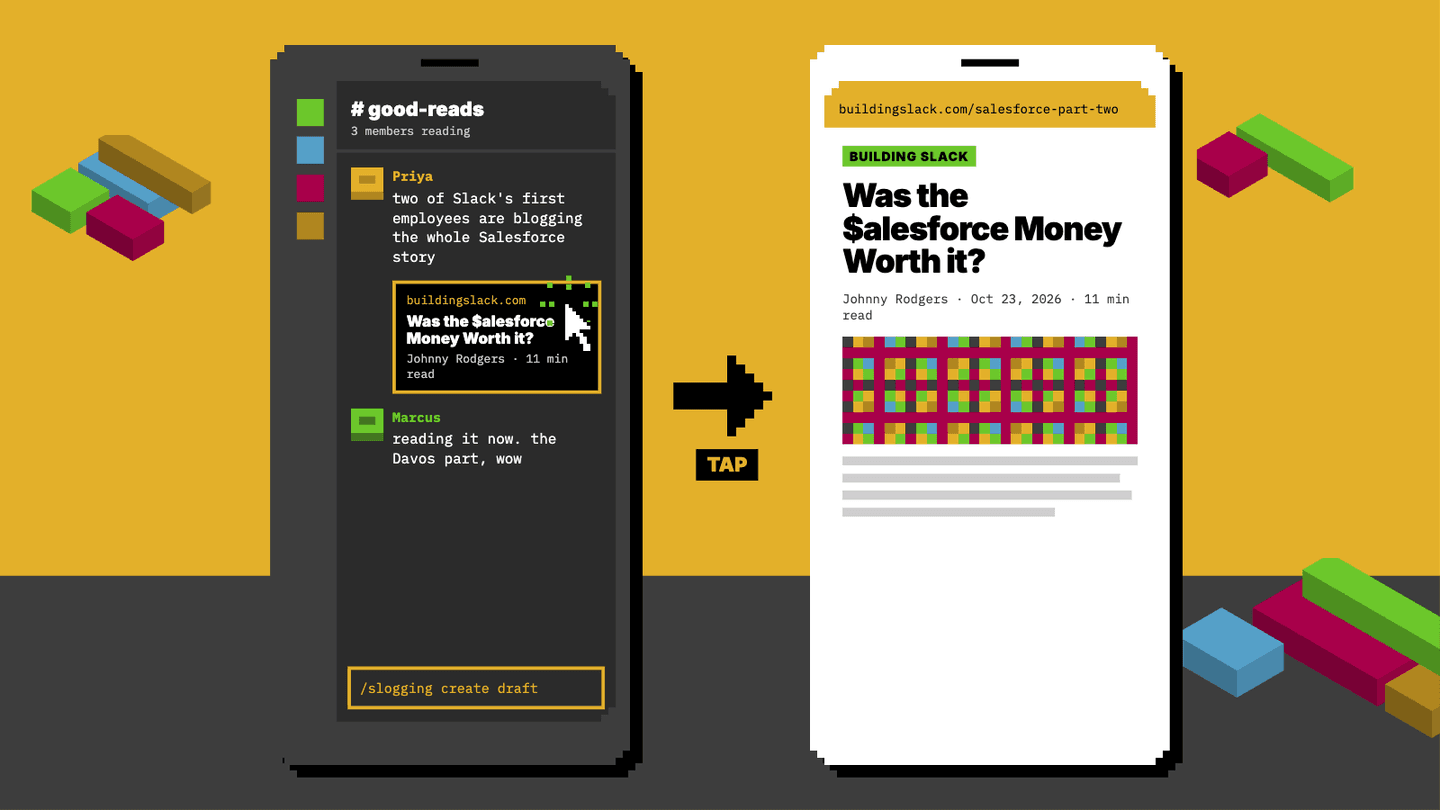
Two of Slack's original eight employees have spent more than two years blogging Slack's history, one post at a time, and their newest post fills in the part of the Salesforce story outsiders never saw. "About" describes Building Slack as a project by Ali Rayl and Johnny Rodgers, and "Salesforce – Part Two", published October 23, 2026, covers the years after the deal closed.
Its sharpest detail comes from Stewart Butterfield, who says he had about an hour with Marc Benioff before the sale was announced: "My last meeting with him was cut short because McConaughey arrived." Read alongside the rest of the archive, the post turns a familiar acquisition story into a fuller one, told by the people who built the product and with founders reviewing their notes.
Why Slack's Early Employees Are Talking Now
Building Slack exists because its authors are free to write it. Rodgers, a former principal engineer, says in "Salesforce – Part Two" that he left in spring 2023 after 11 years. Rayl was Slack's first customer support staffer and later ran customer experience.
Their stated aim, per "About", is to tell how the team built Slack rather than what it built. The site runs no ads and publishes on no fixed schedule, so the payoff is legacy and reputation rather than revenue.
That access cuts both ways, and readers should weigh three things:
- Founder review. Part Two thanks Butterfield, Cal Henderson and others for notes. That buys first-hand detail, but it also means the founders helped shape their own story.
- No Salesforce voice. Benioff, Bret Taylor and Salesforce's sales leaders don't respond anywhere in the post, and the author's scorn for Salesforce culture is open.
- Time and distance. Rodgers wrote Part Two more than three years after leaving, once equity had paid out and the people involved had moved on. Distance lowers the cost of candor, and also lets memory smooth the edges.
The result is Slack's side of the story, told unusually well. It is still a side.
What the Full Archive Adds to the Slack Story
Read in order, the archive shows Slack sold to Salesforce at a low point it had been climbing out of for years. Here are the posts in the order of the history they cover:
- "Day 1": Eight people left at Tiny Speck started Slack in Vancouver a month after shutting down Glitch, reusing the game's server as Slack's message server.
- "Building the Slack MVP": A month in, Butterfield demoed to the board by sharing a Google Doc into Slack and then searching for a phrase inside it.
- "Year 1": Slack launched February 12, 2014, funded by money left over from Tiny Speck's investors and run without perks.
- "The 800-pound gorilla": The inside view of the November 2, 2016 "Dear Microsoft" newspaper ad, which won attention but left Slack still needing to prove it could compete with the biggest software companies.
- "Turning Slack into a network": Shared channels, one of four big bets in Butterfield's Master Plan.
- "The reliability crisis": In September 2018, after a second self-inflicted outage in weeks, Henderson froze releases: "If we can't ship safely, we aren't shipping at all."
- "Rethinking Slack": While the company rebuilt its infrastructure and prepared to go public, the product itself had become cluttered and needed a redesign.
- "Going Public – Part One" and "Going Public – Part Two": Slack filed on April 26, 2019 and chose a direct listing because it didn't need cash and wanted holders to trade on day one without a lockup.
- "The week the world changed": The pandemic made every desk worker remote, sent usage soaring and arrived mid-rollout of the redesign.
- "An Interview with Cal Henderson": A 60-minute interview recorded September 19, 2025, the source of much of the co-founder's commentary on the sale.
- "Salesforce – Part one" and "Salesforce – Part Two": The offer, then the integration.
The new context is the stretch before the offer. Slack had survived Microsoft's entry, an outage crisis and a product overhaul, then watched its stock fall to the low $20s, according to "Salesforce – Part one". A $45-a-share bid arrived at exactly the moment the team was most worn down and the market least convinced.
Eight Revelations and Why Each Is New
1. Slack tried to buy a piece of Salesforce first
What they say: Before the IPO, Butterfield pitched Bret Taylor on selling Quip to Slack. Taylor came back in late summer 2020 and flipped it ("Salesforce – Part one").
Why it's new: Coverage framed the deal as Salesforce's pandemic bet. The Quip origin shows the relationship began with Slack as the would-be acquirer.
2. The founders thought Slack was unbuyable
What they say: Henderson recalls the team had just concluded nobody would buy them: "We didn't think anyone had the money for it" ("Salesforce – Part one").
Why it's new: It explains why the bid felt impossible to refuse: an offer at roughly 28x revenue against a stock trading near $22.
3. Butterfield's spending critiques went nowhere
What they say: Butterfield watched executives approve celebrity appearances while cutting inter-office travel, VPs overhire and then lay off thousands, and a multimillion-dollar Hawaii retreat called Laulima. He raised it with Taylor and Benioff repeatedly ("Salesforce – Part Two").
Why it's new: The leaked 2023 all-hands showed culture friction in general terms. This names the specific spending he objected to.
4. Salesforce reps had no incentive to sell Slack
What they say: Henderson says Salesforce sellers barely used Slack and sold the products they understood. Slack wasn't a dashboard metric, so adding it to a deal looked like a slower sale ("Salesforce – Part Two").
Why it's new: Cross-selling into Salesforce's base was the core deal thesis. This is a co-founder's first explanation of why it underdelivered.
5. Benioff praised Slack without using it
What they say: Benioff singled out Huddles at an all-hands, yet it was clear internally he didn't use Slack himself ("Salesforce – Part Two").
Why it's new: Salesforce now pitches Slack as its interface for work. An insider account that the CEO didn't use it shows how much of that was strategy before it was practice.
6. Davos with will.i.am broke Butterfield
What they say: Expecting customer meetings at Davos, Butterfield was booked onto an innovation panel with will.i.am. He calls it the tipping point ("Salesforce – Part Two").
Why it's new: Butterfield announced his exit in December 2022. This is the first concrete trigger he has given publicly.
7. Bret Taylor blindsided the Slack transition
What they say: Butterfield planned to announce his departure on December 1, with Lidiane Jones succeeding him and Noah Weiss replacing CPO Tamar Yehoshua. Taylor announced his own exit the day before, and Butterfield hadn't been told ("Salesforce – Part Two").
Why it's new: Business Insider reported Taylor's exit, but not that Slack's succession was already set or that the deal's sponsor left without briefing its CEO.
8. Salesforce staff used Slack like email
What they say: Slack customer success leader Dave Macnee describes Salesforce employees stacking @mentions in threads to force attention, the way email gets forwarded up a hierarchy ("Salesforce – Part Two").
Why it's new: It's a small, visible symptom of the larger point: the acquirer adopted the tool without the working habits that made it valuable.
The Culture Failed, but Slack Is Likely Worth More Than $27.7B
The insiders' story is about people, and on the numbers Slack has largely grown into its price. Salesforce paid $45 a share, about 28x revenue, when Slack was approaching $1B in ARR ("Salesforce – Part one"). Benioff now expects Slack to bring in about $3 billion this year, though Salesforce no longer breaks it out and SaaStr puts last fiscal year at $2.4B to $2.6B.
- 9x revenue: a sticky app that holds workers' attention all day, about $27B on $3B.
- 7x–8x ARR: SaaStr's standalone comp, about $17B–$24B on $2.5B–$3B.
- About 4.4x revenue: Salesforce's own multiple, its ~$200B market cap over $46.1B–$46.4B FY27 guidance, about $13B on $3B.
The 9x case is defensible. Slack posted its fastest net new order growth since the acquisition last quarter, and Salesforce calls it the work interface for over a million customers. Daily attention inside companies is exactly what AI agents need, and a strategic buyer would pay for it.
The AI training market prices Slack higher than a revenue multiple does
AI labs now pay to train agents inside copies of Slack. Epoch AI found high-fidelity clones of complex products like Slack cost around $300,000 each, and exclusive environments cost four to five times more than shared ones. Anthropic leaders have discussed spending over $1 billion on RL environments in a year.
Mercor shows what that market is worth. The AI data company raised at $10B in October 2025, crossed $2B in annualized revenue and entered talks at $20B. In July it acquired Deeptune, which sold labs training gyms simulating tools like Slack and Salesforce.
Slack owns the original those gyms imitate, and Salesforce has made itself the gatekeeper. Slack says it doesn't train LLMs on customer data, but in 2025 it rewrote its API terms to bar bulk export and LLM training on Slack data. The value isn't training rights over customer messages; it's control over the most-copied workplace on the market, plus partnerships with labs to train on the real product.
A buyer pricing Slack as an agent platform and training gatekeeper, not as a chat subscription, could reasonably clear $27.7B.
Two cautions keep it from being a clean win. Salesforce itself is valued at roughly the same ~$200B it was at the end of 2020, so the deal hasn't lifted the parent. And matching $27.7B in 2026 is not a return: compounding that price at 8–10% a year since the 2021 close implies a hurdle of roughly $41B to $45B.
What the Final Post Needs to Answer
The archive's verdict so far is that Salesforce bought the product and lost the people. Butterfield, Yehoshua and Taylor were all gone within about two years of closing, and Butterfield told staff that integration without Slack's culture was elimination ("Salesforce – Part Two").
One more post is promised. The open questions are how Slack's teams fared after the founders left, and whether a Salesforce insider will ever tell the other half.