
As a business reporter, I hear two things every day: running a hospitality business is brutally hard, and artificial intelligence is only growing more powerful.
So why not task AI with running a cafe?
Related Article Block Placeholder Article ID: 341994

I am familiar with the soaring costs, compliance checks, and thinning margins affecting Australia’s beloved cafes, but had never delved into the space myself.
To assess the power of today’s off-the-shelf AI tools, I decided it was time to run my own test, entrusting a powerful chatbot with the needs of a small hospitality enterprise.
Setting the parameters
First, I had to choose a model. Initially, I was swayed by Meta’s Muse, which boasts small business tools capable of integrating with Facebook pages and real-world customers.
Smarter business news. Straight to your inbox.
For startup founders, small businesses and leaders. Build sharper instincts and better strategy by learning from Australia’s smartest business minds. Sign up for free.
By continuing, you agree to our Terms & Conditions and Privacy Policy.
But that tool is currently available only to the US and Canada, leaving me to choose from options like ChatGPT, Claude, Gemini, and Grok.
I ultimately settled on Claude, given Anthropic itself had tasked an earlier version of its AI system with running a vending machine.
Before I tasked Claude with running my small business, I had to choose what my business would be, and the essential steps that would bring it to ‘life’.
I decided Claude should run a kiosk in Melbourne. After all, how hard could it really be?
In this scenario, I imagined myself as Claude’s human assistant, with the AI tool handling as many important administrative tasks as possible.
I then turned to the Business.gov.au website, which outlined some of the tasks standing between me (us?) and my (our?) hypothetical enterprise:
- Choosing a business structure;
- Creating and registering a business name;
- Finding the right location;
- Researching the market;
- Acquiring an ABN;
- Registering for taxes;
- Landing the right permits;
- Calculating my costs;
- Identifying stockists; and finally
- Acquiring customers.
Rather presumptively, I dumped that list into my Claude Pro chat, running the Opus 5.5 model, and asked it to formulate a plan.
It dutifully created an editable document, and spent approximately five minutes rattling through each and every item on my list, pledging to check Victorian and federal government regulations along the way.
The result: Melbourne Cafe Business Plan, a brisk but seemingly well-sourced agenda covering each of the points mentioned.
Related Article Block Placeholder Article ID: 346829

It told me my dream cafe would take between six to nine months to establish, with the bulk of that time spent finding the right site and obtaining the right approvals.
The document noted a Pty Ltd company would likely be my best bet, as a sole trader setup would make me personally liable in case things went south (true). It also noted the set-up fee would be $636 (also true).
Elsewhere, I was pleased with the Claude’s specificity.
When plotting a location, it suggested checking if premises had an existing food service permit, noting applications for a new permit can take months. The document warned of third-party websites asking for a fee to register an ABN. Regarding rental disputes, it pointed to the Victorian Small Business Commissioner. Without prompting, the document urged me to beware of rules around single-use plastics.
It gave me rough costings for a POS system. It estimated how much of my monthly revenue would go to wages, super, and WorkCover. It cooked up a break-even calculation. Claude specified that speed is the main driver of customer loyalty in the mornings.
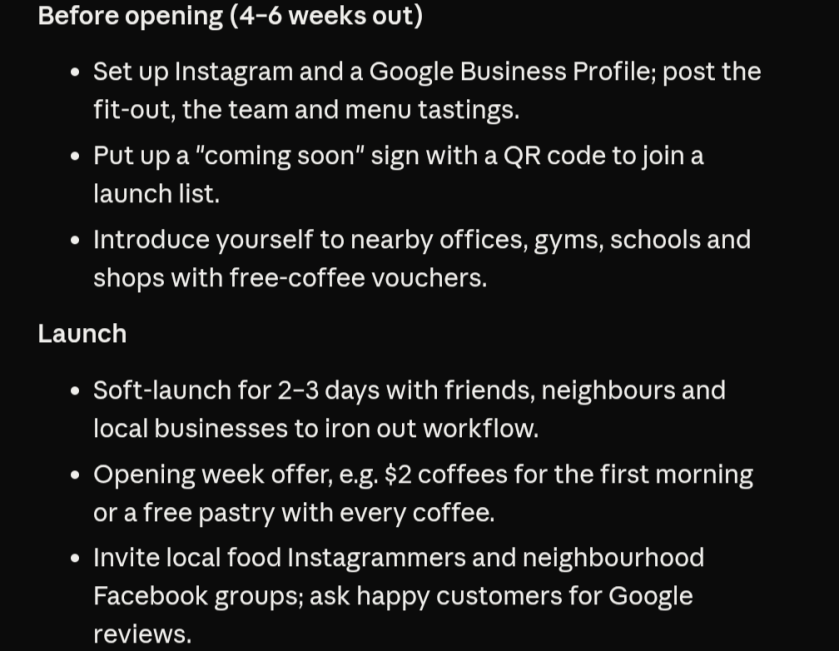
Notably, Claude didn’t trust me to pick and choose a business structure on my own. “Book one session with an accountant to pick the structure before applying for anything,” it said.
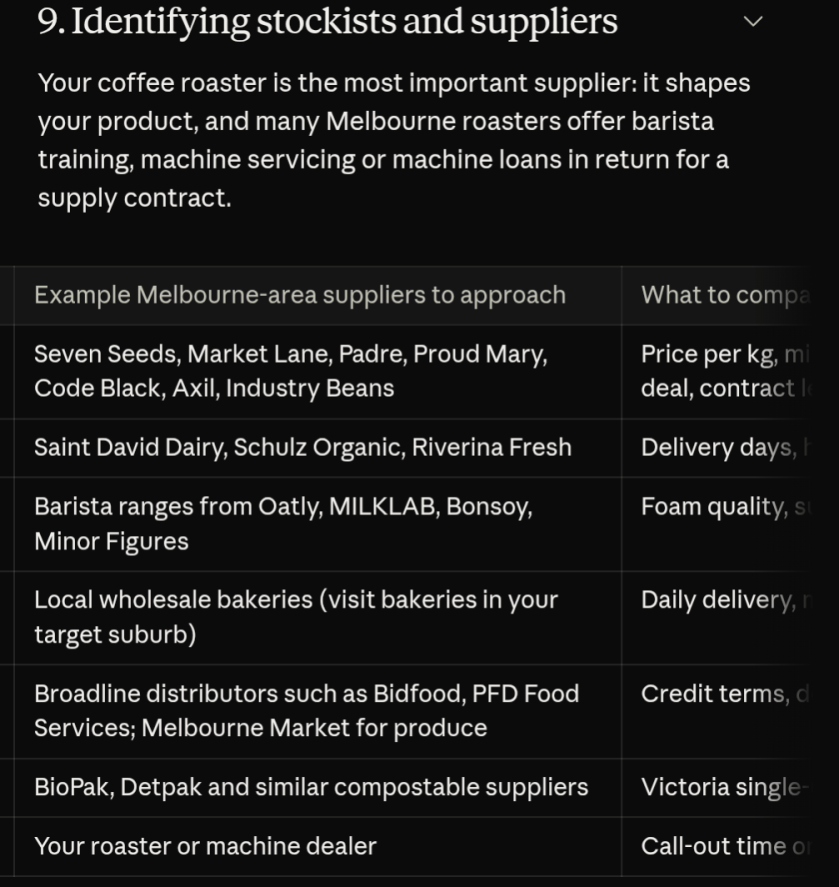
The AI tool was unwilling to let me haphazardly choose suppliers, either. While listing some big-name coffee roasters, like Seven Seeds, Market Lane, and Code Black, it urged me to seek at least three quotes per product category and conduct blind tastings before opening shop.
And Claude seemingly sensed my gung-ho approach with the following disclaimer: “This plan is general information, not legal, tax or financial advice. Confirm with an accountant, a lawyer, and your local council before committing.”
But what would happen if I did commit? And if I wanted my AI assistant actually handle all of that gruelling paperwork?
Related Article Block Placeholder Article ID: 306582

Putting AI to work
Armed with this brief, and context loaded into Claude, I tried to engineer a scenario as close to reality as I could come without actually launching a cafe.
To set a benchmark, I found a real business for sale: a coffee kiosk located in a CBD hotspot, catering to the Monday-to-Friday white collar crowd.
The listing said it sold 70+ kilograms of coffee per week, generating sales upwards of $26,000 a week.
Assuming all I do is coffee, and I charge $6 a cup for my hypothetically fancy flat whites, I would need to sell 4,333 coffees every five days to hit that sales benchmark.
That opportunity comes with a significant cost: the seller sought half a million dollars to take the business over.
Could Claude handle all of the background admin, giving me time to churn out thousands upon thousands of coffees?
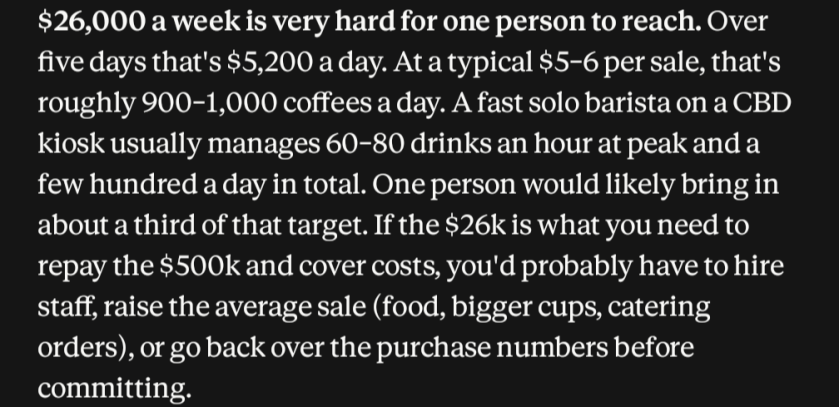
Before even getting to that point, the chatbot advised me that slinging this many coffees per week, by myself, would not be easy.
“One person would likely bring in a third of that target”, it said, advising me to look into simple food offerings to bump margins, or take on staff to help deal with the morning rushes.
With that warning out of the way, the chatbot confidently said it could look up the council forms required for my specific circumstances, and set calendar reminders for insurance and permit renewals.
It offered to connect directly to my accounting software through a list of official connectors, reconcile against my POS, and calculate my quarterly BAS figures.
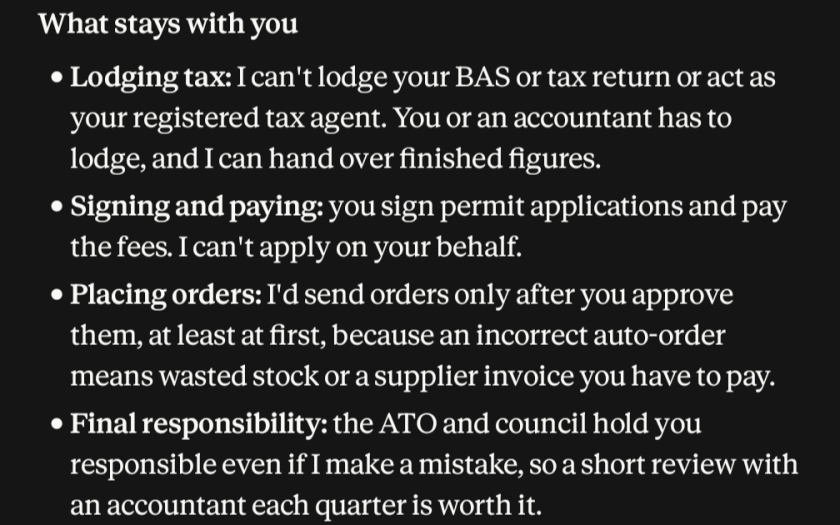
But, once again, Claude refused to directly act on my behalf in terms of BAS filings. “You or an accountant has to lodge, and I can hand over finished figures,” it said.
“The ATO and council hold you responsible even if I make a mistake, so a short review with an accountant each quarter is worth it,” it added.
Dazzled by the promise of agentic commerce, I also tasked Claude with auto-ordering coffee and milk based on inventory levels tracked by my POS.
“I’d send orders only after you approve them, at least at first, because an incorrect auto-order means wasted stock or a supplier invoice you have to pay,” it warned.
I pushed back: hospitality is a hard gig, and I need to build face-to-face rapport with my customers. How could I possibly achieve that, while also drowning in paperwork? Could it not fill out those forms for me? Please?
Again, no. “Your records could be wrong,” it said, suggesting a fallible human such as myself could misplace a receipt or accidentally pay a personal expense on my business card.
Helpfully, if annoyingly, it reminded me I’d probably overlook the fact some simple food items do not attract GST. Getting that wrong would affect my ATO lodgments, and Claude seemingly wanted no part of that.
“I make mistakes,” it continued.
“I’m careful, but my work isn’t error-free, and nothing backs a guarantee from me. If the ATO finds an error, you pay the shortfall and any penalty, not me.”
My automated cafe dreams were fading.
Related Article Block Placeholder Article ID: 346106

The real-world context
There were obvious limitations to my experiment — with no hard accounting details to pass over, lease agreements to parse, or customer complaints to analyse, I could not test the full potential of my Claude cafe partner.
But towards the end of my test run I checked in on Andon Café, a real-life, AI-run coffee shop in Stockholm, Sweden.
San Francisco’s Andon Labs gave its ‘Mona’ agent a lease, some guidance, and tasked it with hiring staff to operate the cozy cafe space.
It posted job ads, held phone interviews via a voice agent, and ultimately recruited staff. With the help of its human counterparts, Mona has, actually, helped run a small-scale hospitalty venture.
According to Andon Labs, the cafe launched in April with an opening bank balance of 573,000 Swedish krona (about $82,000).
Today that stands at just 10 krona, or $1.40.
And the cafe’s human baristas have established a “Wall of Shame” honouring Mona’s biggest missteps, like the time it ordered nearly 23 kilograms of tinned tomatoes for a dish the cafe simply did not sell.
As evidenced by my own tinkering, and the Andon Labs experiment, passing those challenges onto an AI agent and expecting it to find the right outcome is… optimistic, at best.
I wasn’t the only one to think so.
Reading the responses from Claude, I was surprised by phrases that, if uttered by a human, I would take as a subtle call to reconsider my plans.
I was also impressed by its seeming candour about the need for real humans — accountants, lawyers, and baristas capable of monitoring stock levels — to verify core business details.
Outside of the experiment, new business software integrations for Claude, and ChatGPT, Muse, Gemini, and the like emerge every day.
I’d feel much more comfortable with my experiment with those connectors in place, instead of pasting metrics into the chatbot and expecting the AI to formulate a plan.
As a final test of my Claude cafe companion, I handed it my LinkedIn profile and asked it if I’d make a good cafe manager. It instantly pinged my lack of hospitality experience.
Would it hire me over another worker with that background?
“For a cafe manager role, no. If the other candidate has solid cafe experience, including some time supervising or running shifts, I’d hire them over this profile.”
Perhaps it’s best I leave coffee to the experts, then.
Neural Notes is a regular column that looks at how AI is influencing Australia.