Updated October 26, 2026

Illustration: Quartz
Istanbul sits on two continents. The Bosphorus strait runs through the middle of the city, dividing a European side from an Asian side. The same channel connects the Black Sea with the Sea of Marmara. Control of this crossing shaped trade and power in the region for centuries.
Istanbul's landmarks record two long imperial chapters. As Constantinople, the city was the capital of the Byzantine Empire. Hagia Sophia and the Basilica Cistern both date to the sixth century under Emperor Justinian I. After Mehmed II conquered the city in 1453, it became the Ottoman capital. Sultans added palaces, mosques, markets and baths. Many of those buildings still stand within walking distance of one another on the historic peninsula.
This guide gathers 12 things to do in Istanbul for travelers planning a 2027 trip. It is a selection, not a ranking. The list moves across the historic peninsula, the Galata district north of the Golden Horn, the waters of the Bosphorus and the Asian shore around Kadikoy. It includes religious sites, a former royal palace, two historic markets, a medieval tower, a ferry ride and a traditional Turkish bath.
Each slide covers one place or experience. It explains the history behind it and what a visitor will find there. The goal is to help readers decide where to spend limited time, whether a stay lasts three days or two weeks.
A few practical points apply across the list. Several of these landmarks are working mosques. Hagia Sophia, for example, became a mosque again in 2020. Visits to active mosques are arranged around the daily prayers, and modest dress is expected. Access rules, opening hours and entry fees at several major sites have changed in recent years. They may change again before or during 2027. Travelers $TRV should confirm current details with official sources close to their departure date.
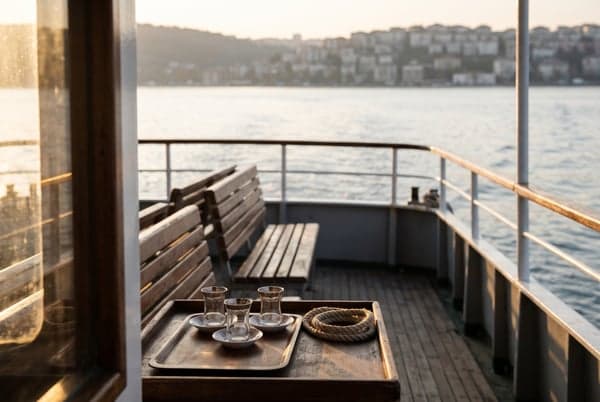
Many of the city's sights sit near the water. Public ferries work as everyday commuter transport for residents. They also give passengers a view of the skyline from the strait. A crossing between the European and Asian shores links the two halves of the city that this list covers.
Hagia Sophia, Justinian's sixth-century church turned mosque

Illustration: Quartz
Hagia Sophia is a sixth-century church built under Byzantine Emperor Justinian I. It has functioned as a mosque again since 2020. Its shifts from church to mosque to museum and back to mosque follow the political history of Istanbul itself.
The building was completed in 537. Justinian's architects, Anthemius of Tralles and Isidore of Miletus, designed it around a large central dome resting above a ring of windows. The dome partly collapsed in 558 after earthquakes damaged the structure. It was rebuilt with a taller profile.
For more than nine centuries, Hagia Sophia was the principal church of Constantinople. Byzantine emperors held major ceremonies beneath its dome. The interior was decorated with gold-ground mosaics of Christ, the Virgin Mary, emperors and saints.
That role ended with the Ottoman conquest of the city in 1453. Mehmed II converted the church into a mosque. Over the following centuries, Ottoman builders added minarets outside, along with a mihrab marking the direction of Mecca and a minbar for sermons inside.
Later Ottoman work left one of the interior's most recognizable features. Large circular panels of Arabic calligraphy were hung high in the nave in the 19th century. They bear the names of God, the Prophet Muhammad and early figures of Islam.
In the 1930s, the young Turkish Republic turned the building into a museum. That status lasted for decades. In 2020, a Turkish court annulled that decision. Muslim prayers resumed inside that July.
Some Byzantine figurative mosaics survive alongside the Ottoman additions. Among them is the Deesis mosaic in the upper gallery, which shows Christ flanked by the Virgin Mary and John the Baptist. The two traditions now share the same walls.
Because Hagia Sophia is an active mosque, visitors follow the conduct expected in any working mosque in Turkey. Shoulders and knees should be covered, and women generally cover their hair. Shoes come off before stepping onto the carpeted floor. Worshippers have priority, and quiet behavior is expected near those at prayer.
Blue Mosque, the Sultan Ahmed Mosque with six minarets

Illustration: Quartz
The Sultan Ahmed Mosque, better known to visitors as the Blue Mosque, was built in the early 17th century under Sultan Ahmed I and stands out for its six minarets. It remains an active place of worship. Visitors time their trips around the daily prayers.
The nickname comes from the interior. Blue-toned Iznik tiles cover much of the lower walls and galleries. Painted decoration in related shades spreads across the upper walls and domes. Iznik, a town southeast of Istanbul, was the center of Ottoman ceramic production in this period.
The architect was Sedefkar Mehmed Agha, who trained under Mimar Sinan. His design follows the classical Ottoman layout of a large central dome supported by smaller domes and half domes. Four massive piers carry the weight of the main dome. That arrangement leaves the prayer hall as one broad, open space. Rows of windows set high in the walls let in daylight.
Most mosques in the city have fewer minarets. The count was unusual for an Ottoman mosque, and it made the sultan's foundation easy to pick out on the skyline.
The mosque sits at the center of the Sultanahmet district, which takes its name from the building. Hagia Sophia faces it across a public square and garden. The long open space along its western side follows the line of the Hippodrome of Constantinople. That Byzantine arena was once used for chariot races. The mosque complex also holds the tomb of Ahmed I, who died in 1617, shortly after the mosque was completed.
In front of the prayer hall is a large courtyard enclosed by a domed arcade, with a fountain at its center. The courtyard gives visitors a place to take in the scale of the facade and minarets before going inside.
Muslims pray five times a day. The prayer times shift with the position of the sun through the year. The Friday midday prayer draws the largest congregation of the week. Checking that day's schedule before setting out lowers the chance of arriving during a service.
The mosque is part of the Historic Areas of Istanbul, which UNESCO added to its World Heritage List in 1985.
Topkapi Palace, seat of the Ottoman sultans

Illustration: Quartz
Topkapi Palace is the complex from which Ottoman sultans ruled their empire for about four centuries. Mehmed II built it after his 1453 conquest of Constantinople. Its best-known sections today are the Imperial Treasury and the Harem.
The palace occupies Seraglio Point, the tip of the historic peninsula. There the Golden Horn meets the Bosphorus and the Sea of Marmara. From that headland, the sultans' residence overlooked the sea approaches to the capital.
Topkapi is not a single building. It is a sequence of gates, courtyards and pavilions that later sultans expanded over generations. Visitors pass through the Imperial Gate into the first courtyard. The Gate of Salutation leads to the second, and the Gate of Felicity opens onto the third.
The layout moves from public to private. The outer courtyards handled the business of state and the needs of a large household staff. The inner areas were reserved for the sultan, his family and a small circle of attendants.
The second courtyard contains the chamber where the Imperial Council, known as the Divan, met to run the empire. The palace kitchens line one side of the same courtyard. They now display the palace's collection of Chinese porcelain.
The Imperial Treasury holds objects the dynasty gathered over centuries. It occupies the Conqueror's Pavilion in the third courtyard. Its best-known pieces include the Topkapi Dagger, set with large emeralds, and the Spoonmaker's Diamond. A separate section holds the Sacred Relics. These are Islamic religious objects, many brought to Istanbul after the Ottoman conquest of Egypt in 1517.
The Harem was the private residence of the sultan's household. The sultan's mother, wives, concubines and children lived there with their servants. Its tiled rooms, corridors and small courtyards show how the dynasty organized and guarded its domestic life.
The palace stopped serving as the main royal residence in the 19th century. Sultan Abdulmejid I moved the court to Dolmabahce Palace on the Bosphorus shore. After the founding of the Turkish Republic, Topkapi became a museum in 1924. It is part of the Historic Areas of Istanbul, which UNESCO inscribed as a World Heritage Site in 1985.
Basilica Cistern and its Medusa head column bases

Illustration: Quartz
The Basilica Cistern is a sixth-century underground water reservoir built under Emperor Justinian I to supply Constantinople. Visitors walk along raised platforms through its columned hall to reach two carved Medusa heads that serve as column bases.
The cistern sits a short walk from Hagia Sophia in the Sultanahmet district of the old city. Its English name comes from the Stoa Basilica, a large public building and square that once stood on the ground above it. In Turkish it is called Yerebatan Sarayi, which means the Sunken Palace.
The Turkish name matches the interior. A brick vaulted ceiling rests on 336 marble columns arranged in 12 rows of 28. The columns do not match one another. Their capitals include Ionic, Corinthian and Doric styles, and many appear to have been taken from older buildings and reused.
The reservoir had a practical job. Aqueducts carried water from sources outside the city walls into the chamber. From there it served the Great Palace of the Byzantine emperors and other buildings on the hill.
After the Ottoman conquest in 1453, most of the city above lost track of the cistern. In the 1540s, the French scholar Petrus Gyllius learned that residents in the area lowered buckets through holes in their basement floors. They drew water this way and even caught fish. His account brought the chamber back to the attention of European readers.
The two Medusa heads stand in the northwest corner of the hall. Each is a large stone block carved with the face of the Gorgon from Greek mythology. One rests on its side, and the other is set upside down beneath its column.
Another column draws attention for a different reason. Known as the Hen's Eye or weeping column, it is carved with a pattern of teardrop-like shapes and is often wet to the touch.
The cistern has also served as a film location. It appears in the 1963 James Bond film From Russia with Love. It also plays a central role in Dan Brown's 2013 novel Inferno and the 2016 film adaptation.
Inside, the hall is dim and damp, with shallow water covering the floor beneath the walkways. Shoes with good grip help on the wet platforms.
Grand Bazaar, Istanbul's 15th-century covered market

Illustration: Quartz
The Grand Bazaar is a covered market in Istanbul's old city. It dates to the 15th century, in the years after the Ottoman conquest of Constantinople, and is one of the largest covered markets in the world.
Its Turkish name, Kapalicarsi, translates as "covered market." It remains a working commercial district rather than a preserved monument.
The market grew around a core commissioned by Sultan Mehmed II. That original structure was a domed stone hall known as a bedesten. It held the most valuable goods, such as jewelry and fine textiles. The hall could be locked and guarded at night. Over the following centuries, shops, lanes and gates spread outward from that center under a network of vaulted roofs.
Mehmed II assigned the income from the bedesten to the religious foundation that supported Hagia Sophia. That arrangement tied trade in the new Ottoman capital to the upkeep of its principal mosque.
The bazaar has been damaged and rebuilt several times. Fire was a recurring threat in a city with so much timber construction. A major earthquake in 1894 also caused serious damage that required extensive repairs.
Inside, streets were historically organized by trade, with goldsmiths, carpet dealers and other crafts grouped together. Some street names still reflect those trades. Around the edges stand hans, multistory courtyard buildings that once lodged traveling merchants and stored their goods. Some hans still house small workshops and repair businesses.
Stalls today sell carpets and kilims, gold and silver jewelry, ceramics, leather goods, textiles, lamps and souvenirs. Much of the stock is aimed at visitors. Other sections continue to serve local traders, particularly in gold.
Bargaining is customary for many goods, especially carpets and jewelry. Comparing several shops before buying gives a sense of the going rate. Carpet buyers can ask whether a piece is handwoven or machine-made, what it is made of and where it comes from.
The bazaar sits in the Fatih district, between the Beyazit area and the Nuruosmaniye Mosque, a short walk from Sultanahmet. Its many gates allow visitors to enter on one side and leave by another. Heading downhill from the market leads toward Eminonu and the waterfront.
Spice Bazaar in Eminonu for spices, tea and Turkish delight

Illustration: Quartz
The Spice Bazaar, also called the Egyptian Bazaar, is a covered market in Eminonu, close to the Galata Bridge. It was completed in the 17th century and sells spices, dried fruit, Turkish delight and tea.
The market's Turkish name is Misir Carsisi. Misir is the Turkish word for Egypt. Egypt was an Ottoman province when the bazaar was finished. Goods from across the empire moved through Istanbul's port.
The bazaar was built as part of the New Mosque complex, known in Turkish as Yeni Cami. Ottoman mosque complexes often included rows of shops. Their rents helped fund the upkeep of the mosque and its charitable work. The market and the mosque still stand side by side on the Eminonu waterfront, near the mouth of the Golden Horn.
The building follows an L-shaped plan. Visitors move through long vaulted halls lined with stalls on both sides. Several entrances open onto the surrounding streets.
Spices are the main draw. Many stalls sell them loose by weight from open bins. Sumac, a tart, deep red spice, is used on salads, onions and grilled meat. Red pepper flakes, known in Turkish as pul biber, appear on tables across the country. Saffron is sold widely, but its quality varies. Cheaper products labeled as saffron are sometimes safflower, which looks similar but has little of the same flavor.
Turkish delight, or lokum, is a soft confection made from starch and sugar. It comes in flavors such as rosewater, lemon and pistachio, usually dusted with powdered sugar. Tea stalls sell black tea, much of it grown along Turkey's eastern Black Sea coast. Apple $AAPL tea and herbal blends are sold alongside it. Dried apricots, figs and dates fill many counters too.
Food carried home is subject to the destination country's import rules. U.S. customs, for example, requires travelers to declare food products they bring into the country.
The streets around the bazaar hold more shops selling the same kinds of goods, along with cheese, olives, nuts and coffee.
Bosphorus cruise by public ferry between Europe and Asia

Illustration: Quartz
A public ferry ride on the Bosphorus shows Istanbul from the strait that divides it between Europe and Asia. From the water, palaces, fortresses, mansions and bridges line both banks.
Many residents live on one shore and work on the other. The public ferries that carry them across are the same boats a visitor can board.
From the deck, both shorelines show layers of Istanbul's past. On the European bank, Dolmabahce Palace sits directly on the water. Ottoman sultans moved their court there from Topkapi Palace in the mid-19th century. Its long marble facade is easier to take in from a boat than from the street behind it.
Farther north, two fortresses face each other across one of the strait's narrowest stretches. Rumeli Hisari, on the European side, was built by Mehmed II in 1452. That was one year before the conquest of Constantinople. It let the Ottomans control ships sailing toward the city. Anadolu Hisari, on the Asian side, is older. It dates to the late 14th century under Sultan Bayezid I.
Between these landmarks, the banks are lined with yalis. These are the wooden waterfront mansions that wealthy Ottoman families built as summer homes. Some still stand in neighborhoods such as Bebek and Kandilli.
Three suspension bridges now cross the strait. The first opened in 1973 and is now called the 15 July Martyrs Bridge. Fatih Sultan Mehmet Bridge followed in 1988. Yavuz Sultan Selim Bridge, close to the Black Sea entrance, opened in 2016.
Near the southern end of the strait, the Maiden's Tower stands on a small islet off Uskudar on the Asian shore.
The Bosphorus is also an international shipping lane. Tankers and cargo vessels moving between Black Sea ports and the Mediterranean pass through it. The 1936 Montreux Convention governs that passage. Passenger ferries share the water with these ships.
Tea and simit, a sesame-crusted bread ring, are commonly sold on board. Private operators also run dedicated sightseeing cruises. Departure points, schedules and fares change. Check them close to a 2027 trip.
Galata Tower views over the Golden Horn and old city

Illustration: Quartz
Galata Tower is a 14th-century stone tower built by a Genoese colony on the hill above Karakoy. Its upper level offers a wide view across the Golden Horn to the old city. Its conical roof is visible from much of the waterfront on both sides of the inlet.
The tower comes from a part of Istanbul's history that is separate from both the Byzantine court and the Ottoman sultans. In the late Byzantine period, the emperors in Constantinople let the merchant republic of Genoa run a trading colony across the Golden Horn from the walled city. The Genoese fortified the settlement, and the tower was built as part of those defenses. Galata had its own administration and commerce. It was a self-governing foothold facing the Byzantine capital.
That arrangement ended with the Ottoman conquest in 1453. The tower survived, and the Ottomans gave it new uses. One was as a fire watch post. Lookouts at the top could spot smoke rising over a city built largely of timber houses.
The tower is also tied to a well-known Istanbul story. The 17th-century travel writer Evliya Celebi recorded that Hezarfen Ahmed Celebi flew from the tower on artificial wings, crossing the Bosphorus to Uskudar. The account is generally treated as a legend rather than a verified event.
Most visitors today climb the tower for the panorama. Looking south, the view takes in the Golden Horn, the Galata Bridge and the domes and minarets of the historic peninsula. On a clear day, the old city's skyline climbs from the waterline up its hills. The view also covers the point where the Golden Horn opens into the Bosphorus.
The tower sits within walking distance of other parts of the city. Steep lanes run downhill from its base toward Karakoy and the water. The slope uphill leads toward the Beyoglu district and Istiklal Avenue. Walking across the Galata Bridge from Eminonu is a direct way to reach the area from the old city.
Suleymaniye Mosque by Mimar Sinan above the Golden Horn

Illustration: Quartz
The Suleymaniye Mosque was designed by the architect Mimar Sinan for Suleiman the Magnificent and completed in 1557. It stands on a hilltop in the old city, overlooking the Golden Horn. Its domes and minarets are visible from the water and from the Galata side across the inlet.
Suleiman ruled the Ottoman Empire from 1520 until his death in 1566. His reign saw long military campaigns and a major codification of Ottoman law. In Turkish he is known as Kanuni, which means the Lawgiver.
Sinan served as chief architect to the Ottoman court. He worked for several sultans and designed a large number of mosques, bridges and other buildings across the empire. Construction at the Suleymaniye began in 1550, about seven years before its completion.
The prayer hall is organized around a large central dome supported by half domes. Hagia Sophia, the Byzantine building a short distance away, uses a similar arrangement of a central dome and half domes. Rows of windows at the base of the dome and along the walls let natural light into the interior. Four minarets rise from the corners of the courtyard.
The mosque was never meant to stand alone. It sits at the center of a complex, known in Turkish as a kulliye. The complex originally included religious schools, a hospital, a public kitchen, a bathhouse and rows of shops. Several of these buildings still surround the mosque. Some now serve different purposes.
The garden behind the prayer hall holds the tombs of Suleiman and his wife, Hurrem Sultan. Sinan's own tomb sits just outside the complex walls.
The terraces along the edge of the grounds face north across the Golden Horn toward Galata. The Grand Bazaar lies a short walk away. The streets running downhill lead toward Eminonu and the waterfront. That position lets a visit fit into a walking route through the old city's commercial districts.
The Suleymaniye remains an active place of worship.
Chora Church (Kariye) and its 14th-century Byzantine mosaics

Illustration: Quartz
Chora Church, called Kariye in Turkish, is a Byzantine church in Istanbul known for the mosaics and frescoes added to its interior in the 14th century. It reopened as a mosque in 2024, the latest of several changes in the building's status.
The name Chora comes from a Greek word meaning countryside. It recalls an early monastery that stood outside Constantinople's first walls. The fifth-century Theodosian land walls later brought the site inside the city. Today the building stands in the Edirnekapi area of the Fatih district, a short walk from those fortifications.
The decoration dates to a rebuilding paid for by Theodore Metochites, a senior official at the court of Emperor Andronikos II Palaiologos. One mosaic shows Metochites kneeling before Christ and offering him a model of the church. He wears the oversized hat that signaled his rank at court.
Metochites was also a scholar and writer at the Palaiologan court. He lost his position after Andronikos III took the throne in 1328 and was sent into exile. He was later allowed to return to Constantinople and spent his final years as a monk at Chora, where he died in 1332.
Most of the mosaics cover the two narthexes, the entrance halls on the western side of the building. Their panels follow the life of the Virgin Mary and the life of Christ in sequence. The scenes from Mary's childhood draw on the Protoevangelium of James, an early text outside the biblical canon.
The frescoes are in the parekklesion, a side chapel built as a burial space. Its best-known painting, the Anastasis, shows Christ pulling Adam and Eve from their tombs. The broken gates of the underworld lie beneath his feet.
Ottoman authorities converted the church into a mosque in the early 16th century. In the 20th century it operated as a museum for decades. During that period, the Byzantine Institute of America led restoration work that uncovered and cleaned much of the decoration.
Kadikoy and Moda on Istanbul's Asian side

Illustration: Quartz
Kadikoy is a district on Istanbul's Asian shore, reached from the European side by ferry. It shows everyday city life away from the old city's monuments, and its market streets and the seaside Moda neighborhood are the main draws.
The district occupies one of the oldest settled sites in the city. Ancient Chalcedon, a Greek colony founded by settlers from Megara, stood here before Byzantium was established across the Bosphorus. The Greek historian Herodotus recorded a remark by the Persian commander Megabazus that the founders of Chalcedon must have been blind. In his view, they had passed over the better site on the opposite shore.
Chalcedon also holds a place in Christian history. The Council of Chalcedon met there in 451. It was the fourth of the early church's ecumenical councils. Its definition of the nature of Christ divided the churches that accepted it from the Oriental Orthodox churches that rejected it. That split remains in place today.
The district's current name comes from Turkish. Kadikoy is usually translated as "the judge's village." The name combines kadi, the Ottoman Turkish word for a judge, with koy, the Turkish word for village.
The food market area lies in the streets just inland from the ferry landing. Shops and stalls there sell fresh fish, fruit and vegetables, cheese, olives, pickles, spices and prepared dishes. The layout suits browsing and small purchases more than a single sit-down meal. Visitors often move from one counter to the next.
Moda is a short walk south of the center, on a small promontory that reaches into the Sea of Marmara. Its waterfront paths and parks look across the water toward the historic peninsula and, on clear days, the Princes' Islands. The side streets hold cafes, bookshops and small stores. The shoreline fills with residents in the evening.
Kadikoy is also home to Fenerbahce, one of Turkey's major football clubs. The club's stadium stands within the district. Match days bring large crowds of fans into the surrounding streets.
For a visitor's itinerary, Kadikoy fits as a half-day or evening trip. It offers a contrast to days spent in mosques, palaces and museums. It also shows the residential side of Istanbul, where much of the city's population lives and works.
Cagaloglu Hamami and the Turkish bath tradition

Illustration: Quartz
Cagaloglu Hamami, built in the 18th century in Istanbul's old city, is among the best-known historic baths in Istanbul. Its rooms follow the classic sequence of an Ottoman hammam, from a dressing hall to a heated marble chamber.
The hammam tradition grew out of the bathhouses of the Roman and Byzantine worlds. Ottoman builders kept the core idea of heated rooms and running water. They organized the bath around washing rather than soaking. A traditional hammam has no deep plunge pool. Bathers rinse with water poured from basins instead.
A visit usually begins in the camekan, the dressing and resting hall near the entrance. Bathers change there and wrap themselves in a pestemal, a thin cotton cloth worn throughout the bath. Wooden clogs or slippers are common for walking on wet marble.
From there, bathers pass through the iliklik, a cooler intermediate room, into the sicaklik, the hot room. At its center sits the gobek tasi, a raised marble platform heated from below. Bathers lie on the warm stone to sweat before washing. Marble basins called kurna line the walls. Taps feed the basins, and bathers use small bowls to pour water over the body.
The scrub is the central treatment. An attendant works over the skin with a kese, a coarse mitt that lifts away dead skin. A soap and foam wash usually follows. A male attendant is traditionally called a tellak, and a female attendant a natir.
Cagaloglu has separate sections for men and women, in keeping with Ottoman practice. Its domed ceilings are pierced with small glass openings that let daylight fall through the steam.
Hammams once served a social purpose as well as a practical one. Before indoor plumbing was common, the neighborhood bath was where residents washed, met and talked. Many Ottoman baths were built as part of mosque complexes. Their income helped support the charitable foundations that ran those complexes.
The bath sits a short walk from Hagia Sophia. Prices, booking options and hours can change. Confirm them directly with the bath before a visit.