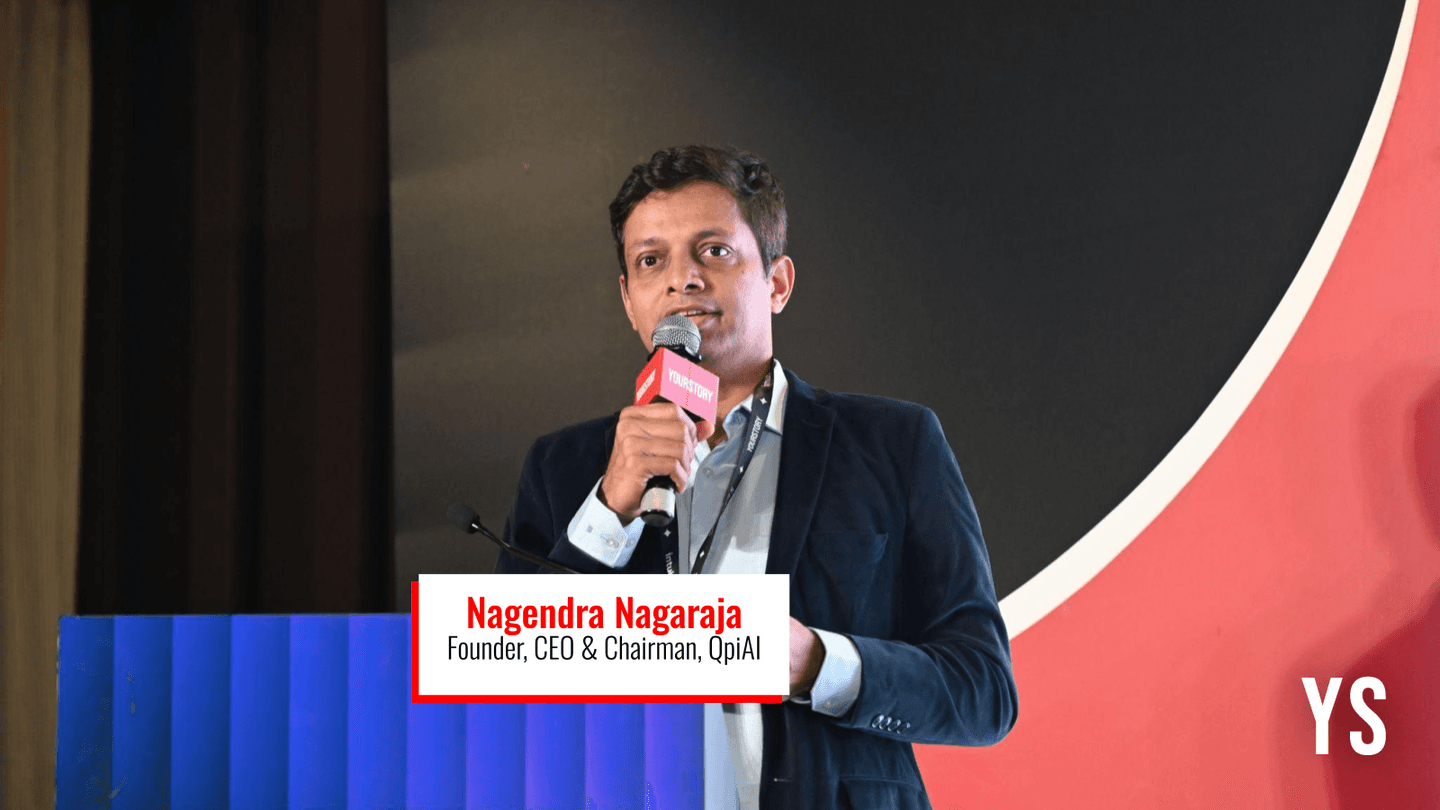
Nagendra Nagaraja, founder, CEO, and chairman of QpiAI, believes that artificial intelligence is fundamentally misunderstood.
“I don’t want to use the word AI, I want to use the word intelligence modelling,” Nagaraja said during his keynote speech at the 17th edition of YourStory’s flagship tech-startup event, TechSparks.
He explained conventional AI primarily automates tasks using digitised human knowledge rather than expanding human understanding. For Nagaraja, true intelligence requires a fundamental paradigm shift.
“Intelligence means that you have some information that nobody has... But the definition of intelligence for me is knowing new things that we can’t know,” he said, adding that “for all intelligence, there is one Godfather... We call that as data.”
Hitting the silicon wall
Today’s AI boom relies on classical microprocessors that process information using binary bits, represented by zeros and ones. However, conventional silicon semiconductors face physical limitations as chip performance scales. Electrical resistance generates heat, creating challenges in chip design and pushing companies towards advanced packaging techniques, including 3D chip stacking. Meanwhile, large data centres are placing increasing demands on power grids, with some consuming gigawatts of electricity.
“A lot of AI companies... understand that they have to spend NVIDIA tax, to give money to NVIDIA to use GPUs,” Nagaraja pointed out.
Additionally, large language models (LLMs), algorithms trained on human text, are hitting data saturation and yielding diminishing returns despite requiring trillions of dollars in investment.
According to Nagaraja, a fundamental limitation of current AI is its total reliance on digitised human text, which represents a miniscule fraction of universe-level information. In contrast, the vast majority of data across the universe, encoded in electrons, molecules, DNA, and crystalline materials, exists in an unquantised, quantum state that classical GPUs cannot process.
Processing high-dimensional, NP-hard mathematical problems on classical supercomputers can require mathematical calculations spanning 10 to the power of 25 years. Quantum computing solves this by using quantum bits, or qubits, which process multi-dimensional data exponentially faster.
“As humanity, for the last 5,000 years, we know 10 power 10 molecules... We need to know 10 power 50 molecules. And we don’t have 25,000 years. We have to do it in one decade,” Nagaraja asserted.
Unlocking nature’s quantum data
Moving beyond human-generated text to modelling natural systems could transform industries, Nagaraja argued.
“There are only two big industries in this world. One is energy, the other is compute. Rest of all are derived,” he said.
For instance, he discussed the challenge of modelling complex chemical reactions associated with plants' absorption and processing of fertilisers. According to Nagaraja, such problems could be beyond the reach of classical computing at scale. He suggested that a quantum system with 3,000 logical qubits—error-corrected qubits designed to operate more reliably than physical qubits—could model such reactions, potentially transforming agricultural production.
Similarly, quantum hybrid models combining classical software with quantum hardware are already enhancing financial fraud detection in major banks with significantly lower energy overhead.
Unlocking these capabilities demands advanced hardware and rapid error correction, the process of fixing quantum noise in real time.
Nagaraja said QpiAI operates what it describes as Asia’s largest quantum fabrication facility in Bengaluru, producing 25-qubit and 64-qubit chips, with an error correction speed of 1.4 microseconds that beats international benchmarks. The company is currently building a ten-acre quantum data centre equipped with 100 quantum computers, alongside plans for 1,000-qubit chips.
“India has arrived... We are one of the 5 countries in the world which has more than 50 qubit manufactured here,” Nagaraja said. Ultimately, advancing beyond current AI limits requires humanity to “become a very good student of nature” to harness its infinite data.