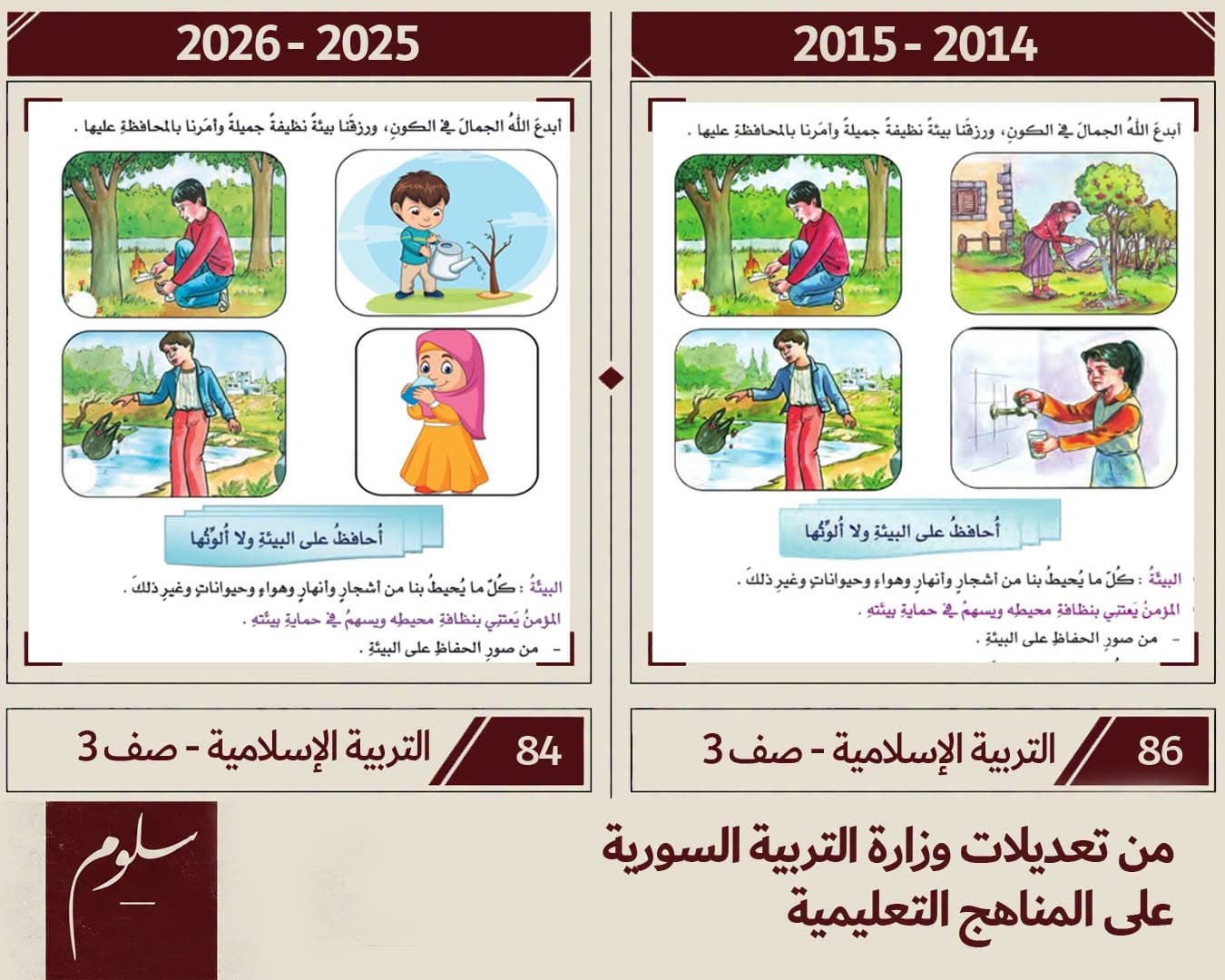
A series of recent alterations to Syrian school textbooks—ranging from the removal of lessons and illustrations to the addition of headscarves on female figures, the blurring of sculptures and artworks, and the deletion of civic education units—has sparked a wide public debate across social media. The changes have prompted renewed scrutiny of the Ministry of Education’s criteria for curriculum review and the extent of its authority over content.
The issue gained momentum after Syrian journalist Mohammad al‑Saloom published side‑by‑side comparisons of older and updated textbook editions. Shortly thereafter, the fact‑checking platform “Verify‑Sy” confirmed the modifications by comparing archived digital copies with the official digital and printed versions approved for the 2026–2027 academic year.
Concerns Over Representation, Women’s Imagery, and Social Diversity
According to “Verify‑Sy,” the documented changes include blurring images of women and children, adding headscarves to female characters, obscuring statues, and replacing fine art reproductions. In addition, entire units on local administration, political life, citizenship, media literacy, and democratic participation were removed from the sixth‑grade social studies textbook.
These revisions have reignited debate over how women and social diversity are represented in educational materials. They have also raised broader questions about who holds the authority to remove or alter content, and whether the changes reflect official policy or discretionary decisions made by textbook committees.
Public commentary has focused heavily on what critics describe as a deliberate narrowing of women’s representation and a systematic erasure of artistic works from the curriculum.
Syrian journalist Eyad Shurbaji published a widely circulated critique, arguing that the focus on imposing social restrictions through textbook edits contradicts official claims of institutional reform. He warned that the influence of hardliner religious actors within public institutions could shape the worldview of future generations far more profoundly than debates over cultural events.
Another commentator questioned whether the revised textbooks still reflect Syria’s religious and ethnic pluralism, noting a widening gap between official rhetoric celebrating diversity and curricular edits that appear to diminish it.
Individual Initiative or Institutional Policy?
The question of accountability has become central to public reaction, with critics urging the Ministry of Education to clarify the decision‑making process behind the revisions and to publish explicit guidelines governing textbook review.
One commentator argued that attributing the changes to “individual initiatives” does not resolve the controversy, stressing the need for an official explanation of whether the edits were mandated by formal directives or introduced independently by review committees.
These concerns have gained additional weight following remarks made by Minister of Education Mohammad Abdul Rahman Turko before the People’s Assembly on September 14, 2026. The minister stated that imagery and symbols associated with the former regime had been removed from new textbook editions as part of an effort to unify the curriculum across all Syrian provinces.
Earlier, on August 17, the Ministry announced that the 2025–2026 curriculum—known as the “Damascus Curriculum”—would be adopted nationwide for the 2026–2027 academic year, noting that national standards for newly authored curricula had been finalized.
International Report Expands the Debate
The domestic controversy coincides with the publication of an October 19, 2026 report by IMPACT‑se, an international organization that monitors school curricula. The report examined 130 textbooks used in grades 1 through 12 during the 2025–2026 school year.
IMPACT‑se found that the curricular revisions implemented after the fall of the Bashar al‑Assad regime extended beyond the removal of regime symbols. They included shifts in the presentation of national identity, religion, and history, as well as a marked reduction in the visibility of women and minority groups.
The report also noted an increased emphasis on Islamic references in certain subjects, changes in the treatment of topics such as jihad and martyrdom, and the reduction or removal of scientific concepts, including sections on evolution and the Big Bang theory.
While the Ministry of Education maintains that curriculum unification is intended to standardize educational benchmarks under newly established national criteria, the documented revisions continue to fuel debate over the future direction of Syrian educational content and the standards that will govern representation, civic education, and diversity in school textbooks.
This article was translated and edited by The Syrian Observer. The Syrian Observer has not verified the content of this story. Responsibility for the information and views set out in this article lies entirely with the author.
The post Controversy Deepens Over Syrian Curriculum Revisions: Women’s Imagery, the Arts, and Citizenship Lessons Removed first appeared on The Syrian Observer.