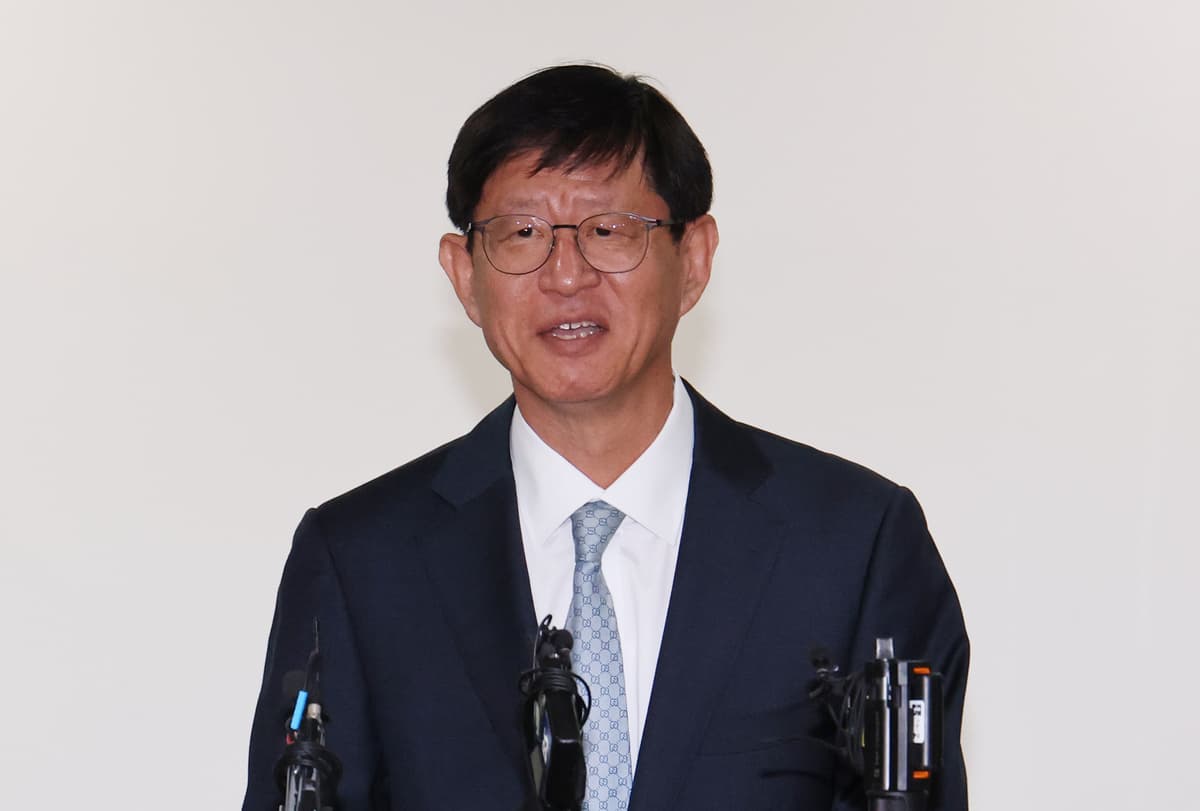
Special Inspector Choi Gil-soo said on the 26th that he would "maintain political neutrality and independence in carrying out my duties to the very end." He drew a clear line against calls from some quarters to expand the scope of inspections down to the secretary level, warning that "conducting inspections in violation of the law is itself punishable."
Choi made the remarks to reporters as he arrived at the special inspector's office, set up in a building in Seoul's Jongno District. "Being appointed special inspector 10 years after the resignation of Lee Seok-su, the first inspector, I feel an infinite sense of responsibility," he said. He laid out political neutrality, independence in carrying out his duties, and preventive inspection as his guiding principles.
On neutrality, Choi said: "If we fail to maintain neutrality and independence in our work, the special inspector system becomes a hollow institution and its effect is halved." He pledged to "take care in advance, on my own, to avoid being drawn into disputes over fairness."
On preventive inspection, he cited the Confucian classics. "In the Chinese classics the Doctrine of the Mean and the Great Learning, there is a term called 'sindok.' It means exercising restraint and engaging in self-reflection when one is alone," he said. "I believe the special inspector system is an institutional check that makes senior public officials constantly reflect on themselves." He added: "In that sense, I want the special inspector's office to be like a panopticon — an entity that can keep its eyes wide open and watch those subject to inspection," referring to the circular prison design in which surveillance becomes internalized.
He also signaled an active approach, saying that "inspection work involves gathering information. It is not something done passively, waiting for someone to come forward, as with criminal complaints."
At the same time, he made clear that he has no choice but to limit those subject to inspection to the categories set out in the law: the president's spouse and relatives within the fourth degree of kinship, and officials at or above the rank of senior secretary in the Presidential Secretariat. "If there is a person subject to inspection and a third party involved, that third party is something like what investigative agencies call a 'witness' — they cannot be a subject of inspection," he said. The opposition has argued that figures such as Kim Hyun-ji, head of the first office of the Presidential Secretariat, who holds secretary-level rank, should also be inspected, but Choi made clear that this is not possible unless the law is amended.
For the time being, Choi is expected to focus on stabilizing operations, including appointing a deputy special inspector and inspection officers and bringing in seconded civil servants. Asked whether there were any allegations he was watching, he said "not yet," adding that "I was just appointed, and if I had begun work before that, it would have been a violation of the Special Inspector Act."