
By PYMNTS | October 27, 2026
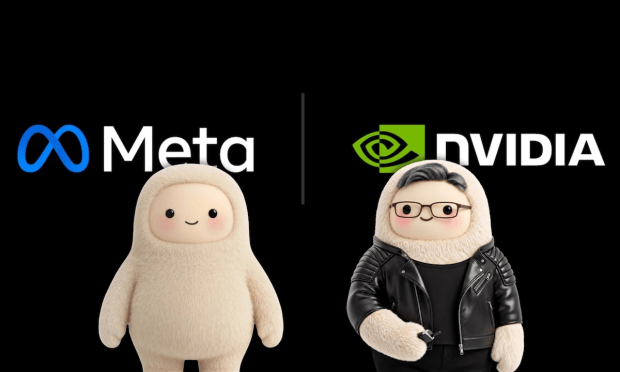
Meta has turned to Nvidia for help in expanding its Muse family of AI models.
The collaboration will focus on improving inference and training performance amid rising demand for “useful” AI agents, Nvidia said in a Monday (Oct. 26) news release.
“AI agents represent a new computing paradigm—software that understands our goals, reasons, uses tools and gets work done on our behalf,” Jensen Huang, founder and CEO of Nvidia, said in the release.
“This changes how we use computers, from operating applications to working with intelligent agents. Nvidia and Meta are expanding our partnership to optimize the computing infrastructure end to end for capable, efficient and secure AI agents, so Muse can empower billions of people to achieve more and pursue greater ambitions,” Huang added.
The Muse artificial intelligence (AI) models and agents already use Nvidia’s infrastructure. Now, the two companies are expanding their partnership to focus on “optimizations across workflows to maximize performance and improve total cost of ownership,” the release added.

We’d love to be your preferred source for news.
Please add us to your preferred sources list so our news, data and interviews show up in your feed. Thanks!
Meta and Nvidia will also consider additional chances to collaborate around Nvidia’s OpenShell Reference Architecture, while Nvidia will also invest $3 billion in Meta’s equity offering, announced Monday.
“Muse is how we bring personal superintelligence to everyone. We’re excited to keep working with NVIDIA to deliver the best personal agents and frontier models for billions of people,” said Mark Zuckerberg, Meta founder and CEO.
Meta’s equity raise hopes to bring in $95 billion to support the company’s AI efforts with Muse as well as growth in its “core apps” like Facebook and Instagram.
PYMNTS wrote last week that Muse has become the “new centerpiece” in Zuckerberg’s AI ambitions, with the executive positioning the model as “the foundation for everything from shopping and advertising to enterprise software and smart glasses.”
In other AI news, new PYMNTS Intelligence research addresses a question the technology has created for small businesses: What happens when these companies can expand their revenue without expanding payroll?
The research conducted in October found that 60% of small- to medium-sized businesses (SMBs) using AI said they can produce more without hiring new workers. Among growing businesses, 16% said they’d skipped a full-time hire because of AI, compared with 10% of businesses seeing flat revenue.
“The findings suggested that AI’s most consequential labor market impact may not be the employees that companies eliminate, but the positions they no longer need to create,” PYMNTS wrote Tuesday (Oct. 27). “As automation makes routine work cheaper, the same forces reducing demand for labor may be creating a new market for human judgment and accountability, something harder to automate.”
For all PYMNTS AI and digital transformation coverage, subscribe to the daily AI and Digital Transformation Newsletters.