
Three numbers and a letter opened the negotiations in a private message: 135K. That was the $135,000 that Silvia Zhang, a Los Angeles businesswoman, offered Tronderrica James, a Nevada woman, in 2023 to carry a child she claimed she was unable to have by any means. Later, an assistant at a surrogacy agency provided more details: “They are a Chinese couple looking for their miracle baby.” A contract sealed the arrangement.
Poppy, as the miracle baby was named, was born at a Las Vegas hospital in February 2025 while James was fighting for her life. James had no idea that the infant would end up in an Arcadia mansion, surrounded by misery. She would become the youngest of the 21 children rescued by authorities. She was just two months old when social workers removed all the children living with Zhang and her partner, Guojun Xuan, who are accused of subjecting them to a strict disciplinary regime that included beatings so severe that one child ended up in the hospital.
Poppy, now one year and eight months old, and the other children remain under the protection of a Los Angeles County agency. Zhang and Xuan have been in jail since their arrest earlier this month and face child abuse charges that could keep them behind bars for more than a decade. Both have pleaded not guilty. A judge set bail at $20 million each, citing their substantial financial resources.
But the case does not end there. The FBI is conducting a parallel investigation alongside the local authorities’ inquiry, focusing on other possible crimes whose details have not yet been disclosed.
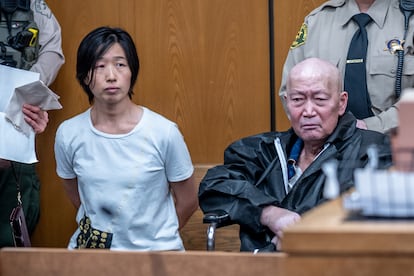
“I find it deeply repugnant that the same people who came before me saying they wanted to start a family and have a ‘miracle baby’ concealed devastating information that would have fundamentally changed my decision to carry their daughter,” James said in a written statement sent to EL PAÍS. “I would describe my experience with Silvia Zhang and Guojun Xuan as one of the most disturbing betrayals of trust I have ever lived through,” she added.
Authorities are still investigating whether Zhang and Xuan are the biological parents of the 21 children who lived in their nine-bedroom luxury home. At least 14 of them were born through surrogacy. “The number of children who were subjected to this alleged horrific abuse is unprecedented,” District Attorney Nathan J. Hochman said at a press conference. “This house could only be described as a house of horrors,” he said.
The 15-page indictment names four surrogate mothers who gave birth to five babies in exchange for payments ranging from $45,000 to $135,000. One of them is Tronderrica James, whom prosecutors refer to by the initials T.J.
According to prosecutors, the defendants recruited women from across the country by claiming they wanted to start a family. Some of the surrogates discovered, only after they were several months pregnant, that their clients already had so many children at home that they could barely care for them. An army of nannies and the watchful eye of 32 surveillance cameras helped the couple enforce their harsh punishment regime, prosecutors allege.
“I did not agree to take part in what was called ‘the house of horrors,’” James told EL PAÍS. “I agreed to help bring a ‘miracle baby’ into the world,” she said.
The miracle of Poppy
Everything seemed filled with hope as preparations were made for Poppy’s arrival. At least that was how the woman who carried the child saw it.
The contract formalizing the arrangement was signed in March 2024. Under its terms, Xuan agreed to provide the sperm. The embryo transfer took place in June of that year at a fertility clinic in Encino, an affluent neighborhood in northern Los Angeles. The surrogate received an advance payment of $8,500, according to a lawsuit she and her husband, Travis James, later filed in federal court in Los Angeles, alleging fraud and emotional distress.
The negotiations with James, the monitoring of the pregnancy, and all communications were handled through Mark Surrogacy Investment, an agency registered at the address of the defendants’ mansion that has been operating since 2021. Xuan was listed as chief executive and Zhang as manager. James says she uncovered those links only months later while investigating the couple in preparation for the lawsuit.
The U.S. federal government does not regulate surrogacy; each state has its own laws governing the practice. The process requires a legal contract between the intended parents and the gestational mother, who undergoes an in vitro fertilization procedure. California has one of the highest rates of births through surrogacy.
The Arcadia case highlights the gray areas surrounding an industry that continues to pose major regulatory challenges. This particular investigation has been complicated by the fact that the defendants operated their own agencies while concealing their ties to them. It is not even clear whether Xuan and Zhang were romantically involved or simply business partners.
How the Arcadia mansion ended up filled with children remains a mystery. Mitchell Krems, the couple’s attorney, told ABC that his clients simply wanted a large family. “He’s being unfairly scrutinized because he has so many children. There’s no law against having all these children, none at all, so my client is not abusive whatsoever,” the lawyer said.
The excitement surrounding Poppy’s arrival began to fade quickly. In July 2024, Zhang appeared largely uninterested in the progress of the pregnancy. “Do you ever speak with Silvia? It seems odd to me that she never answers. Yesterday I sent her the heartbeat and I have not received any response,” James wrote to a representative at Mark Surrogacy Investment.
Some time later, Zhang sent a brief message through the assistant: “I am glad to know the baby is fine,” reads the lawsuit.
More excuses followed to explain her distance: that she was “very sick,” that private messages were getting lost, and that she was “very busy” during the summer. Still, she insisted they were eagerly awaiting Poppy’s arrival. “We are very happy. We can’t wait for our baby to arrive.”
James responded directly, warning that she would stop sharing updates about the pregnancy: “It hurts me a lot that you never answer me, especially when I try to share such important moments with you. I do not believe that you are ‘too busy’ for your own child.”
“I was on the brink of death”
Xuan and Zhang’s indifference reached its peak in the early hours of February 21, 2025, when Poppy was born at a medical center in Las Vegas. Neither of them was present at the birth, despite what the contract stipulated. According to the lawsuit, they left only one precise instruction with hospital staff: that the baby be taken care of immediately after birth and that James not be allowed near her or to say goodbye.
“I underwent an emergency cesarean, suffered severe hemorrhaging and hypovolemic shock, and lost consciousness during recovery. I was truly on the brink of death and needed interventions to save my life. All of this happened in front of my husband and our son, who was then six years old,” James recounted in the statement sent to this newspaper.
Two photographs are the only mementos the family has of Poppy. In one, a doctor placed the newborn behind James while she recovered in a hospital room. In the other, her husband holds the baby in his arms. They never saw her again.
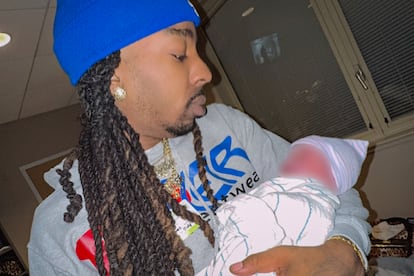
“Despite the circumstances surrounding her birth, she remains a human being whom I helped bring into the world. We sincerely hope she is safe, loved and protected,” James said.
The rooms of torture
When Poppy arrived at the mansion of horror, the situation was unbearable. From the outside, the lavish residence in Arcadia, an affluent suburb 15 miles northeast of Los Angeles, looked like a palace befitting Xuan, a businessman who runs several companies with fortune estimated by authorities at $100 million.
Inside, however, it was a nightmare for 21 children subjected to an almost military-style regime.
Three rooms in the house had been set up as “learning centers,” where the older children were required to sit at desks for several hours a day under the watchful eyes of their caregivers. Those who broke the rules were beaten without mercy. Specific sticks were kept for punishment. According to prosecutors, the most common forms of abuse included blows to the head with an open hand, slaps, and strikes with shoes. Caregivers were instructed not to leave visible marks on the children’s bodies.
“They were subjected to horrific abuse,” said Robert Luna, sheriff of Los Angeles County, who led the investigation, at a press conference.
Poppy had been in the mansion for 72 days when, on May 4, 2025, one of the nannies, Chunmei Li, struck a young boy named Walter so hard on the head that she caused a serious injury. The adults were unable to treat him at home. Two days later, they had no choice but to take him to a hospital, where medical staff grew suspicious of the explanation that the child had fallen from a bed while under adult supervision.
Li has been charged with child abuse causing great bodily injury. She is a fugitive and is believed to be hiding in China.

The day after that hospital visit, Arcadia police searched every corner of the residence and seized the security camera recordings, which became evidence of the child abuse. “What they discovered raised even more serious concerns,” Sheriff Luna said.
The videos showed recent incidents in which a child was struck with a shoe. Other recordings captured the cries of children who had allegedly been beaten in a room without cameras. The footage also showed caregivers removing the children’s clothes to check for marks left by the beatings.
Poppy’s uncertain future
“I felt a physical sickness. But what kind of sick people are these?” James recalls thinking when she learned the details of the case. Her own investigation also revealed that Silvia Zhang ran two other surrogacy agencies operating in Los Angeles: Hope Surrogacy and Future Spring Surrogacy. Both are now under scrutiny from investigators.
On the day of the raid, in May 2025, the 21 children were placed under the custody of a Los Angeles County agency. It took 16 months for the investigation to lead to Xuan and Zhang’s arrest on October 6.
Before that happened, James sent both of them an email: “Explain why you misrepresented yourselves” and “tell me the truth about what happened to the baby I carried in my womb.”
The response, received the next day, did not put her at ease. “I can tell you that Poppy is safe, healthy and well cared for. This situation is complex and emotional for all involved,” an employee of the Mark Surrogacy Investment wrote in an email that forms part of the evidence in James’s lawsuit.
For now, the future of Poppy and the other 20 children remains uncertain. Authorities are keeping the children’s location secret while criminal proceedings against Xuan and Zhang move forward.
“My greatest concern remains the welfare of the children,” James said, adding that she constantly thinks about Poppy and prays to God that she is all right. “They deserve safety, stability, dignity and love. I would not want them to be remembered as the ‘collateral damage’ that has brought us to this situation.”
Sign up for our weekly newsletter to get more English-language news coverage from EL PAÍS USA Edition