
I have been grieving my mother for years, even though she is still alive. Sometimes before falling asleep – in that liminal space between waking and sleeping where the self becomes porous – I’d see the image of the sweet and caring woman who would come to say goodnight, her cheeks covered in thick layers of night cream. Then, out of nowhere, the image would flip into the raging woman who was so entangled in her own suffering that she turned her frustration on us. Over the years, that second woman slowly swallowed the first, as she got pulled into my brother’s addiction. It’s hard to say where her own unhappiness ended and my brother’s suffering began, but together they drifted into a parallel reality, cut off from the world beyond their heads. There was no funeral for this. No condolence cards. No flowers. No phone calls. No leave of absence. What was I supposed to mourn?
And yet what I felt for them, what I still feel, has the unmistakable gravity of mourning. Can there be grief without death? I have come to think that we grieve much more often than we realise, and that death is grief’s most visible occasion rather than its essence. If that doesn’t match your experience, it may be because we rarely call these other losses by their name. Most of our losses arrive without a funeral. That is the human predicament: we are creatures built to attach, living in a world where nothing stays. Sooner or later, we lose the things we care about. And since we are complex beings with a body, a mind, a community and an environment – beings who love many different things – there is a great deal we can lose, from our physical health to our sense of who we are, from relationships to homelands to the natural world we share with other species. For creatures like us, there is no way around heartbreak: to live is to lose. Grief is what love does when its object is gone. It is love with nowhere to go.
Over the past few years I have accumulated many such losses. There is the psychological loss of my father as I knew and loved him: a brutal stroke rendered him incapable of walking and cycling, and cycling was the only thing that could ‘make his thoughts liquid’, as he used to say. There is the loss of old friendships. First you are no longer part of each other’s lives – you just update one another about your life – and then, one day, it becomes awkward to reach out at all. There is the gradual softening of an academic identity I’d spent the most vital years of my life constructing. It was a genuine vocation, a life of the mind that taught me to think slowly and carefully. But it was also, as I came to realise, a way of living safely at one remove from where actual life takes place. What is slipping away is a future in which being an academic philosopher would be the whole answer to the question of who I am.
There was the woman whose calmness, clarity and silence embodied the qualities I have come to like so much about the Nordics since moving to Norway. Like a magical stranger, she entered my life unexpectedly, but at the same time her arrival felt so natural, her presence so obvious, that it was as if she had always been there. After our first meeting, which lasted almost 24 hours, I wrote in my journal: Ze is gekomen om te blijven. ‘She had come to stay.’ And she did, for nine intense months. She tried to teach me to ski. We listened to the music of Nils Frahm, which reminded her of melting snow. And she made me see that the deepest form of intimacy happens in the space between the words.
But despite the depth of our bond, she left, abruptly, as if she had never been there. She had fallen in love with another man. I was left behind, dazed and disoriented, and although my heart was broken, this kind of loss did not have a name that matched how shattered I felt. It was ‘just a breakup’, and it didn’t even deserve that name: we had been dating, but it never technically became a relationship. It was also a romantic connection that ran alongside another one, a long partnership that was open by mutual agreement and conscious design. Much about it wasn’t legible to most people around me. I faced the grief largely by myself. No scripts, no rituals, no recognised form, no legitimacy, no shared language, no way to make sense of what had happened to me.
Part of what made the experience so disorienting was a narrow idea of what grief is. In psychology, in philosophy and in our Western culture at large, grief has been treated almost exclusively as a response to the death of someone we love. It’s a neat, tidy understanding. The most celebrated grief memoirs – think of The Year of Magical Thinking (2005) by Joan Didion and A Grief Observed (1961) by C S Lewis – are concerned with the loss of a life partner. And Michael Cholbi’s Grief: A Philosophical Guide (2021) – one of the most extensive philosophical treatments of the emotion – focuses mostly on the grief we experience at the death of someone we love or who otherwise matters to us.
Restricting grief to bereavement is like restricting pain to cluster headaches
Death is visible and final: it has a body, a date, a medical certificate. The other losses are blurrier: they have no physical object, no clear beginning or end, no tangible proof they happened. We also have an infrastructure for death: funerals, condolence cards, flowers, casseroles, bereavement leave – a whole social script. Perhaps the infrastructure defines what counts: if there is no social and cultural scaffolding to digest the experience, it must not be real grief.
The prime reason for the single-minded focus on death loss, however, must be that bereavement is simply the most striking instance of a broader emotional phenomenon that comes in degrees. But restricting grief to bereavement is like restricting pain to cluster headaches, anxiety to panic attacks, sadness to depression, or pleasure to ecstasy – it is taking the most extreme instantiation of something and making it the essence of that thing.
If grief isn’t just about death, what is it about? What do all these cases of grief share? A good way to answer this question starts from the observation that every emotion has a characteristic thing it is about. Fear is about danger or threat; anger is about offence or injustice; happiness and joy are about flourishing or harmony between self and world. What is grief about? If you say ‘death’, you are doing something weird: you are defining the emotion by the particular thing that sets it off, rather than by what that thing means to us. In technical philosophical jargon, you are making the mistake of conflating an emotion’s material object with its formal object. Fear of sharks, fear of public speaking and fear of heights aren’t three different emotions – shark-fear, public-speaking-fear and heights-fear. All three count as fear because they are about danger: their aim is to tell you something is threatening.
Grief clearly has something to do with loss. Although this gets us somewhere, it doesn’t get us far enough. Mere loss is necessary but not sufficient. If I lose a pen or an old sweater, I am not experiencing any grief. If I have any emotional reaction at all, it will be a slight ripple of annoyance. Perhaps we should add that for there to be grief we must lose something we care about or love, but, again, this is necessary but not sufficient. If I lose a book I really like or don’t get a dream job I applied for, what I experience is frustration or disappointment, sadness perhaps, but not grief.
What sets grief apart is how deeply the loss reaches into the fabric of your life: grief begins where your identity is disrupted. What is lost in the case of grief is not just some concrete, historical object, but a cluster of (future) possibilities that are tightly woven into your sense of identity, life structure or experiential world. When they go, you don’t just lose something: you lose a version of yourself, your life is turned upside down, and you come to inhabit, in a real sense, a different world. This is why death is grief’s most extreme instance, rather than its only one. When someone we love dies, every possibility – not only our own possibilities with them, but their possibilities too – is wiped out. As Matthew Ratcliffe and Louise Richardson, academic philosophers at the University of York, put it in their paper ‘Grief Over Non-Death Losses: A Phenomenological Perspective’ (2023):
Grief is thus distinctive insofar as it involves recognising and comprehending the implications of lost possibilities for the structure of one’s life or world, and – over time – coming to reorganise one’s life accordingly.
This reorganisation is not merely cognitive. It lives in many other places: in the body (the hand that still reaches for the phone to text someone who no longer answers your messages), in how you experience your surroundings (the café you used to visit together that now feels alien or even hostile), or in your autobiographical memories (the shared joke that simply doesn’t land with other people).
‘I am grieving the future children I imagined and believed I would have but am unable to’
My mother is still alive. No one has died: there is no concrete, historical object that has been pulled beyond my grasp. But a whole set of possibilities that had been woven into the structure of my life and world, all bound up with having a mother who was present, responsive, good enough – those are gone. It has become impossible to call her and poke that mind of hers, so unusually free and unusually deep.
The same goes for my father. Sure, he survived the stroke. But the man whose restless mind needed to cycle to make his thoughts liquid – the future I had with that man, the shared cycling trips in the south of France, the conversations that needed repetitive, cyclical movement to come alive – that future was negated. The same structure holds for the woman whose disappearance collapsed an experiential world that felt like a home I had only just found, and for the academic identity I had built over almost two decades. As other vocations began to call more insistently, a single, all-consuming way of being in the world – the thinker, the life of the mind, the person whose future would be organised around reading and writing – loosened its hold.
The case that makes this way of thinking about grief most compelling, though, is one where there is no concrete object of loss at all. Ratcliffe and Richardson’s central example is involuntary childlessness – grief for a child who never was, a future that was imagined, anticipated and deeply woven into one’s sense of self, but that never materialised. Here, no one died and no one left. There is nothing tangible to point to: no grave, no anniversary, no recorded name, no memorial service, no shared practices to give words or meaning to the loss. And yet, as one respondent in their study put it: ‘No one can understand what it’s like to carry this loss. In their minds, no baby meant no loss.’ Another respondent simply called their grief by its name: ‘I am grieving the future children I imagined and believed I would have but am unable to.’ And a third spoke, chillingly, of ‘the death of a future life’.
They lack the interpretative resources to understand and share significant aspects of their experience
‘No baby meant no loss.’ Many forms of non-death loss are what the family therapist Pauline Boss calls ‘ambiguous loss’. These are losses without clear boundaries, without a definite beginning or end – cases where someone is physically present but psychologically gone, or physically gone but psychologically still there. Think of an Alzheimer’s patient whose self has been erased by the disease or of a soldier missing in action. Because many non-death losses are ambiguous, the grief that follows them is not openly acknowledged, socially validated or publicly mourned – what the grief scholar Kenneth Doka has called ‘disenfranchised grief’.
Those whose grief is disenfranchised because their losses are ambiguous don’t just lack scripts or rituals or traditions. They lack the interpretative resources to understand and share significant aspects of their experience. When we lack the concepts to name what it is like to be us, what it is we are going through, we suffer what the philosopher Miranda Fricker calls a ‘hermeneutical injustice’ – an inability to make our own experience intelligible to ourselves and to others. This is not because we are confused, but because the shared language or conceptual apparatus – the frameworks we use to make sense of ourselves – hasn’t caught up. As two of Ratcliffe and Richardson’s respondents put it: ‘It took me a while to understand that what I was feeling was grief’; ‘I never realised this was grief until I found others in a similar situation.’
The same happened to me: when the magical stranger disappeared, my loss was ambiguous – she still existed, we were never officially together, I had another partner – and my grief went into hiding. In a culture where the end of a relationship is ‘just a breakup’ and monogamy is the unspoken rule, I lacked the rituals to digest the grief and the hermeneutical resources to conceptualise and communicate what had happened to me. For ‘self-interpreting animals’ like us, in the words of the philosopher Charles Taylor, the result is that we end up in the dark, as strangers to ourselves.
The narrowing of grief to bereavement is more than a conceptual mistake. It does real damage. What the writer and grief counsellor Stephen Levine called ‘unattended sorrow’ doesn’t dissolve but goes underground, hiding in the shadows, later resurfacing as unexpected symptoms. I have been there. A mechanical tightness in the chest and a hard belly, like wearing a harness to brace against life. Harrowing dreams. Attempts to numb what is too painful to feel alone. And, worst of all, cynicism and a slow erosion of trust. Not just in other people, but in your own feelings, your own intuitions about the depth, sustainability and future of any new connection. When no one around you recognises your grief, you begin to wonder whether you were wrong to feel it at all.
Sigmund Freud understood this, though he read it as pathology. In the essay ‘Mourning and Melancholia’ (1917), he contended that grief is healthy and normal, but only if it is intelligible and bounded. The job of mourning, he argued, is to detach you from the lost object and reinvest your emotional energy elsewhere. If you can’t complete that job, if the loss is unclear or unnamed or ambiguous, you are no longer mourning. Instead, you are suffering from an illness called melancholia. For Freud, grief that cannot do its work calcifies into something darker, something more elusive.
If you deny someone the right to grieve, you deny them access to themselves
But the damage runs deeper than that. When we cannot grieve a loss, we lose something else along with it: the chance to register what mattered to us. Grief is how we come to know what we loved in the presence of its absence. Or as the psychotherapist and grief worker Francis Weller puts it in The Wild Edge of Sorrow (2015):
Grief and love are sisters, woven together from the beginning. Their kinship reminds us that there is no love that does not contain loss and no loss that is not a reminder of the love we carry for what we once held close.
Your grief tells you that you had the courage to love, that you allowed someone or something else to enter ‘the core of [your] being and find a home in [your] heart’. If you deny someone the right to grieve, you deny them access to what they loved and valued, which is to say that you deny them access to themselves. You don’t just rob them, then, of their love; you also rob them of self-knowledge.
The tradition I spent most of my life in – the lineage of Western thinkers who asked how a human being should live – was the first place I looked to understand what was happening to me. These thinkers had a lot to say about grief, but most of it was suspicious and sceptical. Plato believed a good man is the most self-sufficient of all, and least shaken by loss. In the Phaedo, Socrates’ wife Xanthippe is led away wailing before the philosophy can begin, and towards the end of the dialogue, Socrates rebukes his weeping friends for behaving like women. A similar sentiment can be found among the Stoics. Epictetus, in the Enchiridion, compares the loss of a wife or child to a jug breaking. And Marcus Aurelius, who lost many of his own children, reminds himself in his Meditations not to pray that he might keep his child, but to pray that he might not fear losing him.
Behind this way of thinking lies an expensive belief: that attachment is a liability, and that a wise person – someone who has figured out how to live the best possible life – does not need anything that can be taken away from him. If grief is love with nowhere to go, a tradition that treated such love as an error was never going to know what to do with it.
Christianity kept the verdict the ancients had arrived at. In his Confessions (397-400 CE), Saint Augustine looks back on his devastation after a friend’s death, and diagnoses it as a spiritual mistake: ‘Why had that grief penetrated me so easily and so deeply, if not because I had poured out my soul onto the sand, loving someone who would die as if he never would?’ Baruch Spinoza – not religious in any conventional sense of the word – reached the same conclusion. Sadness, he writes in his Ethics (1677), is the mind’s move to a lesser perfection, a loss of its power to act. This means it can never be a good in itself, and its typical source is too much love for things that are impermanent. The cure for grief – and this puts him squarely back into the ancient intellectualist tradition – is understanding: the moment it dawns on us that what we lost could never have been kept, our grief will relax.
The sense that part of oneself has been lost now appears in psychiatry’s most important manual as a mark of disorder
Arthur Schopenhauer, unlike many before him, did not despise grief. In The World as Will and Representation (1818), he values sorrow for one reason only: great personal suffering breaks the will and leads to self-renunciation (Selbstverneinung). Grief is worth having, then, because it has the power to cure us of wanting the world at all, which means that, in the end, he is not so far from the thinkers who came before him. A good life, for all of them, is a matter of loosening our attachments to what is impermanent and fragile.
What began as a doctrine of philosophers leaked into the wider culture. In his landmark study Death, Grief, and Mourning in Contemporary Britain (1965), the anthropologist Geoffrey Gorer found that mourning was increasingly seen as ‘a weakness, a self-indulgence, a reprehensible bad habit instead of as a psychological necessity’. In the 1970s, the historian Philippe Ariès traced the same shift across the industrial West: death, once familiar, had become shameful, something to be hidden. Meanwhile, medicine had entered the debate. In 1961, the psychiatrist George Engel asked, half provocatively, whether grief was a disease. In 2000, the philosopher Stephen Wilkinson answered: yes. In one of academic philosophy’s leading journals, he argued that even normal, healthy grief qualifies as a mental disorder because it meets the standard definition of one. Like all mental disorders, it involves significant distress and interrupts normal functioning. In 2013, the fifth edition of the Diagnostic and Statistical Manual of Mental Disorders removed the clause that had excluded the recently bereaved from receiving a diagnosis of major depressive disorder. Then, in 2022, the revised edition added prolonged grief disorder, whose possible symptoms include identity disruption, such as the feeling that part of oneself has died. The sense that part of oneself has been lost now appears in psychiatry’s most important manual as a mark of disorder – though, tellingly, only when someone has actually died.
But the Western tradition had it backwards. Suppressing, eradicating, denying or pathologising grief doesn’t protect the good life; it sabotages human flourishing by cutting us off from the things we love. More than that, it cuts us off from each other. Grief named and disclosed is grief that can be met, grief that can be placed between you and another person, where the two of you can look at it and hold it together. That shared vulnerability lets one person recognise another in their common humanity. Grief, as Weller reminds us, was never meant to be carried alone; it was meant to be held and processed by a whole village. Strip it of its name and you strip people of the possibility of being seen in their loss, of discovering that the wound they thought was theirs alone is in fact shared by those around them.
Recently, while in the Netherlands, I visited the Kröller-Müller Museum with my father, the same father whose future was negated by a stroke. I looked at him from a distance, the man who once built his life around cycling – to France, to Rome, to Spain’s Santiago de Compostela – now hunched behind his rollator. We stood together in front of Vincent van Gogh’s painting At Eternity’s Gate (1890): an old man, face buried in his fists, clearly hurting. A sorrowful man, looking at a sorrowful man, looking at a sorrowful man painted by a sorrowful man. Years before he painted it, when he first drew the same figure for a lithograph, Van Gogh wrote that there can be an ‘unutterably moving’ quality, ‘something precious, something noble’, in the expression of an old man like that.
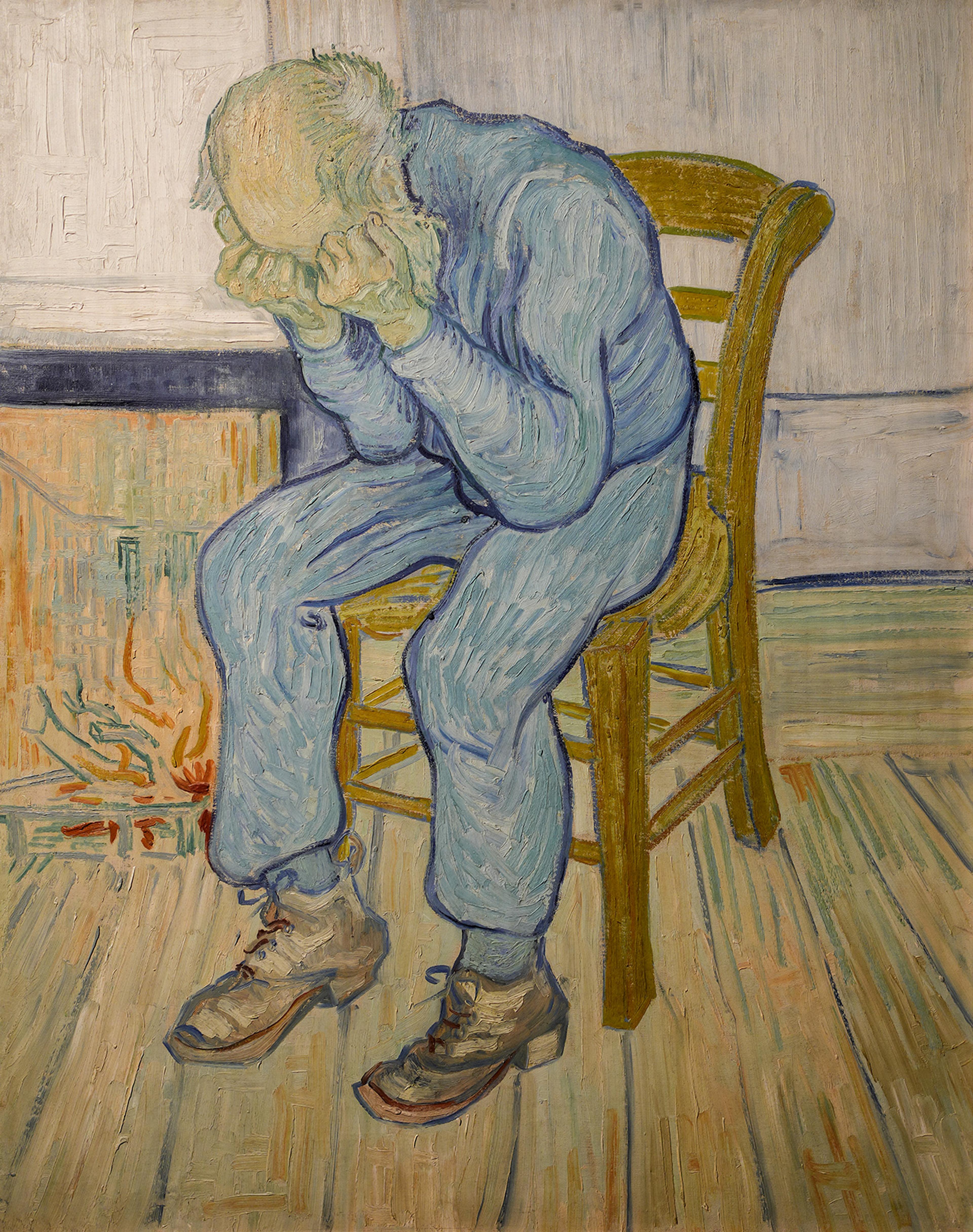
At Eternity’s Gate (1890) by Vincent van Gogh. Courtesy the Kröller-Müller Museum, Netherlands
I didn’t know my father loved Van Gogh as much as I do. We stood there for a long time – somehow in contact with the magic of grief – and something opened up between us that had no name but felt important, exquisitely alive. We didn’t talk about my mother, or how our family had unravelled, or what the stroke had taken from him. We didn’t have to. The painting said what neither of us could.