
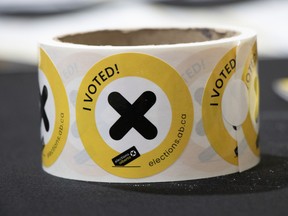
Is Premier Danielle Smith already back-pedalling on the immigration questions her government won in last Monday’s referendum?

Subscribe now to read the latest news in your city and across Canada.
- Exclusive articles by David Staples, Keith Gerein and others, Oilers news from Cult of Hockey, Ask EJ Anything features, the Noon News Roundup and Under the Dome newsletters.
- Unlimited online access to Edmonton Journal and 15 news sites with one account.
- Edmonton Journal ePaper, an electronic replica of the print edition to view on any device, share and comment on.
- Daily puzzles, including the New York Times Crossword.
- Support local journalism.
Create an account or sign in to continue with your reading experience.
- Access articles from across Canada with one account.
- Share your thoughts and join the conversation in the comments.
- Enjoy additional articles per month.
- Get email updates from your favourite authors.
Create an account or sign in to continue with your reading experience.
- Access articles from across Canada with one account
- Share your thoughts and join the conversation in the comments
- Enjoy additional articles per month
- Get email updates from your favourite authors
Sign In or Create an Account
It sort of sounds like it.
On her Saturday radio call-in show, Smith said she was going to “proceed with caution” on the four immigration questions approved by voters.
“What I heard from the results,” Smith added, “is people want us to proceed, but they want us to proceed with caution. I think what I’m interpreting from the results is, ‘Let’s make sure it doesn’t apply to the people who came here and arrived here under the old rules.’”
Fair enough. It would amount to moving the goalposts in the middle of the game for any new rules that cut off non-permanent residents already receiving social services.

Get the latest headlines, breaking news and columns.
By signing up you consent to receive the above newsletter from Postmedia Network Inc.
A welcome email is on its way. If you don't see it, please check your junk folder.
The next issue of Headline News will soon be in your inbox.
We encountered an issue signing you up. Please try again
But frankly, Smith’s attitude seems to extend beyond “grandfathering” existing non-permanent residents.
There is some foot dragging going on. For instance, there is no legislation on the agenda of the pending fall sitting that would implement these new immigration policies. Plus Smith seems affected by the criticism that the margins between “Yes” and “No” on the quartet of questions was “narrow.”
It also has an effect, I’m sure, that they immigration results are less popular in big cities and Smith needs to win Calgary to be re-elected next fall.
By the regular standards of elections, last Monday’s margins were not narrow.
The question on whether Alberta should seek more control from Ottawa over immigration passed 55-45. Should only citizens and permanent residents receive social services passed? 53-47. That’s the same margin that approved the question about whether non-residents should live in Alberta for 12 months before receiving free health care and education. And the question of whether non-permanent residents should be charged a fee or premium to access health care or education until they satisfy the 12-month qualifying period passed 52-48.
Those are margins of 10 per cent, six per cent, six per cent and four per cent respectively.
In our Westminster system of government, any party capturing 52 per cent of the vote typically forms a strong majority. Those winning by 10 per cent form unassailable majorities.
Why is it OK to vest all the power of government in a party that wins by just four per cent of the vote but somehow illegitimate to accept the outcome of a referendum that wins by a similar margin?
In the United States, one person is granted all the awesome powers of the presidency for four years even if their margin of victory is slight.
In 2024, Donald Trump won the presidency with a margin of just 1.5 per cent and look at all the mayhem he has created since.
In 2016, Trump won the presidency despite receiving two per cent less of the popular vote than Hillary Clinton. He got to govern anyway because of the Electoral College and the way Americans pick their chief executive.
On Friday, NDP Leader Naheed Nenshi suggested the UCP government change the law regarding referendums to make it harder to collect enough signatures to force a provincewide vote. That’s probably not a bad idea.
Last Monday’s divisive, $130-million independence referendum may not have happened if the older, higher standard of 294,000 valid signatures had still been in effect, along with a shorter collection period of 90 days.
Instead, the separatists had 120 days to collect a minimum of 178,000 signatures. They collected 223,000 – more than enough to satisfy the new standard adopted by the UCP in 2025, but hardly enough under the older rules.
Going back to the old rules would ensure Albertans would only have to vote in referendums with broad public appeal.
But Nenshi maybe doesn’t need to worry. Smith doesn’t seem eager to act on the recent referendum results. And, course, she is ignoring the results of a 2021 referendum that rejected year-round daylight saving time (DST) to implement 12-month DST starting this weekend.
Join the Conversation
This website uses cookies to personalize your content (including ads), and allows us to analyze our traffic. Read more about cookies here. By continuing to use our site, you agree to our Terms of Use and Privacy Policy.