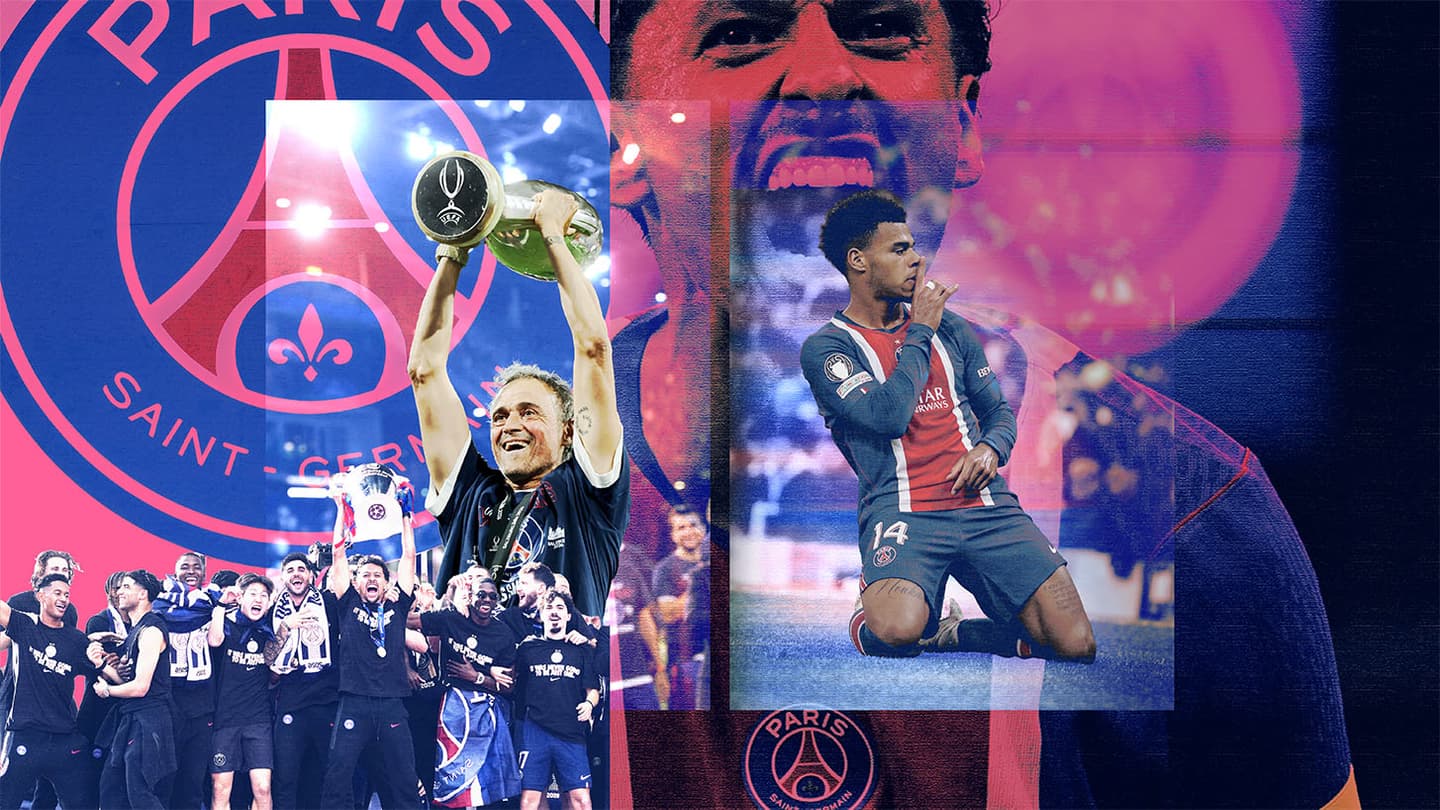
After years of exorbitant spending with mixed results, PSG have found the right formula to become the best club team in the world. It hasn’t been an easy road, but Luis Enrique’s side has finally reached the summit of world football. Let’s see how they got there.
In a footballing world that has conditioned us to believe the best players and teams reside in the Premier League or La Liga, a club from Ligue 1 has found a way to break the mold. It hasn’t been an exactly linear journey for Paris Saint-Germain, but after years of near misses, painful defeats, and expensive experiments, Les Parisiens have finally found their winning formula.
It’s almost mind-boggling to think about the names that have passed through PSG’s doors. Lionel Messi, Neymar Jr., Kylian Mbappé, Sergio Ramos, Zlatan Ibrahimović, and Edinson Cavani have all donned a PSG shirt within the last decade. Qatar Sports Investments bought a majority ownership stake in the club in 2011, and ushered in an era of gluttony, breaking transfer fee records on the pitch and partnering with some of the most luxurious brands off of it.

Despite achieving domestic dominance, including 12 Ligue 1 titles in the 14 seasons between 2012 and 2026, European glory proved to be elusive, and it remained the ultimate objective for the Qatari ownership group. Now, that ambition has become a reality, with PSG delivering performances that could reshape the conversation around Europe’s elite clubs.
In 2024, PSG became the first French team to win the UEFA Champions League, and they defended their title to become the first team to win back-to-back UCLs since Real Madrid’s three-peat from 2016 to 2018. In addition, PSG won consecutive UEFA Super Cups over the Europa League winners, marking an era of dominance unseen before in club history.
Their European momentum has continued this season, with statement UCL victories over Manchester City and Barcelona, both ending in 4-2 wins. After three games, PSG sit atop the league phase standings with three victories and the highest goal tally among the 36 participating teams.
So, how did PSG get here? The answer comes down to a coach, a group of players who fit his vision, and a club that finally figured out what it wanted to be.
Changing the Formula

Photo by Justin Setterfield/Getty Images
After the struggles of the Messi and Mbappé eras, star power became less of a priority at PSG. Instead of building a team around individual superstars, the club shifted its focus toward collective play, tactical cohesion, and a shared identity. To make that transition work, PSG needed a coach who put the team first. Enter Luis Enrique.
Enrique’s footballing philosophy revolves around aggressive possession, intelligent movement, and relentless intensity. Operating primarily within a fluid 4-3-3 structure, his teams are comfortable inviting pressure in their own half, using short, precise passing combinations to manipulate defensive blocks before exploiting openings further up the pitch.
The defining characteristic of his approach is the ability to transition from patient buildup to explosive forward movement. When possession is lost, his teams immediately hunt the ball, applying a suffocating counter press designed to force turnovers before opponents can launch their own attacks. Every player must be comfortable moving into different positions and creating numerical advantages in key areas while remaining committed to the collective defensive effort.
In other words, PSG no longer need to accommodate the individual preferences of their biggest stars. Instead, their players are expected to buy into the coach’s system and embrace the club’s identity.
So far, so good. Since Enrique’s appointment in July 2023, PSG have added an impressive collection of silverware to their trophy cabinet. The 13 titles in the Enrique era reinforce the idea that a cohesive system can accomplish what a collection of superstars alone cannot.
The Right Players

Photo by Alex Grimm/Getty Images
Every philosophy needs the right people to bring it to life. As PSG have shifted their focus from selling superstar dreams to building a championship-winning team, the players have made all the difference.
Nobody needs to be convinced that Ousmane Dembélé, Désiré Doué, Khvicha Kvaratskhelia, Achraf Hakimi, and Nuno Mendes are exceptionally talented footballers. Their contributions at both ends of the pitch have been outstanding, giving PSG the individual quality to complement Enrique’s collective approach.
But where PSG have really gotten things right is in midfield.
Vitinha is the engine that keeps everything moving, capable of navigating pressure in tight spaces, and turning difficult situations into opportunities to move the ball forward. Alongside him, Fabián Ruiz brings a different dimension to the game, combining his passing range with well-timed runs that pull defenders out of position and create space for teammates to exploit.
Then there’s João Neves, the relentless presence who ties it all together. His energy, positioning, and ability to read the game allow him to clean up loose balls and shut down counterattacks before they become a problem.
Together, the three give PSG control without sacrificing intensity. They don’t just dictate the tempo when they have the ball, they make life miserable for opponents when they lose it. The moment possession changes hands, they close down passing lanes, swarm the ball, and force opponents into rushed decisions. It’s a midfield built to win possession back quickly and keep the game on PSG’s terms.
Add the goalkeeping quality of Matvei Safonov and the emergence of defenders like Willian Pacho, and PSG have assembled one of the most balanced squads in world football. This isn’t simply a team with an abundance of attacking talent. It’s a group built to function as a unit, with players who understand their responsibilities and complement one another across the pitch.
If PSG have learned anything throughout their 15-year resurgence in world football, it’s that finding the right formula and identity to win takes time. There are no quick fixes, no handful of superstars who can push you over the finish line. It takes a combination of key elements to turn what was once viewed as a pet project into a footballing juggernaut.
To the establishment, PSG have caused a major rift. While marketing campaigns continue to sell us on the excitement of the Premier League and the glory of Real Madrid, today, the best club team in world football resides in Paris and plays in Ligue 1.
PSG have finally made their mark and are defining an era in world football.