Astronomers have found a huge, dust-reddened quasar that existed less than a billion years after the Big Bang. Daming Yang and his team at Leiden Observatory shared their findings about J1440+0019 in a recent paper on the arXiv preprint server.
This quasar is at a redshift of 6.55 and contains a supermassive black hole that is quickly growing and weighs about 1.1 billion times the mass of our Sun.
Scientists are especially interested in quasars from this time in the universe. This era matches the period of cosmic reionization, when ultraviolet light from the first stars and galaxies removed electrons from neutral hydrogen gas throughout the universe.
Usually, scientists search for early active galactic nuclei by looking for bright ultraviolet light. But this approach often does not work for systems covered in thick dust, since the dust blocks the UV light. As a result, only a few of these hidden, reddened quasars have been found at high redshifts.
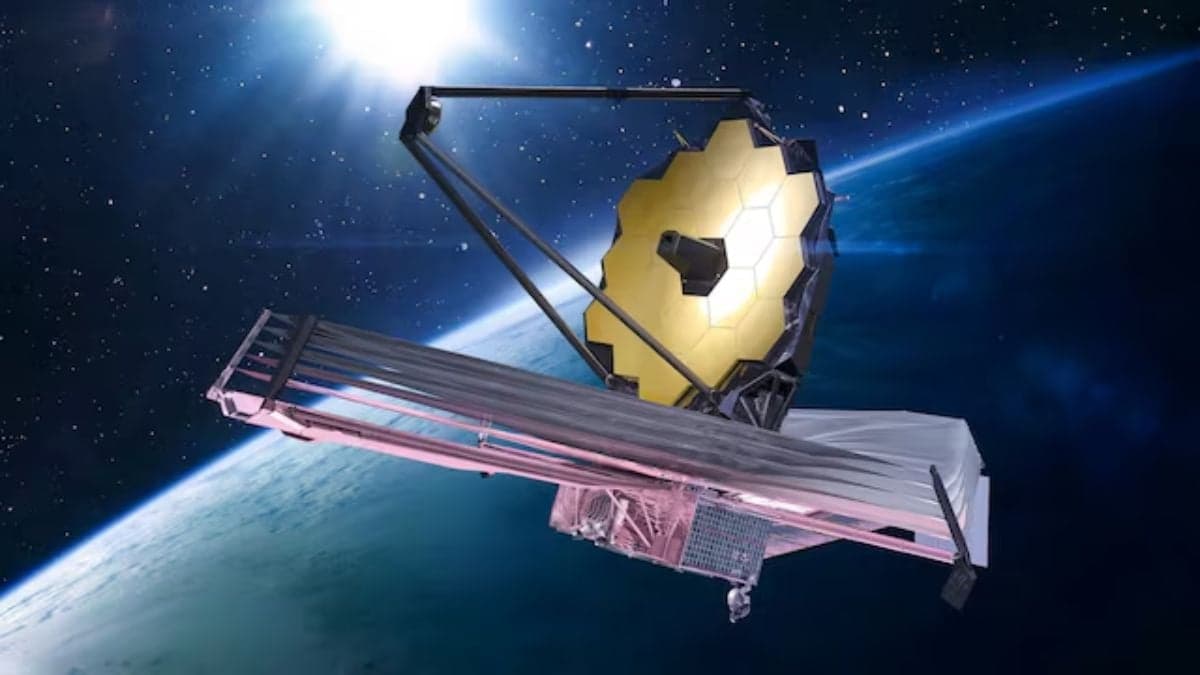
To see through the dust around J1440+0019, the team used near-infrared spectroscopy from the James Webb Space Telescope along with cold gas data from the Atacama Large Millimeter/submillimeter Array.
The spectral data showed that the object is a red type-1 quasar. Astronomers can see its galactic center directly, but the view is still blocked by a lot of dust. The team also saw strong blueshifted absorption systems moving as fast as 3,600 kilometers per second. These speeds suggest there are powerful outflows pushing material away from the center.
Further analysis found that the supermassive black hole is eating matter very quickly and is shining at about 80 percent of its theoretical Eddington limit. The galaxy around it is also very extreme.
The galaxy has about 400 million times the Sun’s mass in dust and is one of the brightest sources of ionized carbon emission at this distance. Scientists estimate it could be forming up to 1,330 new stars each year.
The team pointed out that ALMA collected the needed dust tracers in only five and a half minutes. This shows that future quick surveys could find similar targets for more detailed study without using too much telescope time.
Upcoming missions such as the Roman Space Telescope will probably help close the current gap in observations and create a more complete list of these hidden cosmic giants.