
All of the world’s near-shore coral reefs are at “extremely high risk of collapse,” and 96% of them are considered critically endangered, according to the International Union for Conservation of Nature.
The organisation, for the first time, has assessed the world’s reefs and released what is known as the “Red List of Ecosystems” on 22 Oct. The assessment covers 127 coral reef ecosystems in more than 80 countries and territories, including the Caribbean’s Great Antilles region that incorporates the Cayman Islands.
The researchers at the international conservation body found that while coral reefs everywhere are at extremely high risk of collapse, “most are still alive and can recover if we act now.”
The assessment, carried out by more then 250 experts working in 10 regional teams across 127 reef ecosystems, found that 122 of the ecosystems (96%) are critically endangered, covering 99.8% of the assessed reef area. It showed that one coral reef ecosystem, the Western Galápagos Islands, has already collapsed.
Caribbean region
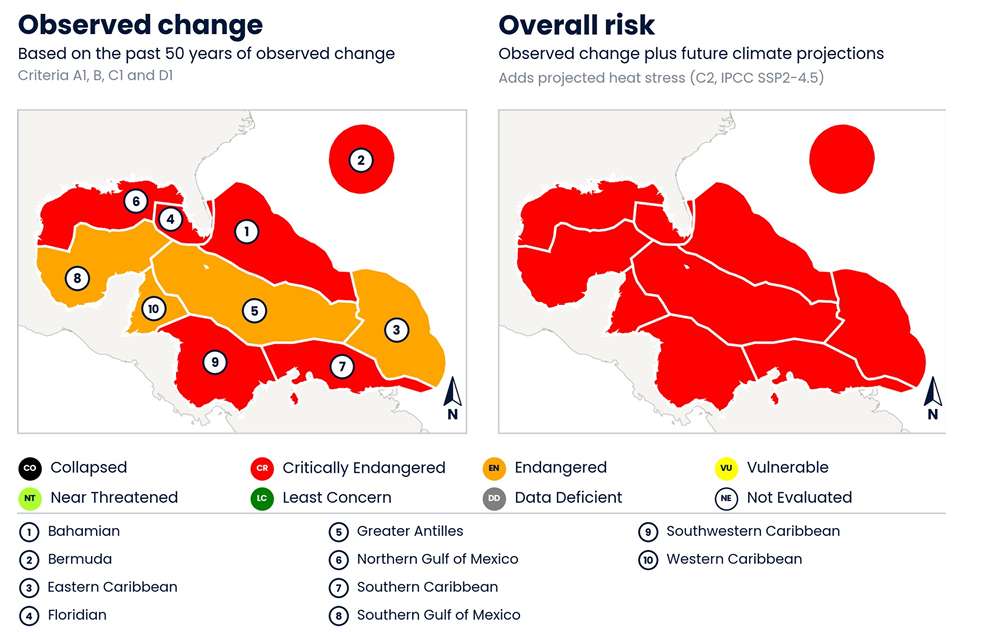
The organisation’s assessment in the Caribbean, which divided the region into 10 coral reef “eco-regions”, found all 10 to be critically endangered.
- Advertisement -
It noted that, based on the past 50 years of observed change, “risk is driven by severe reductions in hard coral cover, restricted geographic distributions combined with ongoing threats, heat stress, and disruption of the balance between corals, algae and fish.”
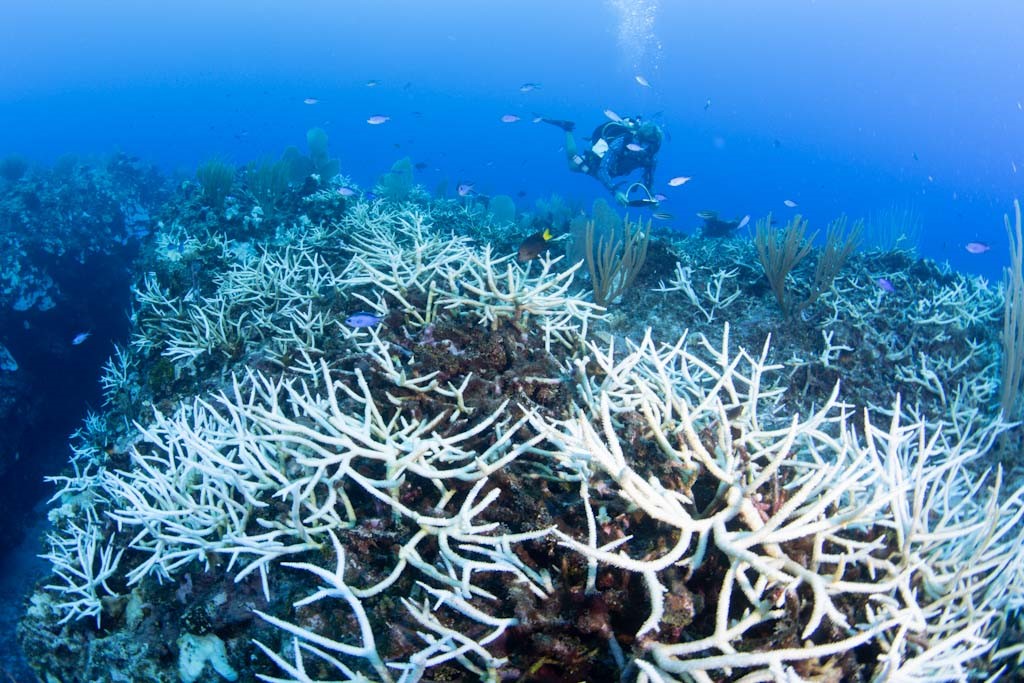
The Caribbean report noted that the region contains 65 species of hard coral, all of which are endemic to the Atlantic Ocean. Shallow reef crests were historically built by branching corals, such as staghorn or elkhorn (Acropora spp.), while fore-reef environments are dominated by large bouldering corals, such as mountainous, lobe or boulder star corals (Orbicella spp.).
International Union for Conservation of Nature researchers found that half of native hard coral species in the region are threatened with extinction, with branching corals considered functionally extinct in many areas.
As with other regions, the report states that marine heatwaves linked to climate change represent the greatest threat to Caribbean coral reefs. These are occurring more frequently and lasting longer, meaning reefs have less time to recover between events.
This thermal stress is causing severe mass coral bleaching and mortality (greater than 50% mortality in recent events). It also notes that between 2018 and 2025, 99.9% of Caribbean reef sites experienced heat stress indicative of bleaching.
It added that heat stress over the past 50 years already threatens 77% of the coral reef ecosystems worldwide. Under future climate projections over the next 50 years, the organisation said, heat stress alone puts 95% of the coral reef ecosystems at critically endangered.
“Corals carry a deep evolutionary record of coping with environmental change, yet the reef ecosystems we see today are remarkably young, shaped over only the last 5,000 to 7,000 years of stable climate. Ocean warming is now outpacing anything in their history, and recurring heatwaves are causing mass bleaching faster than reefs can recover or adapt,” said Marcos Valderrábano, programme manager of the International Union for Conservation of Nature Red List of Ecosystems.
As well as warming sea temperatures, there are also threats from coastal development and runoff of agricultural sediment and nutrients, as well as overharvesting and invasive species, such as lionfish and certain species of fire corals, which are further reducing ecosystem resilience. Catastrophic disease outbreaks, such as stony coral tissue loss disease, white band disease and sea urchin mortality events add further pressure.
Critically endangered reefs jump from 24% to 96%
The organisation noted that, based on the past 50 years of observed change, 24% of coral reefs worldwide are already critically endangered. Climate projections increase that amount dramatically. “The jump from 24% to 96% critically endangered comes from projected heat stress,” the organisation’s report said, adding that marine heatwaves are projected “to become so frequent that reefs may not have sufficient time to recover between events.”
It stressed that critically endangered does not mean collapsed, and that most reefs still have living coral and still work as reef ecosystems. “There is still time to act, but the window is closing,” its report said.
“Local pressures are still a big part of the problem,” it said. “In 63% of the coral reef ecosystems, the balance between corals, algae and fish has been disrupted. Overfishing removes parrotfish, which keep algae in check, and groupers and other predators that hold the food web together. Pollution and sediment also help algae grow at the expense of corals.”
In addition, 45% of coral reef ecosystems are so small or isolated that a single storm, bleaching event or disease outbreak could wipe them out, and 25% have already lost much of their living reef.
In the list, each eco-region was assessed against five criteria, with the level of risk outlined for each one:
- How much living reef has been lost (Greater Antilles, vulnerable)
- Whether a reef is so small or isolated that a single event could destroy it. (Greater Antilles, least concern)
- How often and how severely marine heatwaves cause bleaching, over the past 50 years and the next 50 years. (Greater Antilles, critically endangered)
- Whether corals, algae and fish populations are still in balance. (Greater Antilles, endangered)
- Overall risk, with models of the chance of collapse integrating different parameters together. (Greater Antilles, critically endangered)
The assessment covered the shallow, sunlit reefs, rather than deeper reefs, rocky reefs and cold-water corals.
0 seconds of 2 minutes, 0Volume 90%
Press shift question mark to access a list of keyboard shortcuts
00:00
02:00
02:00